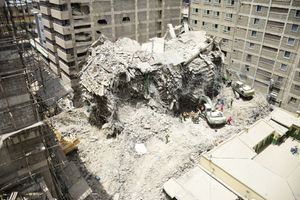
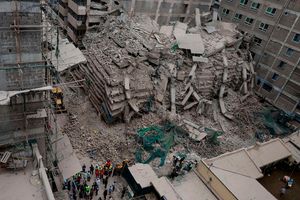
The collapse of a building on Eastleigh’s 9th Street has triggered a blame game among the authorities responsible for approving construction.
As the buck is passed from one office to another, questions are mounting over who approved what, who failed to do their job and, ultimately, who is fooling whom.
Yesterday, the Director of Public Prosecutions (DPP) denied knowledge of any inquiry file on the construction of the ill-fated building.
“No inquiry file relating to the construction of the building has ever been forwarded to the office by the Nairobi City County Government regarding malfeasance by the private developer, professionals or county government officials for perusal and directions,” DPP Renson Ingonga said in a statement.
He added that he had directed the DCI to conduct investigations into the matter. The investigations, he said, “shall establish the circumstances that led to the collapse, including whether there was any act or omission by officials of the Nairobi City County Government, the private developer, contractors or other professionals.”
Nairobi Governor Johnson Sakaja said his officers had not issued any approvals for the construction of the building, and that some of the alleged permits that were making rounds on social media were forged.
Nairobi Governor Johnson Sakaja.
Photo credit: File | Nation Media Group
“That was the fake document that was obtained to claim approvals. He (developer) needs to be summoned on that. There was a change of user, but there was no architectural or building plan approval. That is according to our system,” Mr Sakaja said.
County officials, according to the governor, had flagged the construction twice.
“We arrested people; we are in possession of the OB number,” he said.
He blamed the National Police Service (NPS) for releasing the suspects who had been arrested on cash bail.
“The 14 suspects who were arrested by the county enforcement team were taken to Kamukunji Police Station only for them to be released at 9pm on cash bail of Sh50,000. As it is now, we can’t arrest and prosecute,” he said.
Rescuers at site of a collapsed building in Eastleigh, Nairobi, on October 23, 2026.
Photo credit: Wilfred Nyangaresi | Nation Media Group
But in a rejoinder, NPS Spokesperson Muchiri Nyaga dismissed the governor’s allegations.
“The police have nothing to do with the construction of such structures. These are purely county government mandates and in fact, there is even an enforcement agency in counties, and they have powers to completely stop any work from going on,” Mr Muchiri said.
Saying that the governor’s allegations depict someone attempting to “clutch at straws”, he added that it was high time the county addressed the pertinent issue of illegal approvals, which were costing innocent Kenyans their lives. The arrest of corrupt county officials in possession of large sums of money, he said, was a clear indication that the system was rotten.
On Friday, hours after the building collapsed, the National Construction Authority (NCA) said the project was registered with the authority on July 30, 2025.
“The project registration number is 53128815710410, and the developer on record is 9th Street Plaza Limited,” the statement by NCA read.
A search of government records revealed that Mohamed Khatar Ali Noor, Abdikadir Abdi Sheikh and Abdifatah Ali Noor own 9th Street Plaza Limited, with Mr Ali owning the majority of shares.
Mr Ali told the Nation by phone yesterday that the building had all the approvals. He also said that as of last evening, he was yet to be contacted by the investigating authorities.
The contractor on record, according to NCA, was Stromax Holdings E.A Limited. When contacted by the Nation , Mr John Karuga Ng’ang’a, who is the sole shareholder of Stromax, said he had no comment.
Government records show Mr Karuga has a wealth of experience in construction, including work on projects with the Ministry of Water and Sanitation. He also owns Stramax General Contractors.
According to NCA, the professionals on record for the building were architect Emmanuel Mwangi Maina and Joseph Muturi Mugu as the project structural engineer. However, Mr Mugu published a notice in yesterday’s Daily Nation disassociating himself from the project.
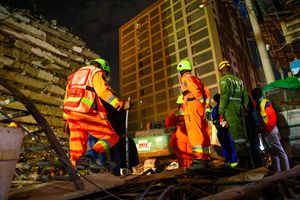
Rescue teams led by Distater Response Unit clear rubble at the site of a building that collapsed in Eastleigh, Nairobi on October 23, 2026.
Photo credit: Wilfred Nyangaresi | Nation Media Group
“I have, through my advocates, requested the project records from the National Construction Authority and Nairobi City County government to establish the information relied on,” he said. But NCA denied it was in receipt of such a request.
Projects of this magnitude require approvals of different agencies, including the National Environmental Management Authority (Nema). On January 6, Nema asked the developer to address some issues to “help the authority make an informed decision”.
“Submit clear and legible architectural drawings with all dimensions clearly indicated,” Nema wrote to the developer. “Kindly note that the EIA processing time stops running until the above issue(s) are adequately addressed. Your response is expected within 60 days, failure to which you will have to reapply,” the authority said.
Nema Director-General Mamo B Mamo told Nation in a text message, "The applicant went underground! Therefore, the project is non-compliant and doesn't have an EIA license."
National Environment Management Authority Director-General Mamo Boru.
Photo credit: Kanyiri Wahito | Nation Media Group
None of the responsible authorities has so far taken responsibility for the tragedy. As of yesterday, a multi-agency team was also reportedly blocking attempts to post images and videos of the scene on social media, with officers frequently confronting those filming and chasing away residents.
The latest tragedy fits into a pattern of ignored warnings, such as the recommendations of a study by NCA on building failures and collapses in Kenya.
The ill-fated building had already been occupied on its lower floors despite being under construction, raising questions about how this was possible, given that mandatory final inspections and the issuance of occupation certificates are only done once construction is complete.
“These two important steps are rarely undertaken, and as a result, sick and dangerous buildings are occupied by innocent tenants,” stated the 2015 NCA report. “To address this, it is recommended that no building should be occupied unless final inspection and issuance of occupation certificate is carried out.”
The report also recommended reforms in the enforcement and compliance departments of the counties, including the hiring of independent building control inspectors, to ensure contractors did not cut corners.
These professionals – registered architects, engineers and planners – were to inspect buildings to avert collapse, which the study blamed on poor workmanship, use of substandard materials, non-compliance with set regulations and standards as well as the limited capacity of regulatory agencies, particularly county governments. The report also stressed the need for surveillance to ensure only registered contractors who had been duly trained were involved in construction.
Rescue teams led by Distater Response Unit work at the site of a building that collapsed in Eastleigh, Nairobi on October 23, 2026.
Photo credit: Wilfred Nyangaresi | Nation Media Group
Further, the report flagged the disjointed process of building approval that involves county governments, Nema and NCA.
“There is need to establish a one-stop centre that co-ordinates all approvals. A similar model is being implemented in Singapore and Malaysia. When implemented, the centre will streamline the coordination between various agencies,” the report stated.
These are safeguards that would have shielded the public from such tragedies had they been implemented over the years.
An audit carried out in 2018 by the National Building Inspectorate covering 14, 925 buildings revealed that 723 were very dangerous, 10,791 are unsafe, 1,217 are fair, and 2,194 are safe.
“These unsafe and dangerous buildings eventually collapse,” stated the report, which estimated that over 200 people have died since the first building collapsed in 1990, with thousands injured.
In May 2024, two years after Mr Sakaja became governor, a sub-committee of urban planning was established to investigate claims that building approvals were being dished out in a private office at Riverside.
The committee, which was chaired by Nominated Member of County Assembly Nasra Nanda, was mandated to investigate approvals that were issued outside the official channel as well as the ones that were influenced by powerful individuals surrounding the governor.
The move followed complaints from the public and different professional groups in the built environment.
One of the fundamental issues that the committee dwelt on was the revelation by one of the county executive committee members that “a series of executive committee meetings led by the governor himself” were held in one of his private offices, where 154 building plans were discussed and 131 of them approved.
However, the sub-committee was disbanded at the point when it was about to receive documents listing the approvals in question.
“We were going to do amazing work,” Ms Nasra said. “But if you are being sabotaged after trying everything, you realise that you, doing the right thing, are blocking [other] people’s interests. My intention was not to point fingers at anyone but to review the last two years’ approvals so that we rectify anything that was off and understand where the gaps were.”
The attempts to restore sanity in the built environment sector, she said, were frustrated by senior officials from both the assembly and the executive.
“These are the issues that I said are coming to bite us. This is not the first time; it happened in South C, Karen, Eastleigh and in the CBD. I believe that these should have been addressed,” she said.
Nairobi County Built Environment and Urban Planning Executive Patrick Mbogo.
Photo credit: Wilfred Nyangaresi | Nation Media Group
Nairobi County Built Environment and Urban Planning Executive Patrick Mbogo had not responded to calls and messages by the time of publication.