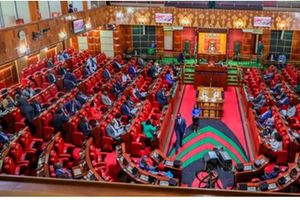
Members of Parliament have called for a review of the instant fines imposed on petty traffic offenders introduced by the National Transport and Safety Authority (NTSA)
While supporting the initiative by NTSA to curb rising road fatalities, the lawmakers pointed out concerns regarding how the authority is implementing the new regulations.
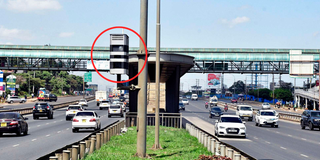
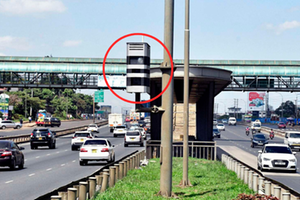
Top of the MPs’ concerns is the hidden camera placed at strategic points on major highways to catch those driving beyond the prescribed speed limit.
The lawmakers questioned why NTSA would hide a camera if its intention is to help curb speeding on major highways.
Speaker of the National Assembly Moses Wetang’ula said speeding is a personal responsibility of the driver and the vehicle owner should not be punished if they were not driving.
According to the MPs, cameras should be placed in visible positions with proper signage to help motorists observe speed limits on various roads.
Additionally, the lawmakers want the fine imposed on offenders to be on the driver of the vehicle at that particular time, not the owner of the car as is the case currently.
The lawmakers also want NTSA to continue public awareness campaigns on the various speed limits imposed on major highways and roads.
Kathiani MP Robert Mbui said that while Kenyans need discipline on the roads, it defies logic for a camera to be hidden or for NTSA to set a 50km/h speed limit on a highway.
“I’m a supporter of the hidden cameras because Kenyans need discipline on the roads, it’s a good idea. There is a need for this to be thought through before full implementation,” Mr Mbui said.
“On Lang’ata road for instance, there is a camera—I don’t know where exactly—but I have been a victim. Sometimes you ask yourself, why would a camera be put in a place where there is no school or pedestrian walkway? It’s basically a highway and you put a speed limit of 50km/h, a place where moving at that speed is likely to cause an accident,” he added.
Starehe MP Amos Mwago who raised the matter said it is unfair for NTSA to fine a person when they have not posted signage indicating the required speed limit.
“There is a big disparity in how these fines are imposed, you will find some people being fined Sh3,000, others Sh5,000 while others get a fine of Sh10,000—there is no standard,” Mr Mwago said.
The National Transport and Safety Authority (NTSA) inspection yard along Likoni Road in Nairobi.
Photo credit: File | Nation Media Group
Manyatta MP John Mukunji said NTSA must continue to engage the people and Parliament on the new rules.
“One day when I was coming from the village, I found people slowing down and I didn’t understand what was going on. The following day, I was fined Sh10,000. These rules should be highly publicised,” Mr Mukunji said.
Funyula MP Wilberforce Oundo said the instant fine does not provide the offender with a chance to defend himself, thus raising constitutional questions.
“The way it is designed, it’s going to be punitive and unfair to the people of Kenya. We need to find a friendlier method to punish the offender,” Dr Oundo said.
Ironically, the same MPs now complaining passed these regulations last year.
The regulations are currently before the Senate for consideration and concurrence. Should the Senate reject the regulations, it would send NTSA back to the drawing board.
Speaking earlier this month on the new regulations, NTSA Director General Nashon Kondiwa said every part of the road covered by cameras will be well-marked with adequate speed limit signs to give motorists enough time to notice them.
Mr Kondiwa also dismissed claims that the authority is pursuing the programme as a revenue generation initiative saying the collected money does not belong to NTSA but is remitted to the exchequer.
“These are exchequer revenues not NTSA revenue. Our focus and mandate is road safety,” Mr Kondiwa said.
A speed camera mounted near Safari Park Hotel along Thika Superhighway in Nairobi in this picture taken on March 12, 2026.
Photo credit: Francis Nderitu | Nation Media Group
The instant fines system was introduced in March this year to enhance compliance with traffic regulations by allowing motorists accused of minor offences to pay prescribed penalties without undergoing lengthy court processes.
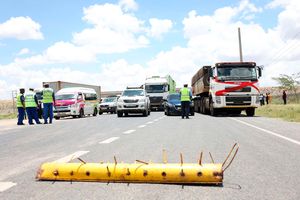
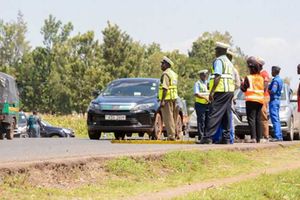
The instant fines system relies on automated cameras, police enforcement and digital technology to identify and process traffic offences. Violations such as speeding, running red lights and lane indiscipline are detected and linked to vehicle registration details.
Once verified, the registered vehicle owner or driver receives a notification detailing the violation, including where and when it occurred and the applicable penalty. Motorists then have the option of paying the prescribed fine within a specified period.
Payments are recorded in compliance with court directives. Motorists who fail to pay within the required time frame face further enforcement action including prosecution or restrictions to NTSA services.
The initiative is part of a broader government strategy to reduce traffic fatalities which claim many lives annually.
The government believes that better enforcement, enhanced technology and faster processing of offences will help curb reckless driving, bribery, and delays associated with court-based prosecution for minor traffic offences.