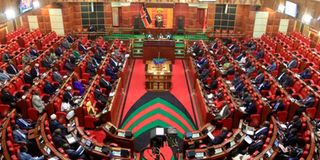
Poor drafting and failure to adhere to constitutional and statutory provisions have dealt a blow to ministries and government departments after Parliament rejected and annulled 17 regulations that had been tabled for approval.
According to a status report of the National Assembly Committee on Delegated Legislation, chaired by Ainabkoi MP Samuel Chepkonga, the regulations were found to have contravened the Constitution, the Statutory Instruments Act and other enabling laws.
The committee, mandated to scrutinise statutory instruments to ensure compliance, returned a harsh verdict revoking the instruments for falling short of legal and drafting standards.
Among the annulled regulations are the Pest Control Products (Fees and Other Charges) Regulations, 2024, the Tariffs for Healthcare Services and the Prevention of Terrorism (Implementation of the United Nations Security Council Resolutions on Prevention, Suppression and Disruption of Proliferation Financing) Regulations, 2024.
Others that suffered the same fate include the Adjudication (Amendment) Regulations, 2023, the Physical and Land Use Planning (Planning Fees) (Amendment) Regulations, 2023, the Survey (Electronic Cadastre Transactions) (Amendment) Regulations, 2023 and the Valuers (Forms and Fees) (Amendment) Rules, 2023.
The committee on Delegated Legislation is required under Standing Order 210 to examine all statutory instruments submitted to Parliament and determine their conformity with the Constitution, the parent Act under which they are made and other relevant laws.
During the third session of the 13th Parliament running from February to December 2024, the committee received 107 regulations.
Out of these, 71 were approved while 17 were rejected. In the current fourth session which began on February 11, 2025, the committee has so far received 55 regulations, approving 29 while 29 remain pending.
In total, 99 regulations have been approved since the beginning of the review period while 17 have been annulled.
On the Prevention of Terrorism Regulations, 2024, the committee faulted the Ministry of Interior and National Administration for failing to comply with Section 11 of the Statutory Instruments Act, which requires that every statutory instrument be accompanied by an explanatory memorandum.
The Adjudication (Amendment) Regulations, 2023, published by the Ministry of Public Works, Housing and Urban Development, were similarly rejected for failure to comply with Section 11(1) of the Act.
The Physical and Land Use Planning (Planning Fees) (Amendment) Regulations, 2023, published via Legal Notice No. 72 of 2024, were also annulled on the same grounds.
Also faulted were the Land Registration (General) (Amendment) Regulations, 2023, which had introduced new charges at land registries, including Sh1,000 for the registration of documents and instruments and Sh2,500 for the issuance of a certificate of title or lease.
The Survey (Electronic Cadastre Transactions) (Amendment) Regulations, 2023 and the Valuers (Forms and Fees) (Amendment) Rules, 2023 were revoked through Legal Notices No. 70 and 69 of 2024 respectively, again for failing to comply with the statutory requirements.
Several regulations from the Ministry of Mining, Blue Economy and Marine Affairs were thrown out for failure to meet drafting standards.
These include the Fisheries (Management and Development – Recreational Fisheries) Regulations, 2023, the Beach Management Units Regulations, 2024, the Fish Safety and Quality Regulations, 2024, the Aquaculture Fisheries Regulations, 2024, the Fish Levy Trust Fund Order, 2024 and the Marine Fisheries Regulations, 2024.
The committee noted that the instruments were not only poorly drafted but also lacked adequate stakeholder consultation as required by law.
The Statutory Instruments Act requires that every statutory instrument be accompanied by an explanatory memorandum to provide clarity, context and justification.
In addition, regulation-making authorities must carry out meaningful public consultation before publication.
The law also compels Cabinet Secretaries to transmit copies of statutory instruments to Parliament within seven sitting days after publication for scrutiny and approval.
Failure to comply with these requirements, the committee emphasised, renders the instruments null and void.
By failing to meet these constitutional and legal thresholds, the 17 regulations now stand annulled.