Donald Trump is reshaping the world and doing so in his own image.
On Friday night into Saturday morning, explosions and blackouts rolled across Venezuela’s capital as US forces seized President Nicolas Maduro and flew him out of the country. The historical resonance was unmistakable.
In 1989, the United States invaded Panama, toppled Manuel Noriega, and transported him to the United States for trial in an operation still remembered across the region as proof that sovereignty could be overridden when Washington judged it necessary.
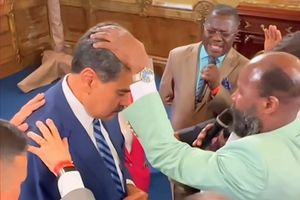
Venezuela's President Nicolas Maduro.
The Maduro raid has now revived that controversial logic at a moment when the global order is already strained by war in Europe, instability in the Middle East, and sharpening competition between great powers.
The deeper story is not simply that Trump used force. It is the way he has collapsed boundaries that once shaped American statecraft. In his second term, the man who promised to be a “peace president” has embraced a politics of leverage and now uses tariffs, territorial threats, raids, and spectacle to recast American power as something less negotiated than imposed.
Trump has put in place a system where access to US markets comes with conditions, security guarantees come with invoices, and the sovereignty of weaker states can be treated as a variable rather than a constant.
Hours after Maduro’s capture, Trump said the United States would oversee Venezuela’s economy and run the oil industry until there is a “safe transition.”
This is not new in the deepest historical sense. Washington has long treated parts of Latin America as a strategic near abroad, a space where the United States claims special interests and expects deference.
Trump appears to have revived the Monroe Doctrine, previously used by some US leaders to justify intervention, overtly and covertly, wherever American interests were threatened.
Over the twentieth century, that tradition produced coups, covert action, and episodic invasions, leaving behind a durable regional suspicion that US commitment to sovereignty has always had an asterisk.
Venezuela now becomes the most vivid modern reminder. Trump did not merely pressure Maduro. He snatched him out of Caracas in a raid rather than forcing him out through sanctions, negotiations, or regional diplomacy.
The implications reverberated widely, creating legal and diplomatic shockwaves. The post 1945 international system rests on a central taboo: states should not seize territory by force, and they should not overthrow one another’s governments through violence. However, those rules have been broken many times.
Trump’s action in Venezuela strains that framework because it looks like enforcement of US law carried out through military means on foreign soil.
Trump’s defenders insist there is no contradiction. They argue that swift, overwhelming action prevents larger conflicts, that intimidation deters escalation, and that the United States must stop tolerating regimes they describe as criminal enterprises.
Strikes on Islamic State linked targets
Trump’s critics reply that this is how imperial power always talks: as necessity, as defence, as order restored. The worry is not only what happens next in Venezuela, but what message is sent to every weaker state that lives in the shadow of a giant.
Trump’s second term has made clear that force is back in fashion, not as a last resort but as an instrument of routine statecraft. In Nigeria, he ordered US strikes on Islamic State linked targets in the country’s north west, presenting the action as a blow against extremist networks that have killed civilians and destabilised border regions.
Nigerian officials emphasised coordination and planning, insisting it was a joint operation rather than a unilateral American action.
But even the need to make that point reveals something about the Trump era. Partners must now manage not only threats in their own territory, but also the optics of American power arriving with a headline, a deadline, and a Washington-centred narrative.
Amid all this, Trump is also building his image as a peacemaker, appearing on global stages to broker agreements while tying stability to extraction.
US President Donald Trump (centre), with President Paul Kagame (left) of Rwanda and President Felix Tshisekedi of the Democratic Republic of the Congo pose for a picture following a signing ceremony at the US Institute of Peace in Washington DC on December 4, 2025.
Photo credit: Reuters
In early December, he hosted Rwanda and the Democratic Republic of Congo in Washington for a ceremony meant to calm eastern Congo’s long running war and open the door to Western investment. The event was packaged as peace and prosperity, but it was also rooted in strategic economics.
Congo’s minerals— cobalt, copper, lithium and gold— are vital to everything from batteries to weapons systems. Trump’s approach to peacemaking is rarely separated from commercial advantage. To him, peace has become not simply a moral imperative, but a condition required for deals, supply chains, and strategic access.
For political scientists, Trump’s foreign policy has become difficult to categorise using the old binaries of interventionist versus isolationist.
Canada as the “51st state”
Trump rejects the liberal language of nation building, mocks the neoconservative establishment, and scorns humanitarian rationales. Yet he embraces the mechanics of coercion: raids, threats, economic punishment, and transactional bargaining.
In Gaza, devastated by Israel’s campaign, Trump’s posture has been equally revealing. He has offered maximal political support to Israel while proposing ideas that treat Palestinian land and lives as movable pieces in an American managed redesign.
At one point he publicly floated the notion that the United States could take over Gaza and “own it”, recasting a shattered territory as a redevelopment project. Later, after meeting Israeli Prime Minister Benjamin Netanyahu, he declared that Israel had fulfilled its obligations while warning Hamas there would be “hell to pay” if it did not disarm quickly.
Donald Trump and Benjamin Netanyahu at the Knesset.
Photo credit: . REUTERS/Evelyn Hockstein/Pool
The result is a diplomatic frame that shifts compliance burdens almost entirely onto Israel’s enemy while insulating Israel from pressure over withdrawal timelines, governance questions, or humanitarian realities. In a wider sense, Trump’s “peace” is presented as order imposed, by American backing, American threats, and American terms.
In the Arctic and the Americas, Trump has revived a vocabulary that postwar leaders generally treated as taboo: territorial ambition. He has fixated on Greenland as a strategic necessity and repeatedly refused to rule out using military or economic pressure to pursue it. He has spoken about the Panama Canal in terms of control and retrieval.
He has also toyed with the idea of Canada as the “51st state”, remarks that Canadian leaders have rejected as insulting and destabilising. Dismissed as bluster, such statements still matter because they shift the boundaries of what becomes thinkable. They normalise the language of acquisition, and in international politics, normalisation is often the first step towards action.
Ukraine completes the picture and sharpens the risks. Trump has positioned himself as the broker of a settlement while pushing a hard-nosed, transactional approach that treats peace as a bargain shaped by leverage.
He has encouraged negotiations that hinge on territory and security guarantees, and he has paired support with economic claims, including preferential access to Ukrainian minerals and investment arrangements that present American assistance as something to be repaid. In Trump’s worldview, even war becomes an arena for deal making.
Russian President Vladimir Putin and US President Donald Trump at Joint Base Elmendorf-Richardson in Anchorage, Alaska on August 15, 2025.
Photo credit: Reuters
The fear in Kyiv, and in European capitals, is that peace becomes another name for pressure, an agreement reached not because justice is secured, but because the weaker party is exhausted and the stronger parties decide the terms.
Economic coercion, meanwhile, has become Trump’s most consistent foreign policy tool. Tariffs are not simply trade policy in his hands. They are punishment, persuasion, and political messaging rolled into one.
He has imposed sweeping duties on major partners, including Canada and Mexico, and has pushed Europe into tariff negotiations that lock in higher barriers than the continent once expected. In the Trump system, tariffs are a form of discipline where a nation is forced to comply on migration, comply on security, comply on energy purchases, comply on industrial policy, or pay.
He has also forced countries to adjust their domestic politics around the possibility of American economic retaliation, especially after the closure of USAID programmes. Governments that once treated US partnership as stable now treat it as conditional, subject to presidential mood, electoral cycles, and public threats.
At home, Trump has fused this coercive style of foreign policy with a hard-edged politics of identity. This has been seen clearly in his recent row with Minnesota’s Somali community.
In early December, he publicly disparaged Somali immigrants while linking the community to high profile fraud cases in the state, and his administration backed the rhetoric with pressure tactics, threatening or implementing federal actions that Minnesota officials warned could punish entire neighbourhoods for the alleged crimes of a minority.
Local leaders in Minneapolis and St Paul moved to reassure Somali residents after reports of a major federal immigration operation, while Democrats including Representative Ilhan Omar, accused the White House of turning a fraud crackdown into an ethnicised immigration dragnet.
The confrontation escalated again as the administration froze, or threatened to freeze, key childcare funding streams to Minnesota while citing fraud allegations involving day care centres, a move state officials called politically charged and disruptive to working families.
Put these strands together, Venezuela’s decapitation raid, strikes in Nigeria, minerals linked peacemaking in Congo, maximal support for Israel coupled with territorial talk in Gaza, pressure politics around Greenland and the Panama Canal, transactional bargaining over Ukraine, and tariff wars aimed at allies, and a coherent picture emerges.
Trump is not withdrawing from the world. He is engaging with it more coercively, more openly, and more personally. He is taking the logic of America First and projecting it outward as a governing principle: American power is to be used to compel outcomes, secure resources, and punish defiance. Supporters argue that the old order was already failing, that Russia invaded
Ukraine, China expanded influence, Iran armed proxies, international institutions stalled, and migration surged. Trump, they say, is responding to reality rather than to liberal fantasy.
Critics respond that realism is not the same as recklessness, and that a superpower’s behaviour defines what becomes normal.
Trump may insist that dominance prevents bigger wars. But analysts also argue that dominance can also provoke, deter, or it can teach other powers to gamble that the international system is too fractured to enforce its own rules.
In Caracas, the gamble is already underway. And the world Trump is reshaping increasingly echoes his own image: less stable, less predictable, and more afraid.