The 2026 FIFA World Cup will stage its final match tonight at the New York New Jersey Stadium, bringing down the curtain on another edition of football’s biggest spectacle and leaving fans with memories that will last long after the final whistle.
It will be adiós to a historic 48-team tournament that brought dramatic comebacks, overnight celebrities, controversy over suspensions and many talking points for supporters in Kenya and around the world.
For some young fans, this will be the first World Cup they will truly remember. For others, it has stirred memories of the first edition that drew them fully into the game.
Every football fan has a World Cup edition they first followed with keen attention. We asked fans from different regions to relive the earliest tournaments that stayed with them.
Comedian and radio personality Daniel 'Churchill' Ndambuki.
Photo credit: Pool
For comedian and radio personality Churchill, the first vivid World Cup memory was Mexico 1986, when Diego Maradona turned the tournament into his stage and Argentina into the stuff of legend.
“The 1986 World Cup introduced us to entertaining football. That’s when I truly fell in love with the game,” he says.
“I remember watching Diego Maradona dribble past player after player before scoring. I kept asking myself, ‘How is this guy unstoppable?’ That tournament completely opened my eyes to football,” adds Churchill, who watched the matches from a neighbour’s house in Machakos on a black-and-white Great Wall television with a red casing.
Back then, few homes owned televisions, and neighbours crowded into one room to watch together. Children sat on the cement floor while adults took the sofas. To Churchill, Argentina showed that football could be both structured and magical, and the shared viewing ritual made the experience unforgettable.
Before the World Cup, Churchill recalls, the Kenya Broadcasting Corporation aired a programme called Football Made in Germany.
“That was our exposure to international football,” he says.
“The World Cup changed everything because it introduced us to different playing styles from around the world. We didn’t even have the English Premier League then.”
Looking at football today, Churchill sees a different world.
“Television technology has improved tremendously. Today, you can pause, rewind and watch matches in high definition while sitting comfortably at home,” he says.
“Beyond that, football has become part of everyday life. There are PlayStations, fantasy football, social media and endless football content. People no longer need convincing to watch football; they genuinely enjoy it,” he adds.
Kieran Godden, the Group CEO of Liberty Kenya Holdings.
Photo credit: Pool
Mr Godden, a South African and the Group CEO of Liberty Kenya Holdings, remembers the 1990 World Cup in Italy, where Germany beat Argentina 1-0 in the final after Andreas Brehme converted a late penalty.
“Watching the World Cup back then wasn’t too different from today. We had dedicated sports channels, so we could follow most of the matches from home,” says Mr Godden.
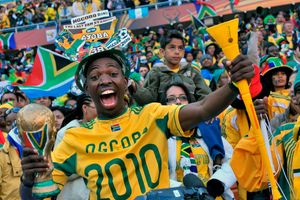
But the 2010 edition in South Africa remains special because it took place while he was in his home country. His suburb became a fan zone, the streets filled with supporters, and normal life almost stood still for a month.
“There was a real sense of organised pandemonium, with fans singing, celebrating and filling the streets day and night. It was chaotic, but in the most unforgettable way,” he recalls, adding that Kenyans will get a taste of that atmosphere when the 2027 Africa Cup of Nations gets under way.
Timothy Simwa.
Photo credit: Pool
Timothy Simwa’s first unforgettable World Cup was the 2002 edition, jointly hosted by South Korea and Japan. He was 11 and in Standard Five, at a time when many matches were played during school hours.
Whenever he could, he sneaked out with friends to the nearest shopping centre, where televisions in video halls drew excited crowds. With no money for a seat, they peeped through windows, squeezed between older spectators or stood on tiptoe for a glimpse of the action.
Brazil’s Ronaldo, Ronaldinho and Rivaldo lit up that tournament, but Ronaldo’s unusual haircut in the final also made its way to Kenyan villages.
“Within weeks, it seemed every football-loving child wanted to look like the Brazilian superstar,” Mr Simwa recalls. “That hairstyle spread like wildfire and, back in our village, boys queued at local barber shops asking for the ‘Ronaldo’ cut.”
Ambrose Olwa.
Photo credit: Pool
Mr Olwa was nine when Mexico hosted the 1986 World Cup. His strongest memory, like that of many who watched that edition, is Maradona: the controversial “Hand of God” goal against England and the brilliance that followed.
“I don’t think any player has dominated a World Cup the way Maradona did in Mexico. He carried Argentina almost single-handedly to the title with a series of unforgettable performances,” says Mr Olwa, now a 49-year-old entrepreneur.
He watched on a black-and-white television at home with family members, sometimes relying on the commentator to identify players. The following year, Kenya hosted the All-Africa Games and Gor Mahia won the Mandela Cup, moments that made football feel closer to home and deepened his passion for the game.
According to him, the World Cup still attracts huge audiences, but the emotional connection has changed. The rise of club football, he argues, has shifted loyalties.
Mr Olwa feels social media, fantasy football and sports betting have also changed how people relate to football. Many fans now follow individual players, statistics or betting outcomes as closely as the matches themselves.
“In the past, supporting your country was the main story. Today, football is more commercial and more fragmented, even though the World Cup remains the biggest sporting event in the world,” he says.
Abdisalan Lakicha is the chairman of the Football Kenya Federation in Mandera.
Photo credit: Pool
For Mr Lakicha, chairman of the Football Kenya Federation in Mandera, the 1994 World Cup in the United States was the first he followed from start to finish.
In Mandera, few families owned televisions, so a neighbour’s small black-and-white set became the centre of the world for a month. That neighbour, he remembers, was Mr Adan, a retired police officer.
By evening, Mr Adan’s sitting room would fill with plastic chairs, upside-down jerricans and mats. Some matches ran late, testing the host’s rule against making noise after 10pm.
“The air was thick with the smell of tea and sweat,” Mr Lakicha recalls.
Brazil’s Romário and Bebeto left a mark, especially Bebeto’s famous baby-rocking celebration, which boys in Mandera practised in the dust the following day. Brazil’s penalty shootout victory over Italy in the final remains etched in his memory.
Naftali Njoroge.
Photo credit: Pool
Mr Njoroge’s first memorable World Cup was France 1998, the tournament he says turned him into a hardcore football fan. Then a Class Seven pupil at Murinduko Primary School in Njoro, he would sneak from home to watch matches at his uncle’s house, the only one in the village with a black-and-white Great Wall television.
That edition also came with chewing gum stickers of World Cup players. The stickers were placed underneath the wrapper, so you had to buy gum to get one.
Mr Njoroge collected many such stickers and decorated his mathematical set and schoolbooks with pictures of favourites such as Ronaldo, Rivaldo, Roberto Carlos, Lilian Thuram and Dunga.
“I even copied the hairstyle of some of the players, but when I tried it, I was beaten by my mum and told to shave my head,” says Mr Njoroge, a driver and businessman.
To buy more gum, he sold avocados and guavas from his father’s farm.
“Every pack was a surprise. You never knew which player you would get. Finding your favourite players inside the chewing gum was magical,” he says.
At school, duplicates were swapped with classmates, and Brazilian players were the most prized.
Mr Yusuf grew up in Nairobi’s Eastlands before relocating to Germany in the late 1990s, where he is involved in volunteer work.
Growing up, he was glued to the Football Made in Germany programme on KBC TV. In Eastlands, he also watched football legends JB Ogolla, Dino Kitavi, Abdalla “Bazooka” Musa, John “Shito” Lukoye and Bernard “Zico” Otieno, among others, practise.
His earliest World Cup memory is Spain 1982, when Italy beat West Germany 3-1 in the final at the Santiago Bernabéu.
He and many others were rooting for Brazil, whose players — among them Socrates, Zico and Serginho — seemed to turn the game into a dance.
“They had these samba drums, and it was as if they were dancing. The game was like a dance,” he says.
To Mr Yusuf, the 1982 and 1986 tournaments remain among the most iconic.“If you ask wazee, they will tell you that in the ‘82 and ‘86 World Cups, people were playing fantastic football,” he says.
Reporting by Elvis Ondieki, Elizabeth Ngigi, Bernard Rotich, Eric Matara, Manase Otsialo, Rushdie Oudia and Eddy Ashioya