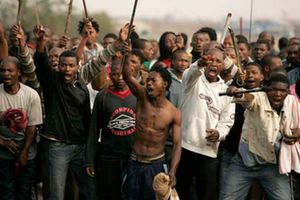
Kenya and other African states face mounting costs to evacuate nationals from South Africa, where violent mobs have ordered foreigners to leave by June 30.
And the crisis has also exposed gaps in documentation, with some evacuees lacking valid papers, forcing diplomatic missions to issue temporary travel passes.
On Friday, Kenya’s High Commission in South Africa asked authorities to allow Kenyans to travel to the mission premises in Pretoria for temporary documents enabling them to depart.
In a note to security officials, the mission said it was issuing temporary passes to those able to leave by 3 July.
“Kindly note that some of these Kenyans have irregular status in South Africa and are hence proceeding to the High Commission in Pretoria to obtain travel documents to facilitate their repatriation back home by the Government of Kenya,” the notice stated.
That alone reflected the problem South Africa is grappling with: Illegal immigration. But the matter took a violent twist as mobs have targeted foreigners from other African countries. Mozambique, Malawi, Ghana, Zimbabwe and Nigeria have already launched evacuations for their nationals.
Last week, the Kenyan High Commission in Pretoria said it was compiling a list of those who felt endangered for evacuation to Nairobi.
“The Kenya High Commission in Pretoria wishes to assure Kenyan nationals in South Africa that the Mission remains available to provide consular assistance where necessary. Kenyans requiring urgent assistance or experiencing distress are advised to contact the Mission on +27 76 177 2675 or +27 12 362 2249,” it said on 18 June.
It remains unclear how many Kenyans live in South Africa, with estimates ranging between 20,000 and 30,000. The Mission says it often urges nationals to register on the diaspora portal, but as registration is not compulsory, only a handful comply.
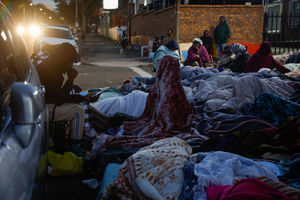
33-year-old Princess Adjei eats a meal on the street where she is staying after her salon was destroyed in a xenophobic attack on May 18, in Durban, South Africa, June 8, 2026.
Photo credit: Rogan Ward | Reuters
It is also unclear how many have overstayed visas or lost passports, as few report such incidents. Other Kenyans travel for short stays such as business, conferences or tourism and are not considered at risk. Official data showed some 58,000 Kenyans visited South Africa for tourism in 2024, the first year after short-stay visas were lifted.
Earlier in June, the Kenya Diaspora Association in South Africa (Kedasa), a lobby for Kenyan residents, asked the government to consider evacuating Kenyans targeted by violent mobs.
“We respectfully request an urgent engagement on this matter given the growing concerns being expressed by members of the Kenyan community across South Africa,” said William Thegeya, Kedasa’s secretary-general, in an open letter to High Commissioner Jane Ndurumo.
The association says it has since worked with the High Commission to compile a list of Kenyans wishing to return home, though travel dates have not been revealed.
Kenya has previously evacuated nationals from crisis situations, but this could be the first due to xenophobia. Relations may not be damaged yet, as President William Ruto, during a tour of South Africa in June, admitted that migration flows largely stem from people seeking better opportunities. He said African peers should improve governance at home, so citizens do not have to travel and cause friction in other places.
South Africa itself has faced pressure, with countries across the continent accusing it of turning its back on those who helped end apartheid.
“These incidents do not reflect the values or position of the South African Government and its people,” said Ronald Lamola, South Africa’s Minister for International Relations.
“Those responsible will face the full force of the law, as will anyone exploiting migration concerns to advance political, personal, or criminal agendas.” Mr Lamola was responding to concerns by WHO boss Dr Tedros Adhanom after two Ethiopians were killed by a mob in June.
Mr Lamola reiterated South Africa’s stance: while condemning mobs targeting foreigners, it wants other African countries to take responsibility too.
“The management of immigration challenges requires a continental response to the root causes and the push-and-pull factors,” he said.
South African authorities have struggled against rising mob violence. Figures from the Armed Conflict Location & Event Data Project (ACLED) show anti-migrant demonstrations increased sharply from April to mid-June 2026. ACLED recorded 61 events nationwide, mainly driven by the March and March movement but also involving security forces.
“Targeted attacks during this period have been particularly deadly. Since 2022, ACLED records at least 148 fatalities in attacks on migrants — committed by either state forces, violent mobs, or unidentified perpetrators,” noted Dr Ladd Serwat, Senior Africa Analyst, and Susanna Deetlefs, Regional Desk Coordinator for Africa and North America, in a joint assessment on Friday.
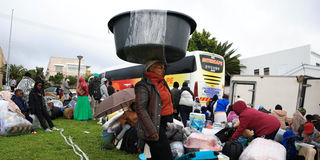
Displaced migrants shelter in a hall, following an escalation in anti-immigrant protests which heightened fears among foreign communities, in Kleinmond, South Africa, June 3, 2026.
Photo credit: Esa Alexander | Reuters
“Following the latest demonstrations in 2026, several nations — including Ghana, Malawi, Mozambique, Nigeria, and Zimbabwe — have coordinated the repatriation of thousands, a move that has strained bilateral ties and heightened economic risks.”
Most violence is concentrated in KwaZulu-Natal and Gauteng, where most African migrants live, but it has also spread to the Western Cape, fuelled by local political sentiments ahead of municipal elections.
ACLED says that while anti-migrant sentiments have long existed in South Africa, 2026 could be the most violent year yet, with events already exceeding annual totals from peak years 2022 and 2025.
For South Africa, xenophobia presents a paradox: it campaigns for Palestinians trapped in Gaza, equating their plight to apartheid.
“We welcome the opportunity to discuss the push-and-pull factors behind it. What drives migrants away from their homes?” posed Clayson Monyela, Head of Public Diplomacy.
“In discussing possible solutions, [we must put on the agenda] the role of countries where migrants come from, the role of countries that provide safe passage, and how we assist receiving countries like South Africa in managing challenges.”
He was responding to Ghana’s request to have the matter discussed at the African Union’s mid-year summit.
Ghana formally wrote to the AU requesting that xenophobic attacks in South Africa be placed on the agenda at the upcoming Mid-Year Coordination Meeting of heads of state and government. That meeting, initially scheduled in Egypt, was postponed to October following the Ebola outbreak in Congo.
In a letter to AU Commission Chairperson Mahmoud Ali Youssouf, Ghana’s Foreign Minister Samuel Okudzeto Ablakwa said the situation in South Africa has led to loss of lives and continues to pose serious risks to the safety and well-being of African nationals.
Among Ghana’s demands is the establishment of a fact-finding mission to examine the underlying causes of xenophobic violence and propose remedial interventions.
“The facilitation of dialogue and reconciliation initiatives aimed at promoting tolerance, inclusion, integration, and renewed commitment to continental unity among African people,” Mr Okudzeto said.