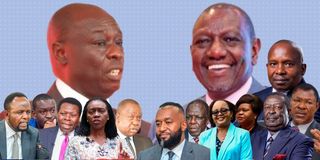
If the race for 2027 presidential candidates has slowly but surely started taking shape, an equally consequential contest is quietly unfolding beneath it — the battle to become deputy president.
Unlike previous elections, where deputy presidential candidates were largely selected to deliver regional votes, the 2027 contest presents a far more complicated equation.
It is being shaped by shifting alliances, the fallout from Mr Gachagua's 2024 impeachment, ODM's cooperation with the Kenya Kwanza administration in the broad-based arrangement, fragmentation of Mt Kenya politics and the opposition's search for a formidable coalition capable of unseating President Ruto.
The calculations have become so fluid that nearly every influential political figure is now being viewed through the lens of deputy presidential suitability.
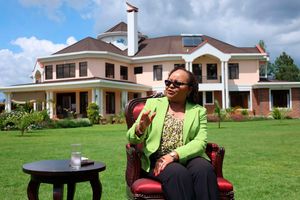
Deputy President Kithure Kindiki speaks at Mukuyuni Township in Makueni County on June 5, 2025.
Photo credit: Pius Maundu | Nation Media Group
On President Ruto's side, Deputy President Kithure Kindiki remains in pole position, and his allies have made it clear the man from Tharaka Nithi County will retain his position in the next election’s ticket. But his position, some analysts say, “is by no means unassailable.”
Cabinet Secretaries Wycliffe Oparanya (Cooperatives), Hassan Joho (Mining and Blue Economy) — all former ODM Deputy Party Leaders, National Assembly Speaker Moses Wetang’ula , Governors Gladys Wanga (Homa Bay) Anne Waiguru (Kirinyaga) and Prime Cabinet Secretary Musalia Mudavadi have all found themselves drawn into conversations over who could eventually partner President Ruto should changing political realities demand a different ticket.
Across the divide, the opposition faces an equally delicate balancing act.
Should Kalonzo Musyoka secure the presidential ticket, Nairobi Senator Edwin Sifuna of the Linda Mwananchi camp has increasingly been mentioned as a possible running mate.
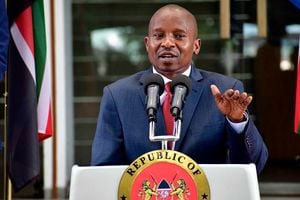
Wiper party leader Kalonzo Musyoka addresses party delegates at Wiper House in Nairobi on April 24, 2025.
Photo credit: Francis Nderitu | Nation Media Group
If Jubilee candidate Fred Matiang'i eventually loses the presidential race within the coalition, his name could equally feature prominently in deputy presidential calculations.
Others regularly mentioned include People's Liberation Party leader Martha Karua, DAP-K leader Eugene Wamalwa, Democratic Party leader Justin Muturi and Trans Nzoia Governor George Natembeya.
Trans-Nzoia County Governor George Natembeya.
Photo credit: Dennis Onsongo | Nation Media Group
Unlike Cabinet appointments, where regional considerations can be spread across several ministries, the deputy presidency offers only one slot.
That single position must simultaneously satisfy regional expectations, ethnic balancing, campaign financing, coalition management, governance experience, political loyalty and succession calculations.
Despite persistent speculation surrounding alternative candidates, political analysts largely agree that Deputy President Kindiki enters the race as President Ruto's strongest option.
The strongest voice behind the professor has been Public Service Cabinet Secretary Geoffrey Ruku, who has already drawn a line in the sand over Prof Kindiki’s position as deputy president.
"Those looking for seats should not bother with the presidency or the deputy presidency. That seat belongs to Kindiki. There is no vacancy now, and there will be no vacancy in 2027,” Mr Ruku charged.
He has even gone further to put Mt Kenya West on notice that the Eastern part risks dissociating from it should they fail to back their “son” – Prof Kindiki. "The time has come for us to politically divorce as the mountain. If you cannot support our son, Kithure Kindiki, after we have supported you all along, then let us split the mountain."
This voice got a boost from President Ruto during his recent visit to Meru County where he appeared to express his confidence in Prof Kindiki.
Since assuming office, Prof Kindiki has embarked on relentless tours across Mt Kenya, commissioning projects, presiding over economic empowerment programmes and engaging local leaders in what many analysts view as a carefully choreographed campaign to rebuild President Ruto's support in the region.
For President Ruto, retaining Prof Kindiki offers some advantages.
First, it reassures Mt Kenya that the region remains represented at the highest level of government despite Mr Gachagua's dramatic exit.
Democracy for the Citizens Party (DCP) leader Rigathi Gachagua.
Photo credit: Bonface Bogita | Nation Media Group
Second, replacing him barely two years after his appointment could reinforce opposition claims that the President exploits rather than partners with regional leaders.
Third, Prof Kindiki has largely avoided political controversies while steadily cultivating goodwill among elected leaders.
If President Ruto concludes that Mt Kenya is no longer recoverable, pressure could mount to deploy the deputy presidency elsewhere in search of new electoral arithmetic.
That possibility partly explains why ODM figures have increasingly featured in succession discussions. Co-operatives Cabinet Secretary Wycliffe Oparanya has emerged as one of the latest names being floated after a section of ODM leaders openly suggested he would make a formidable running mate.
National Assembly Minority Leader and Suna East MP Junet Mohamed recently told a rally that he would gladly support Mr Oparanya's elevation should President Ruto eventually seek a different deputy.
"I also support those who are saying that the Deputy President should come from ODM. I support that,” he said.
Mr Mohamed went on to identify Mr Oparanya as his preferred candidate, arguing that party loyalty should be a key consideration.
"If Oparanya becomes Deputy President, he will be closer to me than someone from another party because he belongs to our party. Isn't that true? So let us unite so that we can hunt together," he said, perhaps what some observers noted was due to the background where the statement was made, since Mr Oparanya comes from Western Kenya.
The remarks reflected growing confidence among sections of ODM that the cooperation agreement between ODM and Kenya Kwanza could ultimately translate into even higher political rewards.
Mr Oparanya's appeal, however, lies beyond Western Kenya. A seasoned administrator, former Kakamega governor and experienced Cabinet minister, he presents himself as a technocratic figure capable of complementing President Ruto's economic agenda.
Homa Bay Governor Gladys Wanga speaks during the Orange Democratic Movement (ODM) Special Delegates Convention at the ASK Dome, Jamhuri Expo Centre in Nairobi.
Photo credit: Bonface Bogita | Nation Media Group
Her growing national profile, mobilisation skills and influence within ODM have elevated her into conversations about the future of the broad-based arrangement.
Supporters argue that choosing Ms Wanga would simultaneously strengthen President Ruto's relationship with ODM, improve his standing among women voters and significantly expand Kenya Kwanza's appeal in Nyanza.
Perhaps no region has mounted a more organised campaign than the Coast. Political leaders there have openly begun lobbying for Mining Cabinet Secretary Hassan Joho to become President Ruto's running mate.
Supporters argue that after decades of producing influential Cabinet ministers but never a deputy president, the Coast deserves representation at the second-highest office.
They point to Mr Joho's political experience, business background, youth appeal and growing partnership with President Ruto as qualities that make him an attractive national candidate.
But the campaign illustrates how every region now sees the deputy presidency as the most realistic route to national influence.
Prime Cabinet Secretary Musalia Mudavadi remains one of the country's most experienced politicians and continues to command respect across sections of Western.
Elevating him, analysts say, would also strengthen President Ruto's position in Western Kenya.
If President Ruto faces difficult choices, the opposition's calculations may prove even more complicated.
For months, attention has centred on Kalonzo Musyoka and Fred Matiang'i as the leading contenders for the presidential ticket.
On Thursday, Kitui Senator Enoch Wambua publicly claimed that Mr Gachagua had settled on Mr Musyoka as the coalition's preferred presidential candidate.
The Wiper leader himself appeared to reinforce that perception, saying: "Everything he has said, I want to confirm. That's exactly how things are."
He maintained that producing a single opposition candidate against President Ruto remained non-negotiable.
For analysts, Mr Wanjigi's significance extends beyond his presidential ambitions.
Beyond former President Uhuru Kenyatta, few opposition leaders possess comparable financial muscle.
Mr Wanjigi also introduces another variable. Should Kalonzo eventually become the opposition flag bearer alongside Edwin Sifuna, the coalition would leave out Mt Kenya without representation at the top of the ticket.