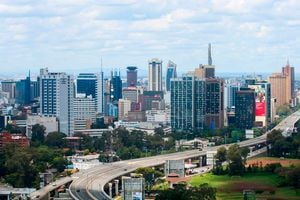
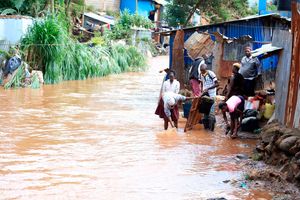
As Nairobi struggles to decide the fate of its river system, public debate keeps returning to the visible and simple: demolitions, evictions, and the mapping of riparian land.
The assumption is that bulldozers can provide a permanent answer, and that once illegal structures are cleared, the rivers will recover. This is a dangerously simple reading of a much deeper problem.
If Nairobi Governor Johnson Sakaja gets to read this, let him learn that Nairobi’s rivers are not only choked by what stands on their banks, but by everything the city pours into them through neglect, inadequate infrastructure, poor regulation, and unplanned growth. Removing structures may create space by the riverbanks, but it will not, on its own, bring the waters back to life.
Nairobi Governor Johnson Sakaja at his office in Nairobi.
Photo credit: File | Nation Media Group
History shows us that cities do not destroy rivers in a single dramatic act, nor do they clean the rivers in a single act. They poison the rivers slowly, by allowing waste, indifference and poor planning to accumulate over decades. That is why Nairobi may have something important to learn from London, a city that first abused its rivers, then buried some of them, and is still spending heavily to repair the damage.
Nairobi was once known for its cool, clear waters – the only other reason that the city exists. Yet from the arrival of the railway in 1899 and the rapid urban growth that followed, its streams and rivers increasingly came to be treated as drains. Raw sewage, and I have said here before, industrial waste and household refuse found their way into waterways that should have sustained life.
London travelled a similar road long before Nairobi did. Its rivers were once sources of drinking water, transport and livelihood, but as the city expanded, they became dumping grounds for the filth of urban life.
The most striking example is the River Fleet, once one of London’s most important tributaries. It is said that the river supported trade and daily life, and for centuries, it was part of the living geography of the city. But as London grew, the river became choked with rubbish, sewage and the runoff of a swelling population. What had once been an asset turned into a public embarrassment and a health hazard, just as the Nairobi River has turned into these days.
And this is where Nairobi can learn from London. The city’s first instinct was not restoration in the modern sense, but engineering. After the Great Fire, Christopher Wren and Robert Hooke tried to tame the lower Fleet by converting part of it into what was called the New Canal. The river was widened, deepened and lined with wharves in the hope that a more orderly waterway would improve the district and serve commerce.
The only thing that the engineers had forgotten was how to deal with silt and a population that still treated the river as a dumping site of refuse. And this is what we might need to learn for Nairobi.
London found that it still had a deeper problem since the city's population treated the watercourse as a place to throw refuse. To solve this problem, engineers decided that the river had to disappear into the bottom of the city. That is how River Fleet vanished, making sure that its waters, as it passed through London, were clean.
A bridge over Nairobi River at Grogan area that was wept away by floods following heavy rains in the city.
Photo credit: Dennis Onsongo | Nation Media Group
In its current state, the Nairobi River is effectively dead; if it cannot be restored, perhaps it should be buried from public view. It would not be the first urban river to disappear. London shows that degraded rivers can be pushed out of sight, allowing real estate and infrastructure to rise above them.
The Walbrook, once central to Roman and medieval London, was buried underground centuries ago. The Tyburn, which once supplied drinking water and flowed through areas that are now among London’s wealthiest districts, was gradually forced below the surface as suburbs expanded and sewer systems absorbed its course. In other words, London erased some of its river after they were polluted beyond rescue.
There have long been arguments that burying rivers does not solve a city’s sanitation crisis; it merely hides it from public view. The Thames is a powerful example. By the mid-19th Century, it had become a foul carrier of human and industrial waste. In the hot summer of 1858, the stench grew so unbearable that the episode entered history as the Great Stink. Even the Houses of Parliament, standing on the riverbank, could not escape it.
Once the smell became intolerable to lawmakers, Parliament approved the funding that allowed engineers, led by Joseph Bazalgette, to construct an interconnected sewer system designed to intercept waste before it flowed directly into the Thames. Nairobi may need a similarly serious investment in infrastructure if the river is to be protected as it passes through the city. Yet the Thames also shows that buildings can remain on a river’s banks without condemning it to filth. What this suggests is that it is not the space between buildings and the river that cleans a waterway, but the systems that prevent waste from entering it in the first place.
And that is the real lesson for Nairobi. Rivers can coexist with buildings, roads and major institutions. The Palace of Westminster stands on the Thames, yet its presence is not the reason the river was polluted.
A section of the heavily polluted Nairobi River.
Photo credit: Dennis Onsongo | Nation Media Group
The issue is not simply whether structures stand near water, but whether a city has the infrastructure and discipline to stop sewage, storm overflows and industrial waste from entering the river in the first place. Modern London has returned to that same lesson. The Tideway Tunnel, the so-called super sewer now being built into London’s system, is meant to capture and divert overflows that would otherwise pour untreated waste into the Thames.
Nairobi should take note. Demolishing buildings on riparian land may create the appearance of decisive action, and in some cases, it may indeed be necessary. But it is not, by itself, a river-cleaning strategy. Pollution does not enter Nairobi’s rivers from one source or one neighbourhood. It comes from broken sewer lines, illegal discharge, storm-water runoff, factories, informal settlements, and the daily failures of urban management across the city. A bulldozer can clear a riverbank, but it cannot intercept sewage upstream.
London’s history shows two things at once. First, a city can be so careless with its rivers that it turns them into underground sewers and eventually forgets they were ever there. Second, recovery is possible, but only when authorities accept responsibility for the waste system as a whole.
The Fleet disappeared because London allowed urban growth to outrun planning. The Thames began to recover only when the city invested in the hard, expensive work of interception, drainage and treatment.
Nairobi should not wait until its rivers exist only as names on old maps. It should restore them while they are still visible, still flowing, and still capable of renewal. London’s lesson is not that cities must bury their rivers to survive, but that once a river is reduced to a sewer, restoring it becomes far costlier than protecting it from the start.
Waste dumped on a section of Nairobi River in this picture taken on September 15, 2024.
Photo credit: Lucy Wanjiru | Nation Media Group
For now, the Nairobi River remains a natural wastewater drain, and bulldozers will not solve that problem. Only serious investment in sewerage and storm-water infrastructure can do so: systems that stop sewage from entering the river and that carry runoff away in a controlled and separate network.
Nairobi must choose: either to bury the river and let it flow unseen beneath the city, or to revive it through the kind of sustained infrastructural investment that once rescued the Thames. What it cannot do is continue with half-measures.
Bulldozers alone will not save a river that is still receiving sewage and polluted runoff. If Nairobi wants the river to live, it must build the sewerage, drainage, and waste-management systems needed to keep pollution out of it. There are no two ways.
John Kamau is a PhD candidate in History, University of Toronto, Canada. Email: [email protected] ; On X: @johnkamau1