Kenneth Matiba was rich. He owned hotels. He owned schools. He had interests in horticulture, industry and blue-chip companies.
Long before he became the face of defiance against President Daniel Moi, Matiba had already built what many African businessmen of his generation only dreamt about: a sprawling private empire stitched together by nerve, discipline and instinct.
Unlike many politicians who found wealth after power, Matiba went into politics already rich and left it diminished, broken by illness, persecution and unforgiving debt.
By the time he sought the Mbiri parliamentary seat in 1978, he was already a man of means, confidence and reach. It is that arc — from wealth to distress, from empire to auction battles — that makes his story worth revisiting today, as Raphael Tuju’s own debt saga revives familiar questions about ambition, borrowed money and the heavy personal cost public men sometimes pay when private dreams begin to collapse.
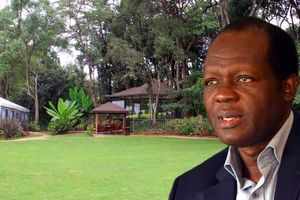
Former Cabinet Secretary Raphael Tuju.
Photo credit: File | Nation Media Group
At the centre of Matiba’s fortune stood the Alliance Group. There was Alliance Jadini Hotel, Alliance Safari Beach, Alliance Africana Sea Lodge and Naro Moru River Lodge.
There was Hillcrest in Karen, one of the country’s most prestigious schools, born out of his 1970s dream of building not just properties, but institutions. He had sizeable interests in Carbacid.
He had stakes in flowers, nurseries and allied companies. He was among that first post-independence African elite that sought to prove that Kenyans could own, run and expand serious business concerns in sectors once dominated by settlers, foreigners and old commercial families.
He tried real estate. He bought struggling properties. He turned around neglected hotels. He partnered, improvised, expanded and learned. One of his earliest ventures was Brunner’s Hotel in Nairobi, a tired city establishment that suggested little glamour. But Matiba had an eye for underperforming assets. He could see value where others saw fatigue. Together with his associate George Robinson, he moved into property and hospitality with the appetite of a man who understood that wealth is rarely found in perfection. It is often found in distress, then made respectable through capital, will and management.
Jadini was among the early tests of that instinct. It was rundown, poorly managed and commercially limp.
Matiba fought its management, dismissed those he believed had grown too comfortable and rebuilt the place. When it reopened, it carried not just the promise of profit but the stamp of a man who wanted to be counted among Kenya’s serious builders. Naro Moru followed. The coastal hotels followed. Hillcrest followed. Soon, the empire had a shape, then a reputation, then a gravity of its own.
When Matiba entered politics, he did so with the confidence and style of a man already used to power. His campaigns were grand, marked by long motorcades, lavish hospitality and public generosity that reflected both his wealth and stature. He was not just seeking office; he was bringing into politics the presence of a man who had already made his mark elsewhere.
At first, the two worlds appeared capable of co-existing.
Kenneth Matiba at a past Saba Saba rally.
Photo credit: File
Matiba had trusted hands in business, especially Stephen Smith, the long-time associate who helped steady the Alliance interests. While Matiba moved through government and later elective politics, the empire held. The hotels traded. The schools remained prestigious. The businesses carried on with the confidence of a structure whose founder still cast a large shadow over every decision.
Then politics turned, as it always does. His break with Moi changed the story. What had once looked like the career of a wealthy insider became the journey of a marked dissident. This was not a simple quarrel between politicians. In Kenya, politics rarely stops at politics. It seeps into business, banking, licences, contracts, bookings and reputation. Soon, Matiba’s commercial empire began to feel the chill of state hostility. Government and parastatal bookings in his hotels thinned out. Harassment intensified. Pressure grew around him and his family. By the time he openly joined the call for multi-party democracy in 1990, he was no longer merely a businessman with political interests. He was an enemy of the state.
Detention without trial, and by a man he had helped set up business, broke more than his political freedom. It broke his health. The stroke he suffered after his incarceration weakened him physically and, in business terms, removed the one man who had held together a complex private empire through force of intellect, instinct and authority. Empires of this kind are often more personal than they appear on paper. They depend on one commanding centre. Once that centre weakens, the cracks begin to spread.
The tourism sector itself was under strain and ethnic clashes and violence at the Coast destroyed the peace with paradise. Matiba had made a major goof: Political campaigns, to fuel his presidential ambitions, had consumed large amounts of money. His managers became more powerful, and advisers grew more influential as they took advantage of an ailing Matiba.
His children were in the business, yes, but they were not Kenneth Matiba in full command, nor were they Stephen Smith. The balance began to shift. And whenever the balance shifts in a debt-heavy enterprise, the banks are never far away.
Then came the loans. Like many large Kenyan business empires, Matiba’s wealth had been built not only on vision and property, but also on leverage. Debt sits quietly during years of growth. It is only in years of distress that it reveals its true character. What had once looked manageable began to swell under interest, penalties and delay. Barclays Bank moved in. Receivership threats emerged. Court orders came. The old empire of hotels and schools was no longer being discussed as a monument to enterprise. It was now being discussed as security.
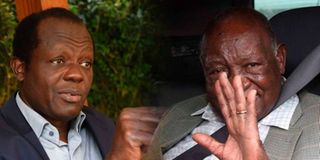
Kenneth Matiba (left) and Charles Rubia.
Photo credit: File | Nation Media Group
Barclays Bank’s attempt to place Matiba’s hotels under receivership quickly took on a political colour. His Ford-Asili supporters rallied behind him and urged loyalists to withdraw their money from the bank, casting the dispute not merely as a commercial matter, but as part of a wider assault on a man who had already suffered greatly for his politics.
Matiba himself dramatically chased away four receivers sent to take over the hotels over a debt that had ballooned to nearly Sh1 billion from an original Sh300 million. Even with a court order in hand, Police Commissioner Philemon Abong’o was unwilling to force him out, perhaps in recognition that Matiba had already endured more than most. In the fallout, Matiba dismissed his long-serving hotel manager, Chris Modigell, accusing him of siding with Barclays.
And here the Matiba saga acquired the quality of public drama. Just as Raphael Tuju’s debt troubles have generated language of persecution, state intrigue and lender ruthlessness, so too did Matiba’s battle with Barclays become politicised.
His supporters did not want to see the dispute merely as a matter of unpaid loans. They saw it as part of a broader campaign to finish a man who had already been punished for standing up to Moi. When Barclays tried to move in, there were calls by Matiba loyalists to boycott the bank. Receivers were confronted. The debt was wrapped in the vocabulary of nationalist resistance.
In a sense, this was understandable. Matiba had suffered enormously. His businesses had not collapsed in a neutral environment. They had been shaken by political persecution, dried-up state-linked business and the incapacitation of the founder through illness. To his followers, the bank’s actions looked less like ordinary loan recovery and more like the final act in a long punishment of a patriot.
Veteran politician Kenneth Matiba waves at a crowd as he leaves Kimorori Primary School grounds in Murang'a County on May 19, 2016.
Photo credit: File | Nation Media Group
But this is where the tragedy of Matiba’s story lies. Politics could explain his weakening but it could not erase the loan. The sympathy could only slow the process but did not stop interest from accumulating. Finally, and this was the lesson learnt, public anger could embarrass a bank but did not restore the cash flow needed to hold together hotels, schools and heavily burdened companies.
This is the hard lesson at the centre of the Matiba saga. Once an empire built on prestige and property slips into debt distress, the language of politics may rally crowds, but the language that decides its fate is the language of security, default and recovery. A school ceases to be only a school. A hotel ceases to be only a hotel. It becomes collateral.
Matiba fought. He resisted receivers. He fought a vulture fund demanding Sh1 billion. He accused the banks of punitive interest and of undermining local entrepreneurs. He fired long-serving managers he believed had sided with the lenders.
In Parliament and public debate, his case fed a wider conversation about high interest rates and the vulnerability of Kenyan businesses to aggressive bank enforcement. But by then, the decline had advanced too far. Hillcrest, that old dream born in 1974, slipped away.
The Alliance Group became entangled in legal disputes, restructuring battles and later claims from those who said they had helped rescue portions of the family wealth.
In the end, the empire no longer looked like empire. It looked like distress: court files, charge documents, disputed asset sales, preservation orders, bitter letters and family companies trying to keep hold of what had not yet been taken.
That is how private kingdoms often die in Kenya. Not in one dramatic moment, but in instalments.
Matiba’s case shows how quickly wealth can become exposure. It showed that politics can wound a business empire but cannot protect it from arithmetic. It showed that once debt enters the bloodstream of a troubled enterprise, prestige begins to lose its force. The borrower may still command public sympathy, but the lender commands the paper.
Kenneth Matiba was rich. He owned hotels, schools and companies. He had the aura of permanence. He looked like a man who had built something too large to fall. But politics weakened him. Illness slowed him. Loans cornered him. And when the final battle came, it was no longer about expanding the empire. It was about saving what was left of it.
John Kamau is a PhD candidate in history, University of Toronto. Email: [email protected] @johnkamau1