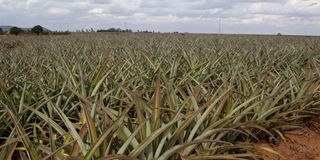
In my article last week on Kakuzi plantations and the need to give 3,200 acres back to locals, a reader drew my attention to another festering problem on the edge of Thika: the pineapple wall that blocks the proposed city from growing towards Murang’a County and over River Chania boundary.
The faster Del Monte, the Murang’a and Kiambu devolved governments and the national government confront this issue, the better. That the company has created a pineapple barrier along River Chania is not in dispute. It is the same dilemma Kericho town faces with the British-owned tea estates that ring it. Leaders have backed the county’s bid to acquire 1,000 acres from the estates to allow Kericho to expand.
Nairobi has grown in much the same way throughout colonial and post-independence periods: by consuming the landscapes around it. The once densely wooded Kikuyu highlands gave way to suburbs like Kileleshwa, Spring Valley and Westlands. What remains of those original forests is largely confined to small protected pockets like Karura forest and the Arboretum.
Donholm, which began as Donholm Dairy Farm, was eventually subdivided and absorbed into the city as a residential estate. Muthaiga also started as a farm that supplied Nairobi with milk and butter. In recent years, coffee bushes were uprooted from Gigiri and the city has swallowed almost all the former grazing lands of Eastlands.
The same pressure on land is driving the rapid expansion of the Nairobi metropolitan towards Kiambu County, where real estate development has turned coffee farms in Kikuyu, Ruiru and Kiambaa into the city’s new “bedroom” communities. Meanwhile, Nairobi National Park functions as a stubborn buffer to the city’s southern sprawl. Proposals to encroach on the park, reroute infrastructure or “rationalise” its boundaries are not just technical planning options but political choices about what kind of city Nairobi wants to be.
An aerial aerial view of pineapple plantations at Del Monte farm in Thika, Kiambu County.
Photo credit: File | Nation Media Group
These are real planning and political questions, not abstract debates. They touch on livelihoods, ecological survival, transport, housing, and the injustices of land allocation. That is why an honest, inclusive discussion on how much land Del Monte should surrender to allow Thika to grow has become urgent. It is a debate that cannot be postponed and demands negotiation and resolution while there is still room to shape the trajectory of urban growth.
When Del Monte leases came up for renewal in 2022, the controversy that followed – the acrimony, opacity, high-handed posturing on all sides – only confirmed how politically charged this land has become. No one seriously disputes that Del Monte hosts Africa’s largest pineapple plantations or that it functions as an economic engine, employing thousands and anchoring related industries. That matters. But it cannot, on its own, settle the question of whether vast tracts of strategic land should remain locked in a low-density, single-use plantation model while Thika strains under the pressures of urbanisation.
Thika is running out of well-located land for housing, schools, hospitals, light industry and transport corridors. Growth is being pushed outwards into ecologically fragile areas, or else forced into unplanned, crowded settlements with inadequate infrastructure. As witnessed in Kericho, plantations at the urban fringe “freeze” land that could host mixed-use development, neighbourhoods and public amenities. The opportunity cost of maintaining a single crop over tens of thousands of acres in such a strategic location is enormous.
The nearby Thika Greens, a former coffee farm, shows what can happen when private land is reimagined in the context of metropolitan growth. This tract has been converted into a planned serviced estate with housing, recreational facilities and a growing service economy. The transformation has generated new property rates for county governments, new businesses and alternative jobs. It has also demonstrated that, with proper planning, infrastructure can be laid out systematically instead of being retrofitted chaotically after informal settlements have taken root.
Chania River in Thika.
Photo credit: File | Nation Media Group
When President Jomo Kenyatta allowed California Packers (Calpac) – a US firm – to take over the failed Anglo-French Company sisal and coffee farm near Thika, he was not thinking about Thika’s future as a city. He was thinking in terms of a fourth cash crop. Coffee, tea and sugar were already emerging as the pillars of Kenya’s foreign exchange. Pineapple, processed and exported under a global brand, was to be the new star. The idea was simple: a large estate to guarantee supply, plus African smallholders and outgrowers feeding the factory and sharing in the profits.
It was also a delicate political moment. Kenyatta was struggling to persuade white commercial farmers – then the bedrock of the economy – to stay on. Some had already abandoned their farms, expecting a government buyout or hoping that a new African elite would move in individually or through land-buying companies. Most of the companies that came to operate in Kenya became public listed after selling their shares to locals. Del Monte has retained its foreign signature with no local ownership.
Initially, the government had earmarked the Anglo-French farm for settling landless Africans. The plan was abandoned after a legal battle the government won. It later emerged that members of the Kenyatta-era elite had an eye on this land, which was ideal for coffee and emerging crops like pineapple. That political tug-of-war partly explains why the leases took long to sign – 1970 for the Kiambu parcels and 1973 for the Murang’a side.
In choosing to go with a foreign processor, the Kenyatta government made a strategic bet: that modern capital and a well-known brand would open doors in the international market that a small, local firm could not.
Parliament was told in 1969 that the US company would grow its pineapples and that African outgrowers and other planters would deliver their quotas to the factory. Some MPs were puzzled. Why not recapitalise the existing Kenya Canners factory and let it process pineapples as a public enterprise? Why was Calpac not interested in coffee? The government tried to run the 500-acre coffee farm itself and failed.
Elsewhere, the administration was pouring money into sugar factories in western Kenya, cotton mills in Nyanza and a cashewnut factory in the Coast – many of which would collapse or limp along as ghosts. The pineapple experiment was to be different. Outgrowers would supply the private firm and be paid on delivery. In practice, the smallholder side of this dream fizzled out in Kiambu, Murang’a and Nyeri, thanks to sabotage.
Del Monte is not a colonial dinosaur. It was invited into the country after independence by Agriculture minister Bruce McKenzie and persuaded to buy a stake in the Thika-based Kenya Canners factory, which was handling mainly pineapples. Why it has never invited locals to buy shares is not strategic.
To cut a long story short, Murang’a County previously demanded 3,000 acres from Del Monte to build a city along the Thika-Kabati highway, prime land opposite the Thika Greens golf and housing project. There were also Kandara squatters seeking part of the land.
So where does that leave us – and Thika? Nobody denies that Del Monte is a post-independence foreign investment that has provided jobs, foreign exchange and some measure of stability in a volatile economy. While the company has a right to seek protection for its core business and complain when confronted by opportunistic land grabbing, we also cannot pretend that Thika can become a city while pressed against an endless pineapple fence. Towns become cities by expanding – by creating new industrial zones, housing estates, schools, universities, hospitals and parks. They cannot do that if the land beyond their river is locked up in monoculture.
The challenge is not to burn down the pineapple wall but to open gates in it. Del Monte will have to give up some land that borders the highway – enough and in the right places to allow Thika to cross River Chania and grow in an orderly way towards Murang’a.
The company deserves something too: security of tenure on a more compact core estate, clear rules and freedom from extortion disguised as “public interest”. It is important to engage in a national conversation about transitioning from plantations to cities, and about how we treat enterprises that have been part of our story for decades. We owe it to Thika – and to history – to get this one right.
Kamau is a PhD candidate in history, University of Toronto. Email: [email protected] X: @johnkamau1