A trove of declassified Federal Bureau of Investigation (FBI) documents reveal how the American domestic spy agency tracked civil rights activist Malcolm X (born Malcolm Little) during his mid-1960s visit to Kenya and even bugged his hotel room to snoop on his private conversations.
The African American revolutionary civil rights activist was on an extensive tour of Africa to build a relationship with the African independence movements.
This was because apart from being one of the most militant black activists, Malcolm X was also a Pan-Africanist, who saw Africa as the base for black Liberation. As he put it himself, he was visiting Africa and other countries in the world to explain the “inside story” of the African American problems in the United States.
However, Malcolm X’s new dalliance with Africa, alarmed the then FBI Director J. Edgar Hoover who feared that African nationalists and communists might exploit Black American activism to incite internal security crises within the US similar to the Mau Mau insurgency in Kenya.
In fact, one spy whose name is redacted from the documents would later inform the FBI after interacting with Malcolm X, “Little (Malcolm X), expressed a strong admiration for the Mau Mau terrorist activities in Kenya before that nation became independent. He contrasted the bold use of violence of Africans in Kenya with the fitness of the Africans in South Africa.”
Just before Malcolm X left the US in April 1964, for the extensive tour that lasted seven months, an informer told the FBI that he had bought a round trip ticket to Africa at cost of $1300.80 and that his itinerary was " New York to Frankfurt, to Cairo, to Jeddah, to Cairo, to Khartoum, to Nairobi, to Lagos, to Accra, to Algiers, to New York."
On July 17, 1964. Malcolm X addressed the First Ordinary Assembly of Heads of State and Governments of the Organisation of African Unity (OAU) in Cairo, which was also attended by Kenya’s new prime minister, Jomo Kenyatta. In his speech to African leaders, Malcolm X said: "We stand defenceless, at the mercy of American racists who murder us at will for no reason other than that we are black and of African descent.”
He added: "Our problems are your problems. We have lived for over 300 years in that American den of racist wolves in constant fear of losing life and limb. Recently, three students from Kenya were mistaken for American Negroes and were brutally beaten by the New York Police. Shortly after that two diplomats from Uganda were also beaten by the New York City police who mistook them for American Negroes.
"Our problem is your problem. No matter how much independence Africans get here on the Mother Continent, unless you wear your National dress at all times when you visit America, you may be mistaken for one of us and suffer the same psychological and physical mutilation that is an everyday occurrence in our lives.
"Your problems will never be fully solved until and unless ours are solved. You will never be recognized as free human beings until and unless we are also recognized and treated as human beings.”
After visiting West Africa and the Middle East, Malcolm X, arrived in Kenya in October, 1964 and booked himself in the New Stanley Hotel in Nairobi, where he hoped to stay for two weeks. Incidentally Congressman John Lewis, another fiery American civil rights activist, was also staying in the New Stanley hotel.
It was not until the evening of October 7, when the two bumped into each other in the lobby, the luxurious Victorian-era Hotel. Despite the surprise, the two used the opportunity to chat about the happenings in America.
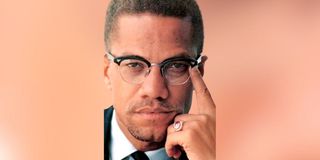
African American revolutionary civil rights activist the late Malcolm X.
Photo credit: File | Nation Media Group
As a result of their conversation, Lewis invited Malcolm X to a rally in Selma, an American city, which was to be held on February 14, 1965. And Malcolm accepted the invitation.
Two days earlier, an excited Malawian student known as Louis Nthenda had also bumped into Malcolm X at the new Stanley Hotel and convinced him to give a speech at Oxford in the UK. Nthenda was heading to Oxford to take up a graduate research scholarship at St Antony's College when he made a stopover in Kenya to catch the next day’s connecting flight.
That evening in the hotel’s dining room, he was able to recognize Malcolm X immediately, having followed his Middle Eastern and African travels on television.
"We were the only blacks in the (New Stanley Hotel) dining room," Nthenda recalled later, "and I asked if I could move over to his table. By the end of the evening, he had accepted my suggestion of the Oxford Union inviting him to a debate before year end."
One strange thing is that despite Malcolm X spending almost two weeks in Kenya, meeting leaders, attending social functions and giving television interviews, no photo or footage of him doing so was publicly released. This was deliberate. The CIA and FBI, worried about his growing international fame, wrote to African governments, warning them to limit the reception they accorded him.
Kenya being one of the most strategic outposts for the West, there was no way its leadership was going to give Malcolm X publicity by associating with him in public and jeopardise crucial foreign financial aid.
On October 20, 1964, Malcolm X attended Kenyatta Day in Nairobi, with one FBI document noting that, “he appeared prominently at social functions although he was not a guest of GOK (Government of Kenya).” On October 21, 1964 Malcom appeared on VoK-TV in a special interview during which he stated that African independence movements had given great impetus to the African Americans.
Malcolm X revealed that he came to Kenya at the invitation of certain government members whom he didn’t want to name. He also disclosed that he had previously visited Nairobi on his way to Dar-es-Salaam and that he had been in Kenya for four or five days secretly in order to contact government leaders without publicity.
He also secretly met Pio Gama Pinto, a Kenyan revolutionary who just like him stood up against imperialism, internationalism, racism and economic oppression.
Malcom X left Kenya on October 24, 1964 for a four-day visit to Ethiopia where he gave a talk at the University College Addis Ababa and also met leaders. Even there the FBI used spies and installed bugging devices in his hotel room to eavesdrop on his conversations.
According to one conversation recorded by the FBI at the Ethiopia Hotel, Malcolm X complained that there were so many African Americans in Kenya but they were in bed with the US government instead of fighting against the oppression.
“There are a lot of American Negroes in Kenya,”Malcolm X said. “They ought to organise themselves into pressure groups so that they can get some respect from the US government.”
He went on to point out that the refugees from Angola, South Africa and Mozambique were organised and commanded respect as a result.
He also revealed to his audience that while in Nairobi he had complained to the then US Ambassador to Kenya William Attwood about an alleged effort by the embassy to prevent Americans from meeting him. He went on to express his fears about the same being replicated in Ethiopia saying, “I know they sent word here that I was coming and they are trying to keep me from making any public speeches.”
African American revolutionary civil rights activist the late Malcolm X.
Photo credit: File | Nation Media Group
Even as he returned to the US after his extensive tour of Africa, Malcolm X never forgot to honour the two impromptu invitations he had received while staying at the New Stanley Hotel Nairobi, one by the Nthenda the Malawian student who asked him if he could give a speech at Oxford, and another one by Congressman John Lewis, who invited him to a rally in Selma.
These two spontaneous interactions in Nairobi gave rise to what could be described as a crystallisation of Malcolm’s political philosophy, and a perennial sample of his revolutionary thought towards the tail end of his life.
He first honoured Nthenda’s invitation to give a speech at the Oxford Union on December 3, 1964. Standing tall at the heart of one of the world’s oldest universities, Malcolm X gave a speech that was controversial to some and revolutionary to others.
According to some analysts, the speech was the best encapsulation of Malcolm X’s ultimate views on race, American politics and what could only be called universal human rights.
Having honoured Nthenda’s invitation, on February 14, 1965 Malcolm arrived at Selma as he had promised Lewis in Nairobi. But Dr Martin Luther King Jr was not too enthusiastic about his presence because of his militant style of agitation. In fact, after arriving in Selma, Malcolm held a private meeting with King’s wife, Coretta Scott King, and assured her that he didn't have any problem with her husband.
“I didn’t come to Selma to make his job difficult,” he assured Coretta. “I really did come thinking that I could make it easier. If the white people realise what the alternative is, perhaps they will be more willing to hear Dr King”.
Unfortunately, the local authority ordered the arrest of Lewis and Dr King before the rally took place. They then blocked Malcolm X from meeting them. Nevertheless, Malcolm X, accompanied by Mrs King, gave a speech at Brown Chapel AME Church, where he praised Mau Mau pointing out that they had” frightened the white man" in Kenya.
And seven days later, he was assassinated on February 21, 1965. And four days after that, his friend Pio Gama Pinto, a Kenyan icon for social justice and leftist movement whom he had met in Nairobi, was also gunned down in the city. Both men were considered as threats to the economic and political status quo.
In a twist of fate, Kisilu Mutua, the man who was jailed for killing Pio Gama Pinto, was pardoned by Kenyan President Daniel arap Moi in 2001 after serving 35 years. Kisilu who was jailed at the age of 22, maintained that he was wrongfully convicted.
Similarly, Muhammad Aziz the man, who was jailed for killing Malcolm X, was paroled in 1985, after serving 20 years in prison. Aziz later proved his innocence and his conviction was officially vacated in 2021.
Following his exoneration and a subsequent multi-million-dollar settlement with the State of New York, Aziz relocated to Rwanda in 2023 to seek a peaceful new chapter of his life at the age of 88.