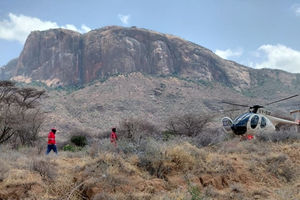
Deemed to be the safest mode of transport, air travel is now coming under sharp scrutiny following a series of crashes that the country has witnessed, the latest being the Wednesday incident in which seven people perished in Samburu.
Through the skies, Kenya has lost prominent leaders ranging from Members of Parliament and Cabinet Secretaries to top military chiefs. They include Agriculture Minister Bruce Mackenzie, who perished in Ngong Hills in 1978; Labour Minister Ahmed Khalif (2003); Roads Minister Kipkalya Kones and MP Lorn Laboso (2008); Internal Security Minister George Saitoti and his deputy Orwa Ojode (2012); Chief of Defence Forces General Francis Ogolla (2024); and Emurua Dikirr MP Johanna Ng’eno (February 2026).
Among those killed in Wednesday’s crash near Mount Ololokwe in Samburu County were Michele Sensi-Contugi, director of Ecuador's Strategic Intelligence Centre, and his wife, Stephany Hollihan. The helicopter was piloted by Kenyan John Outram, director of African Heli Adventures.
Another victim was José Alberto Suárez, president and general manager of Telemundo's stations in Orlando, Tampa and Fort Myers-Naples, Florida.
An analysis by the Nation’s research desk shows at least 25 air crashes since 1978 on Kenyan soil, with 22 of these involving civilian aircraft and nine involving military helicopters.
The most lethal occurred in 1992, when a military chopper crashed in Kaloleni, killing 46. But recent years have been just as alarming: between 2020 and 2024 alone, Kenya recorded at least 20 crashes.
In most of these crashes, the most common reasons given include mechanical failure, environmental hazards, loss of control, poor visibility, pilot error or the aircraft’s condition. But in most cases, the causes remain classified as “unknown” — a vague conclusion that provides no real solutions.
In the case of the death of Ng’eno, a preliminary investigation report by the Aircraft Accident Investigation Department revealed that the aircraft encountered thick fog, drizzle and extremely low visibility shortly before the crash.
Aircraft records reviewed by investigators showed that the helicopter had a valid maintenance certification, no deferred defects and sufficient fuel, with its weight and balance within prescribed limits.
The investigation further established that key aircraft components, including the digital engine control unit, engine multifunction display and GPS unit, were recovered and sent to France for analysis to help determine the probable cause of the crash.
In the case of the death of Chief of Defence Forces Francis Ogolla, a military report found that engine malfunction caused the chopper crash that killed CDF General Francis Ogolla and other officers.
A scene where a KDF helicopter carrying Chief of Defence Forces General Francis Ogolla and 11 others crashed at Sindar, Kaben Location at the border of Elgeyo Marakwet and West Pokot counties.
Photo credit: Oscar Kaikai | Nation Media Group
General Ogolla died on April 18, 2024, after a chopper he was travelling in alongside other officials crashed in Kaben, Marakwet East.
The ministry said that the Huey Helicopter KAF 1501 was assessed to have had a relatively high level of reliability, having conducted several operational and training missions, including VIP flights.
“Further, the flight was operated by a qualified, competent crew. However, dependent on information from the survivors, after experiencing Complete Power Loss, the Pilots of KAF 1501 attempted to control the Helicopter to a clear Landing Zone but lost positive control of the aircraft,” the report read.
According to the report, the investigations established that the helicopter suffered Engine Compressor Stall (Surge).
“Based on facts and evidence gathered, and indicated in the findings above, the Board of Inquiry is of the opinion that the Bell UH-1H-II (Huey) Helicopter KAF 1501 crashed due to Engine Malfunction,” reads the ministry’s report.
For Ahmed Khalif, the first Labour minister under Mwai Kibaki’s National Rainbow Coalition (NARC) government, who died after the 5Y-EMJ plane crashed during take-off at Busia airstrip, the poor condition of the runway and a defective cockpit voice recorder were identified as the main causes of the crash.
According to the report, the poorly maintained runway was only 1,000 metres long, 300 metres of which were unusable, leaving the pilots with a mere 700 metres compared with the 1,200 metres the plane needed to take off successfully.
According to the report, it was also found that the plane was not fitted with a Flight Data Recorder.
The inquiry report says although the plane's certificate of airworthiness was current, it did not comply with all the conditions required by the regulations.
The plane crashed during take-off, killing Mr Khalif and injuring Cabinet colleagues Raphael Tuju, Martha Karua and Linah Kilimo, and Assistant Minister Njeru Githae.
The leaders were returning to Nairobi after attending an election victory party at the home of Cabinet colleague Mr Moody Awori.
Concerned by the persistent recent crashes involving light aircraft, nominated MP Umulkher Harun last year called on the Ministry of Transport to provide the safety status of all light aircraft in the country.
A scene where a chopper crashed at Chepkiep Village in Mosop sub-County of Nandi on February 28, 2026, where six occupants, including MP Johanna Ng'eno, died on the spot.
Photo credit: Jared Nyataya | Nation Media Group
However, the fourth session of the House lapsed last year without the statement having been responded to on the floor of the House.
In her questions, Ms Harun sought to know the condition of light aircraft utilised by aviation training centres in the country.
She also wanted the ministry to furnish the House with the frequency and adequacy of inspections of both aircraft and airstrips to safeguard student pilots and instructors.
In its report, the ministry was also expected to outline to lawmakers measures that had been put in place by the Ministry of Roads and Transport to designate alternative training airstrips, particularly in open spaces that are clear of obstacles and away from dense urban settlements.
The lawmaker also wanted to know the clear steps being taken by the Ministry of Transport to review and strengthen policies, regulations and legislation aimed at improving aviation safety standards in the country.
The Transport Committee is yet to formally table any report to the House addressing concerns related to the increased air crashes in the country.
Aviation experts now point to a lack of follow-ups on investigations, failure to implement recommendations made by various investigations and a lack of technical capacity to handle complex crashes.
According to Pascal Rabii Aketch, an aviation lawyer, the recent accidents in the country necessitate a national conversation on whether the civil aviation framework is adequately equipped to ensure safety.
According to Aketch, the Kenya Civil Aviation Authority (KCAA) needs adequate funding and staff since it plays a central role in the aviation industry, yet 90 per cent of its surplus capital is remitted to the National Treasury after approved expenditure.
The Kenya Civil Aviation Authority Headquarters at the Jomo Kenyatta International Airport, Nairobi.
Photo credit: File | Nation
He pointed out that in the KCAA 2023-2028 strategic plan, the authority identified 59 vacancies within its Aviation Safety, Security and Regulation Directorate and that the Auditor-General, in its report for the financial year ended June 2023, recorded 28 flight operations inspectors and three aerodrome and ground aids inspectors.
“This means that additional funding is therefore necessary to recruit, retain and equip sufficient inspectors,” Mr Aketch said.
He also proposed that, to tame the high number of air crashes, air navigation services should be separated from KCAA.
“An independent Air Navigation Service provider should provide these services, while KCAA focuses on regulation, certification, safety oversight and enforcement in order to eliminate any conflict that may arise by KCAA regulating the very services it provides,” Mr Aketch said.
“It is needless to say that air navigation services are of paramount importance to air safety and therefore need meaningful regulation by an independent body,” Mr Aketch said.
There is also a need to have an independent Air Safety Commission to monitor the implementation of accident investigation recommendations.
“For these reforms to see the light of day, legislative action and additional public funding need to be undertaken. The goal should be simple: accident investigations must lead to concrete safety improvements, not merely reports,” Mr Aketch said.
In 2023, Parliament adopted the East African Community (EAC) Multilateral Agreement on Aircraft Accident and Incident Investigations, which aims to improve aircraft safety in the region.
The agreement was adopted by various countries in the region at the 16th Meeting of the Sectoral Council on Transport, Communication and Meteorology, held from June 24 to 28, 2019, in Kampala, Uganda.
The agreement noted that despite the Kenya Civil Aviation Authority’s efforts to improve safety oversight through recruitment, training, development of safety procedures and enforcement, the number of aircraft accidents has continued to rise.
The agreement is meant to actualise the requirements of the East African Community Treaty and the Convention on International Civil Aviation (Chicago Convention), which require cooperation in matters pertaining to both the Chicago Convention and the East African Treaty.
The Chicago Convention requires that all civil aircraft operations be carried out in accordance with minimum operating standards, procedures and practices.
Additionally, the EAC Treaty, particularly Article 92, provides that Partner States should implement measures to ensure that air transport services are safe, effective and profitable; states should adopt common policies for the growth of civil air transport in the area; harmonise civil aviation rules and regulations; and coordinate efforts and cooperate in order to maintain high security.
By ratifying the agreement, Kenya can benefit from enhanced cooperation with other member states, leading to improved accident and incident investigation capabilities. This will contribute to identifying safety risks, implementing preventive measures and fostering a culture of continuous improvement in aviation safety.