The strengthening relationship between Kenya and China is causing indignation in the United States, with Senator James Risch recently calling for a review of US-Kenya ties .
Although Risch’s views are not a reflection of the official position of President Donald Trump’s administration, historically, Washington has always construed dalliance with China as connivance to undermine its strategic interests. At times Washington goes to the extent of forcing countries to withdraw from agreements or even sabotaging deals.
In May 1964, when the then Minister for Home Affairs, Jaramogi Oginga Odinga, made an extensive tour of China and Russia and secured massive aid, Jesse MacKnight, who was a senior official at the US State Department, summoned the head of Chancery at the British Embassy in Washington on May 22, 1964. He complained on why the British were not using their influence to undermine Nairobi’s dalliance with Beijing and Moscow.
So severe was the Americans’ resentment that the British, who still wielded influence in Kenya, began fearing that Washington could bypass them and start putting pressure on Prime Minister Jomo Kenyatta (later president) directly.
One British diplomat wrote in a document marked secret, “We may hope that the Americans here will refrain from bagging Mr Kenyatta or his ministers, and we should be prepared to restrain them, if necessary.”
The Chinese aid secured by Jaramogi was the largest ever offered to Kenya by a foreign government at that time, and sent jitters in the corridors of the US State Department in Washington. By then, China was trying to court the newly independent Africa states through, gifts, cheap loans and by opening diplomatic missions in their capitals.
Jaramogi with his delegation, which also included the Minister of State in the Prime Minister’s Office Joseph Murumbi, were received like celebrities when they arrived in Beijing, then known as Peking, on May 3, 1964, for an eight-day visit.
They were warmly greeted by Mao Tse-Tung, Chairman of the Central Committee of the Chinese Communist Party and by Liu- Shao-Chi, Chairman of the People’s Republic of China. On the fourth day of their visit they held talks with the Chinese Premier Chou En-lai and his deputy Chen Yi, before later on signing a draft agreement on economic and technical co-operation.
Among China’s offer to Kenya were a free grant of £1,071,000 to help Kenya stabilise its balance sheet, especially at a time when the government was struggling to raise salaries for soldiers of the newly formed Kenya Army, which hitherto had been part of the British Empire forces and funded from Her Majesty’s coffers.
The Chinese also offered an interest-free loan of £5,300,000 with no conditions attached. This was to be given to Kenya between July 1, 1964 and June 30,1969 to meet the cost of industrial and agricultural development projects and was to repaid over 10-year period beginning January 1, 1975, in the form of Kenyan exports to China or any other convertible currency agreed by the two governments. The agreement also proposed for Chinese economic experts and technical personnel to be dispatched to Nairobi under the technical assistance program.
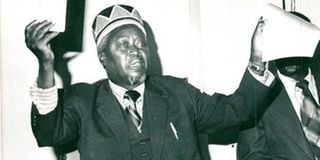
President Jomo Kenyatta and Vice President Jaramogi Odinga at Ichaweri in Gatundu in 1964.
Photo credit: Pool
During the visit Jaramogi also address a rally of 1,500 people from all walks of life who turned up to welcome him and his delegation to Beijing.
In his speech after attacking British colonialism in Kenya, he declared,” Now that we are free, we must not shut our eyes to the intrigues of our economies, the imperialists, who would like to regain control through the control of our economies. In other words, we must safeguard ourselves against neo-colonialism.”
Speaking about the crisis in Congo to the jubilant crowd, Jaramogi described the United States as a “neo-colonialist power of the worst type”, adding,” The wealth of this great African country which should be used to serve the need of the poverty-stricken country is diverted to America to enrich even more capitalist parasites.”
Unlike the Americans, the British were flexible in their perception of the aid secured by Jaramogi since it could lessen their financial burden of having to meet some of Kenya’s needs. “If our long-term objectives are to promote the economic and social development of the developing countries as rapidly as possible, then surely we must welcome the participation of other donors, since we are manifestly unable to meet the needs of these countries ourselves,” Mr RBM King head of Finance and Regional Programmes at the British Department of Technical Co-operation advised.
Instead the British were more concerned about Jaramogi’s speech in Beijing, which they believed was one-sided and aimed at painting Britain in bad light. H.S.H Stanley, who was the acting British High Commissioner to Kenya, following the sudden departure of Sir Geoffrey de Freitas, was asked by the Foreign Office in London to raise various aspects of Jaramogi’s speech with Mzee Kenyatta.
Apparently, Mzee Kenyatta had already got wind of the jitters Jaramogi’s visit to the East had caused in western circles and was avoiding meeting the British diplomat. In a telegram marked confidential to his seniors in London, Stanley expressed his frustration about the inability to secure an appointment with Mzee Kenyatta by stating, “I regret, despite constant pressure still unable (10.00 GMT) get an appointment with Kenyatta. Though have vague promise of ‘something today’. Therefore, cannot hope report before meeting, if this take place.” He went on, “For what is worth my guess he will not publicly disclaim Oginga Odinga’s statements though he may be wiling indicate privately that these not government policy.”
Stanley finally managed to meet Kenyatta on May 14 and wrote, “I saw Kenyatta 12:00 GMT today 14 May, Cabinet Secretary Ndegwa present”. During the meeting he raised with Kenyatta some of Jaramogi’s remarks in Beijing which he stated were one-sided, but Kenyatta told him that he had not read the speech and therefore could not comment. Stanley then produced a copy of the Times newspaper which contained an excerpt of Odinga’s speech and showed it to Kenyatta.
Mzee Kenyatta careful not to be dragged in Cold-War machination towards his friend Jaramogi, informed Stanley that he could not comment on the matter behind Jaramogi’s back since there was not proof that the speech was reported accurately.
He, however, promised to talk to Jaramogi on his return to Nairobi from China and Russia. “He (Kenyatta) said he would not like to comment behind Odinga’s back since he might not have been properly reported, but would speak to him on return tomorrow and consider then whether some statement should be made to correct the record on Kenya’s position,” Stanley reported.
As the meeting came to a close, the British diplomat suggested to Mzee Kenyatta whether he could say something friendly about Britain in public to whitewash Jaramogi’s attack on Britain, and Kenyatta agreed. Stanley would later inform London, “He readily assented to my suggestion that he might anyway say publicly something friendly about Britain soon.”
However, the decision by British officials to focus on Jaramogi’s remarks instead of the consequences of the aid he had negotiated for didn’t sit well with officials in American President Lyndon B Johnson’s administration.
As a result, on 22 May 1964, just a week after Odinga’s returned and declared at the airport that, “We have laid foundation upon which continuous cooperation and mutual help in field of economic and cultural development will be built in our country”, Mr. Macknight the Director Office of Eastern and Southern African Affairs in the US State Department, summoned the British Head of Chancery and expressed the concerns of his seniors.
Mzee Jomo Kenyatta (left) with then Vice President Jaramogi Oginga Odinga.
Photo credit: File | Nation Media Group
The American official accused Britain of being concerned about Jaramogi’s remarks instead of looking at the bigger picture of the consequences of Chinese and Soviet aid to Western interests in Kenya, and failing to take steps to mitigate them.
“The upper level of the State Department was anxious to have a thorough assessment of the significance of these development simply from the point of view of Kenya, but as regards Western interests in general; the whole East African area; Kenya economic planning; the implications for existing western projects and so on,” read a telegram marked confidential and priority sent by a British diplomat in Washington. For this reason, United States asked its missions in Dar-es-Salaam, Kampala and Zanzibar to provide their assessment of Kenya’s new ties with China and Russia and their effects on the region.
US’s concerns were that such aid was being used by Communist Russia and China to penetrate key points in Africa in order to introduce the presence of technicians and to facilitate the spread of propaganda.
According to the State Department, Kenya was a key point in East Africa and it was necessary for the West to act quickly in order to prevent Uganda, Zanzibar and Tanganyika from contamination with communism.
Consequently, one of the points of discussion between MacKnight of the US State Department and the Head of British Chancery in Washington was whether they should try to block the whole or parts of the aid secured by Jaramogi.
“The question which arose for policy decision were whether we should try to block the whole deal or part of it and if so how; what projects the Western Powers might offer to undertake and how they should be allocated,” the British diplomat wrote.
While the Americans were robust in opposing the aid given to Kenya by the East, they were putting pressure on the British to do the distasteful task of curtailing the Chinese and the Soviet influence.
“Mr MacKnight said that his superiors tended to look to the United Kingdom to take the lead over this and to undertake the main burden” the British diplomat reported. Eventually, most of the projects negotiated for by Jaramogi in China and Russia were sabotaged and never took off as Cold War intrigues manipulated by external forces took centre stage in the post-independence Kenyan government.