For years, five land buyers believed they had secured a piece of Mavoko’s booming property market. They held title deeds, purchase agreements and official search documents and considered their ownership unquestionable.
But a court battle has ended with a costly verdict: the land was never lawfully available for sale.
The Environment and Land Court in Machakos upheld the cancellation of multiple titles, ruling that the buyers acquired parcels originating from a fraudulent subdivision scheme.
The case pitted the five purchasers against Daniel Wambua Mukuvi, acting for the estate of his late mother, Mary Mbula Mukuvi.
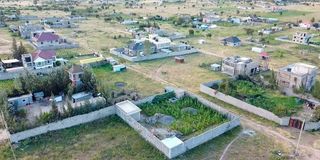
Marked property built on a disputed piece of land in Mavoko, Machakos County in this picture taken on May 30, 2025.
Photo credit: Bonface Bogita | Nation Media Group
The dispute began with a 2018 suit in which the buyers claimed ownership of Mavoko Town Block 2/14655, 14757, 14685, 14714 and 14715.
Mr Mukuvi, as administrator of his mother’s estate, filed a counterclaim alleging that part of her land had been unlawfully subdivided, transferred and sold through a fraudulent scheme.
The Mavoko court later consolidated the case with a separate suit filed by Mr Mukuvi and his wife over the demolition of developments on the disputed land.
On July 31, 2025, the court ruled in favour of the estate, cancelled the disputed titles, restored the mother parcel to Mary Mbula Mukuvi’s name and awarded the estate more than Sh1.5 million in compensation.
The five buyers appealed to the Environment and Land Court in Machakos. On September 29, 2026, Justice Koross dismissed the appeal, upheld the lower court’s orders and ordered the appellants to pay the costs.
At the centre of the dispute was land originally owned by the deceased. Evidence accepted by the courts showed that she had sold only 10 acres through agreements entered into in 2009 and 2010. The estate argued that an additional 15 acres were later carved out and transferred through transactions with no legitimate basis.
The extra acreage was subdivided into numerous plots, some of which were sold to unsuspecting buyers.
The purchasers argued that they had bought the land and held title deeds issued through the registration system. They said they had conducted due diligence before buying.
But both courts found that ownership could not be determined merely by possessing a title deed. Instead, they examined the root of the titles.
Marked property built on a disputed piece of land in Mavoko, Machakos County in this picture taken on May 30, 2025.
Photo credit: Bonface Bogita | Nation Media Group
Justice Koross said the buyers failed to satisfactorily explain the origin of their ownership documents after the estate challenged the legitimacy of the subdivisions.
The lower court found that the seller and surveyors had perpetrated fraud in causing Mbula’s land to be subdivided, a finding endorsed on appeal.
The judgment details a paper trail in which parcel numbers repeatedly changed through subdivision. Several mutation forms produced by the buyers were unregistered and lacked evidence of the approvals required for subdivision.
Justice Koross also questioned the purchasers’ due diligence. Some agreements referred to Mavoko Town Block 2/14349, yet the parcel had already ceased to exist after being subdivided years earlier.
“One questions the due diligence exercised by the appellants,” the judge observed.
The ruling highlights the risks for property buyers who assume a title deed automatically guarantees ownership. Where the origin of a title is challenged, courts may require holders to demonstrate the chain of transactions leading to it.
For the estate, the decision ended a long fight to recover land it argued had been unlawfully taken through irregular transactions. The courts accepted evidence that the deceased had sold only 10 acres, with no explanation for the additional acreage transferred to third parties.
The court therefore cancelled the disputed titles, restored the mother parcel to the estate, permanently barred the buyers from the land and awarded the estate more than Sh1.5 million.
The buyers, despite saying they had purchased the land in good faith, were found not entitled to retain it. Justice Koross said their remedy was to seek damages from those who sold the parcels to them.