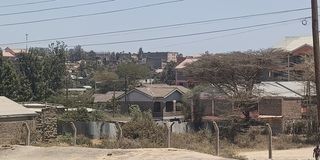
There is an old adage that if you want to recognise a person from Kitengela town, look for a layer of dust on their face or shake their clothes and watch a cloud of dust spread around them. For residents of Noonkopir, however, the dust is more than a joke. It has become a daily reality that threatens their health, livelihoods and property.
Once considered an attractive and convenient neighbourhood on the outskirts of Kitengela, Noonkopir drew homeowners in droves in the 1990s, attracted by the prospects of an ideal place to build homes and settle their families. But decades later, the promise of the neighbourhood has gradually been buried under clouds of dust, with residents along the Kitengela–Ongata Rongai bypass bearing the brunt of a neglected road.
Over the years, the once-promising neighbourhood has slowly turned into a nightmare, especially for dwellers along the Kitengela–Ongata Rongai bypass.
Dust emanating from Kitengela-Ongata Rongai road envelop a section of Kitengela Noonkopir estate, Kajiado County,on Aug 27 2026.
Photo credit: Stanley Ngotho | Nation
The neglected road leading into the estate, west of Kitengela township, has become a major source of misery for residents. Every passing vehicle sends thick clouds of dust billowing into the air, enveloping homes in a choking haze and coating windows, furniture and household belongings with a fine layer of dirt.
On a normal day during the dry season, the dust finds its way into virtually every room, forcing residents to keep their doors and windows shut for much of the day. For families living in the estate, what was once seen as a quiet and convenient neighbourhood has become a daily struggle, with concerns over the health effects of prolonged exposure to dust growing by the day.
On Thursday morning, Nation met Naomi Kimani, 64, a rental property owner, sitting outside her compound. Layers of dust were visible all over the compound. Dust particles could be seen against the beams of the morning sun. She sat pensively, staring at the empty staircase as if waiting for someone.
Her three-storey building was virtually empty, with tenants said to have relocated due to dust and noise from the nearby Kitengela–Ongata Rongai road, where hundreds of trucks ply daily to dozens of building-material quarries in the far west.
“Who wants to live in a plot enveloped with clouds of dust that bring health complications? Tenants barely hang around for three months. I am unable to service the loan I acquired when building the building 10 years ago,” said Ms Kimani, adding that she relocated to one of the Nairobi suburbs after developing chest complications associated with the dust.
Coincidentally, Ms Kimani, frail and weak, had visited her plot to supervise some repairs in one of her two-bedroom houses, not because she was expecting a tenant but just in case, she told Saturday Nation .
The picturesque estate was shrouded in clouds of dust that spiralled across the horizon against the blue skies on a sunny day characterised by sweltering heat. It has become a norm for locals.
The 30-kilometre road that meanders across part of Noonkopir estate connects the populous Kitengela town in Kajiado East Sub-County to Ongata Rongai township in Kajiado North Sub-County, touching a part of Machakos County in the Empakasi neighbourhood.
The hardest-hit residents are those living within the first 10 kilometres from the Namanga Highway in Kitengela town.
The road also connects to dozens of quarries producing quarry stones and pozzolana, ingredients used in cement processing, in Sholinke and Nkurunka villages. Most cement processors outsource pozzolana from these neighbourhoods. Locals claim the situation is usually worse during the rainy season.
The road further runs parallel to the Nairobi National Park boundary and the Standard Gauge Railway (SGR) line to Tuaala neighbourhood. It then snakes past the African Nazarene University to the SGR Ongata Rongai station, extending to Limpa and finally connecting to Magadi Road.
According to Kajiado County government records, at least 400 trucks are said to ply the route per day. The county government charges Sh1, 600 per truck ferrying pozzolana and Sh500 for trucks ferrying other building materials. The trucks operate for six days a week, from Monday to Saturday, leaving behind a cloud of dust and pain for locals.
The deteriorating road has also affected property values and rental demand, with some homeowners and tenants abandoning the area in search of cleaner and more habitable neighbourhoods.
One of Ms Kimani's tenants told Nation she was planning to relocate to Athi River around the end of the month after a two-month stay she described as hell. A civil servant, she relocated with her family to Kitengela after being transferred to work in the region.
“The dust spread in the house like fine smoke, choking us. Children are most affected. You cannot hang washed clothes on the outside clothesline due to dust, but also inside the house doesn't help much. My last-born child has been suffering from a consistent cough since we moved to Kitengela,” she said. “Sanitation is a tall order considering the town grapples with persistent water shortage.”
A truck leaves a trail of heavy dust on Kitengela-Ongata Rongai road Kajiado County on Aug 27, 2026.
Photo credit: Stanley Ngotho | Nation
In most rental and residential buildings Nation visited, the houses were either deserted or not fully occupied, with most tenants improvising various methods to block the usually spiralling dust. The creaking noises of trucks heading to quarries around 4am have become Mr Odongo's alarm.
Mr John Odongo, a tenant along the road, said dust and mud alternate depending on the seasons, leaving part of the neighbourhood uninhabitable and underdeveloped.
“For over 20 years now, my compound is dotted by temporary rental houses. The dust from the deplorable road and unfulfilled promises since when the late George Saitoti was an MP for the larger Kajiado North Constituency up to now has slowed development,” said Odongo.
Most of the private schools that thronged the road, apart from Noonkopir Girls High School, tucked away from the road in the school compound, have since relocated to other parts.
Kitengela Medical Hospital partner and health practitioner Moses Saningo told Saturday Nation that the facility, not exclusively, receives an average of 15 cases of upper respiratory infections, most of which are attributed to dust.
He, however, said the majority of patients are adults who are mostly exposed to dust-laden surroundings while earning a living.
“Inhaling dust irritates the lining of the nose and throat, which breaks down the body's natural defences and makes upper respiratory infections much easier to catch. It's common in naturally dusty regions, including Kajiado County. Adults are mostly affected compared to children. We advise people working in dusty areas to wear face masks,” said Saningo.
According to Lawsavic Property Management Company director Lawrence Kiambi, the value of properties in Noonkopir estate near the Kitengela–Ongata Rongai–Kiserian road has stagnated for the last 10 years owing to the pathetic state of the road.
“Most land buyers had anticipated the road would be tarmacked, but it has taken ages. Those who built rental houses have not been able to reap benefits owing to the pathetic road that could be a major economic artery to the locals once rehabilitated,” said Kiambi.
Helpless locals said the road was last rehabilitated by the Kenya Rural Roads Authority (Kerra) in 2014. Despite numerous protests by transporters and locals, no other major rehabilitation has taken place since.
According to Kenya Rural Roads Authority (Kerra) records, the roads agency spent Sh232 million through the Ministry of Nairobi Metropolitan Development to rehabilitate the road at the time. The improvement, however, was short-lived.
The tarmacking of the road has been advertised several times by both Kenya Rural Roads Authority (Kerra) and Kenya Urban Roads Authority (Kura) over the last 10 years before hitting a snag. The road is classified as a Class C road under Kerra.
Most truck drivers who spoke to Nation on Thursday said the number of trips each truck makes per day has reduced to two from five initially because of the deplorable state of the road.
“From 4am to 5pm, nowadays a truck can hardly make three trips. Also, vehicle breakdown is more frequent, making the trade almost untenable. We also get affected by dust,” said a driver ferrying pozzolana to one of the giant cement processors in the neighbouring Athi River township.
The ripple effects of the bad road have affected the economic backbone of residents of both Nkurunka and Sholinke villages, who depend on quarrying activities. The area boasts some of the biggest stone and pozzolana quarries in the entire vast county.
Now, residents sense danger for their livelihoods, with dozens of investors fleeing to neighbouring Machakos County.
“Dozens of locals survive from quarries. The brisk stone and pozzolana business have been affected by the bad road,” said John Sayole.
Kajiado County Resident Engineer Washington Mugambi said the tarmacking of the road had been affected by a lack of funding over the past three financial years, with Sh1.56 billion initially quoted for the road works.
“The road design is complete. We are hopeful funds will be allocated in the current 2026/2027 financial year. All roads agencies have been allocating funds received to various projects this week in Mombasa. By next week we will know if the road was prioritised,” said Engineer Mugambi.