In February 2003, Titus Naikuni arrived at Kenya Airways carrying one of corporate Kenya’s most seductive promises: to turn the national carrier into a dominant African airline.
The former Magadi Soda chief executive, and once a member of President Daniel Moi’s World Bank-backed “Dream Team”, was regarded as the technocrat who could create the true “Pride of Africa.”
For a while, the dream appeared real as Naikuni imposed commercial discipline, opened routes and rebuilt confidence.
Four years later, Kenya Airways reported a Sh4.1 billion profit in 2007 and another Sh3.9 billion the following year.
Its aircraft became symbols of a confident Kenya, and Nairobi seemed destined to rival Addis Ababa as an African hub.
Then-Kenya Airways CEO, Mr Titus Naikuni. Photo/FILE
Twenty-three years later, that dream remains a nightmare on KQ’s balance sheet, the consequence of mistakes made before Naikuni arrived, compounded during his tenure and left unresolved long after his departure. For the six months to June 2026 KQ recorded a net loss of Sh16.08 billion. The pre-tax loss was Sh15.92 billion, compared with Sh12.17 billion in the same period last year.
The alarming part is that the airline earned more and still lost more. Revenue rose 9.1 per cent to Sh81.25 billion, but operating costs increased by 13.8 per cent to Sh91.9 billion. That produced an operating loss of Sh10.64 billion, up from Sh6.24 billion in the first half of 2025. Interest, leases, foreign-exchange movements and other financing costs did the rest.
The Sh16 billion loss is blamed on expensive fuel, the Middle East conflict, grounded aircraft and a shortage of spare parts. These were immediate causes. But KQ arrived here through choices stretching back to its glory years: early success bred ambition, ambition produced reckless expansion, and each rescue preserved the mistakes underneath.
The first warning arrived in 2009. After 13 profitable years following privatisation, Kenya Airways posted a Sh5.66 billion pre-tax loss when its fuel hedge turned against it as oil prices collapsed. KQ was locked into expensive contracts while competitors bought cheaper fuel.
While the loss should have forced a sober reassessment of risk, it instead, was treated as turbulence on an otherwise unstoppable climb. Within two years, KQ unveiled Project Mawingu, the ten-year strategy that was supposed to establish Nairobi as the gateway linking Africa to Asia, Europe, the Americas and Australia.
Mawingu captured the optimism. KQ planned to grow from about 42 aircraft to 115 by 2021 and from 58 destinations to 117 across six continents. Its first five years required an estimated $3.65 billion in aircraft financing. A Sh20.7 billion rights issue helped fund pre-delivery payments.
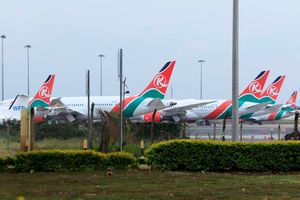
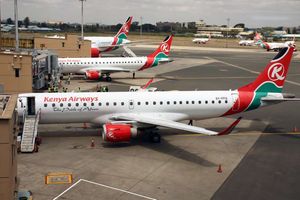
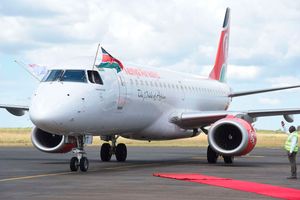
A fleet of Kenya Airways planes at the Jomo Kenyatta International Airport in Nairobi.
Photo credit: File | Nation Media Group
Aircraft were bought or leased in dollars while much of KQ’s income came from weaker currencies. It committed to years of payments on the assumption that passengers, tourism and Nairobi’s infrastructure would grow with the fleet.
That assumption proved disastrous as KQ added seats faster than the market could absorb them. More so, JKIA did not develop at the speed required as it was caught up in aviation politics. Unlike other successful airlines, KQ did not control the duty-free, fuel, catering and ground-handling revenues enjoyed by some state-backed competitors, yet paid high airport charges and taxes.
Then came a succession of shocks: Kenya’s military intervention in Somalia, terrorism, travel advisories, the West African Ebola epidemic and a slump in tourism. The new aircraft leased in a scandalous deal still had to be paid for even when routes weakened. During the Ebola crisis, KQ estimated that its West African network was losing about $4.5 million every month.
But the shocks exposed decisions already made and that had not been erased. The wage bill had more than doubled from about $70 million in 2007 to $157 million by 2011. Attempts to reduce staff were challenged in court and provoked industrial conflict. KQ had expanded its fleet, workforce and network at the same time, leaving management without an affordable retreat when revenue failed to match the plan.
And that was not the only legacy problem. The KLM partnership, inherited from the 1996 privatisation, added another layer of weakness whose ramifications still haunt the airline. Though the partnership had brought expertise, European connections and international credibility, it also gave the Dutch carrier minority-protection rights over important appointments, fleet decisions and alliances involving airlines regarded as its competitors.
The partnership never worked as promised. KQ was to feed passengers from its African network into both airlines’ long-haul flights, while KLM provided connections across Europe. But KLM reportedly sold more tickets in East Africa and retained routes that KQ had expected to take over, even as KQ marketed both airlines’ services.
A Seabury industry review report exposed KQ’s weakness: the Dutch partner complained that KQ entered joint meetings unprepared, while some managers reportedly did not understand.
KQ was therefore trapped twice. It had surrendered part of its strategic freedom to a stronger partner, but had not developed the institutional capacity to extract full value from the relationship. It was an unequal marriage compounded by a weak spouse.
As Mawingu project unravelled later, KQ surrendered assets and markets it would later need. Valuable London Heathrow slots were sold and less attractive slots leased. Some potentially profitable routes were dropped or reduced, giving competitors room to establish themselves. More so, skilled pilots and engineers were poached by better-paying airlines. Rather than establishing a strong dedicated freight operation, KQ remained largely dependent on cargo carried in passenger aircraft bellies.
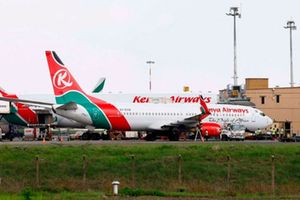
A fleet of Kenya Airways planes at the Jomo Kenyatta International Airport in Nairobi.
Photo credit: File | Nation Media Group
Ethiopian Airlines moved in the opposite direction, building cargo, maintenance, training and a hub supported by government policy. Kenya opened Nairobi to well-financed rivals and expected KQ to compete largely on passenger tickets, a network airline controlling little of the economy around its home airport.
By 2015, the dream had become a corporate disaster. KQ reported a then-record pre-tax loss of nearly Sh30 billion. The airline that had planned to conquer six continents began selling two Boeing 777-200 aircraft and subleasing three Boeing 777-300s and two Dreamliners under a rescue programme called Operation Pride. Aircraft acquired for expansion were now being moved out to reduce costs.
Naikuni left at the end of 2014, and Mbuvi Ngunze inherited Mawingu’s burning wreckage. Blaming terrorism, Ebola, excess capacity and hedging, he promised a turnaround within 18 to 24 months and said KQ needed $200 million. The ten-year dream had become an emergency survival plan.
Operation Pride reduced routes, sold aircraft and cut costs, but it could not erase the loans and lease obligations accumulated during expansion. In 2016, KQ recorded a Sh26 billion annual loss, then the largest corporate loss in Kenyan history. High financing costs had become a permanent passenger on every flight.
By 2017, the airline could not meet obligations to local banks. The resulting restructuring converted debt into shares. The government’s holding rose to 48.9 per cent, a consortium of lenders received 38.1 per cent and KLM’s stake fell to 7.8 per cent. Government offered contingent guarantees worth $750 million. While that prevented immediate collapse, the conversion of debt into equity did not make the airline operationally profitable. As the balance sheet changed; the business model did not.
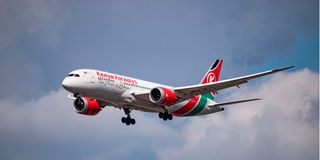
A Kenya Airways Boeing 787-8 Dreamliner aircraft.
Photo credit: File
Sebastian Mikosz, who replaced Ngunze in 2017, became the next chief executive associated with a rescue. By 2019, the confidential Project Simba memorandum was again warning of technical insolvency. KQ carried obligations estimated at Sh220 billion and had no cash-flow buffer. It earned about Sh75.80 per seat kilometre but spent Sh77.60 producing it. The more it flew under those economics, the more fragile it became.
Project Simba proposed that KQ take over JKIA’s aviation assets and earn revenue from maintenance, fuel, catering, car parks and ground handling. The plan ran into resistance from the Kenya Airports Authority, unions and political interests. The integrated hub that was supposed to compensate for KQ’s thin margins never materialised. Then Covid-19 arrived and pushed an already technically insolvent airline back into the government’s arms. Then Mikosz left, frustrated by the politics.
Even the apparent recovery repeated the old illusion. KQ recorded a Sh5.53 billion pre-tax profit in 2024, its first in more than a decade. But Sh10.55 billion of the improvement came from foreign-exchange gains after the shilling strengthened. When the currency effect faded and three Dreamliners were grounded, KQ returned to a Sh17.93 billion pre-tax loss in 2025.
The same grounded aircraft helped produce the current crisis. KQ had demand but lacked enough serviceable long-haul capacity. Passenger traffic fell nine per cent in the first half of 2026 even as fuller cabins and better fares lifted revenue. Cargo income grew 18 per cent to Sh8.77 billion, but remained only about 11 per cent of total revenue. Meanwhile, the fuel bill climbed to roughly Sh29 billion and operating costs outran income.
Seen in isolation, each explanation sounds plausible: a hedge, terrorism, Ebola, Covid-19, the shilling, expensive fuel, spare-parts shortages and Middle East wars. Seen together, they reveal an airline built without resilience. KQ repeatedly expanded before securing the capital, fleet depth, cargo base, hub efficiency and management discipline needed to withstand aviation’s inevitable shocks.
The promise made in 2003 did not collapse in one dramatic moment. It burnt slowly: in the 2009 hedge, the audacity of Mawingu, the dollar loans, the unused seats, the surrendered routes, the uneven KLM partnership, the sale and sublease of aircraft, the conversion of bank debt into shares, and the succession of rescue plans that changed names but carried forward the same liabilities.
The Sh16 billion half-year loss is merely the latest smoke from that fire. What began as the dream of making Nairobi the crossroads of African aviation became an airline that could increase its revenue and still deepen its losses. The Pride of Africa was not hit by one crisis but was flown into the red by two decades of ambition unsupported by financial and institutional strength.