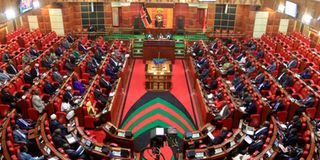
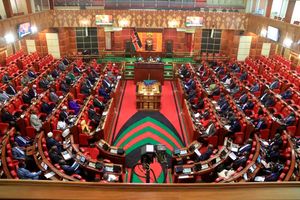
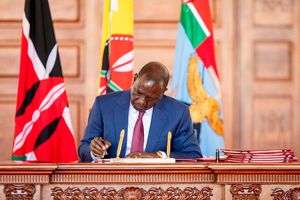
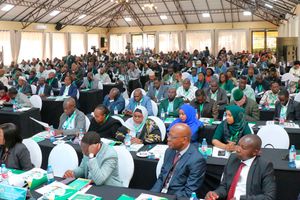
It is race against time for Parliament to enact pending election related laws to streamline the election processes ahead of the August 2027 General Election.
Although National Assembly Speaker Moses Wetang’ula has promised to expedite the passage of the government-sponsored Bills, the Independent Electoral and Boundaries Commission (IEBC) is worried that passing the Bills less than two years “to the election may undermine its planning within the set timelines.”
The National Dialogue Committee (Nadco) report election-related Bill- Elections (Amendment) Bill 2024, the Election Offences (Amendment) Bill 2024 and the Political Parties (Amendment) Bill 2024 are sponsored by Senate leadership- Kericho Senator Aaron Cheruiyot (leader of majority) and his Kilifi colleague Stewart Madzayo (leader of minority).
Senate Majority Leader Aaron Cheruiyot.
Photo credit: File | Nation Media Group
The Bills were published last year, passed in the Senate and transmitted to the National Assembly for concurrence.
The National Assembly has since passed the Elections (Amendment) Bill 2024 with amendments and transmitted back to the Senate for consensus.
The IEBC Act, which expanded the selection panel that recruited the current IEBC commissioners, is the only success story from the Nadco report.
With 21 months until the August 2027 General Election, the process of enacting the Bills is already behind schedule.
This is against the recommendations of the Independent Review Commission (IREC) on electoral reforms that was chaired by retired South African Judge Johan Kriegler in a report that was adopted by parliament in 2008.
Borrowing from the IREC report, IEBC in a document presented to Parliament warns that persistent enactment or amendment of electoral laws too close to elections undermines planning and implementation of electoral activities within the set electoral timelines.
“This tendency upsets the recommendations of the Kriegler commission that legal reforms ought to be undertaken at least two years to the general election,” the IEBC document states.
But speaking during a meeting with Dr Ed Barnett, the Deputy British High Commissioner to Kenya and Permanent Representative to the UN Environment Programme (UNEP) and UN Habitat in his office, Speaker Wetang’ula noted that Parliament will not allow delays that undermine the country’s electoral credibility.
“As a House, we have resolved that within the next two or three months, we will be done with the Bills. We cannot be reviewing laws six or seven months to a general election,” said Speaker Wetang’ula.
National Assembly Speaker Moses Wetang'ula.
Photo credit: File | Nation Media Group
Speaker Wetang’ula went on to acknowledge that restoring public trust in the IEBC remains work in progress and urged the IEBC commissioners to intensify public engagement to dispel fears and rebuild confidence.
Nadco, a bipartisan arrangement, was established to cool the political temperatures in the country following deadly protests after then Azimio leader the late Raila Odinga disputed the outcome of the August 9, 2022 presidential election.
Other than the Nadco Bills, the IEBC in its presentation to the Constitution Implementation Oversight Committee (CIOC) reveals that it has identified gaps in the electoral legal framework and generated “a raft of proposals in Bills and their accompanying statutory instruments” to Parliament.
They include Elections (Amendment) Bill 2022, County Governments Election Laws (Amendment) Bill 2024, Draft Referendum Bill 2020, draft Referendum Regulations 2020, rules of procedure for settlement of disputes, draft Election Campaign Financing (Amendment) Bill 2020, and draft Election Campaign Financing Regulations 2020.
There are also the rules of procedure on delimitation of boundaries 2021, Election (Voter Registration) (Amendment) Regulations 2022, Election (General) (Amendment) Regulations 2022 and Election (Voter Education) (Amendment) Regulations 2022.
The others include Elections (Party Primaries and Party Lists) (Amendment) Regulations 2022 and Elections (Technology) (Amendment) Regulations 2022.
The Elections (Amendment) Bill 2024, seeks to actualise Article 88 (4) (g) of the Constitution that requires Parliament to recruit an independent firm to undertake an evaluation of the electoral process within a year of a General Election.
The Bill also proposes an audit of the register of voters used during the election and a review of the role of media and civil society in the elections, an assessment of the voting procedures on the election day and a review of the vote counting procedures on the election day.
The evaluation, the Bill proposes, shall include a review of the legal framework, processes and costs associated with the electoral progression with a report required to be submitted to parliament within 90 days of the appointment of the independent firm.
“The Bill proposes to provide for the appointment by parliament of an independent firm to carry out an evaluation of the electoral process after a general election,” the Bill reads in its memorandum and objects of reasons.
The evaluation is critical in informing the subsequent processes in terms of reforms that may need to be undertaken to reinforce the credibility of the Kenyan electoral system for efficiency purposes while also ensuring value for money among others.
To actualize this, the Bill proposes to insert new sections- 87A, 87B and 87C- in the Elections Act.
The evaluation process, according to the Bill, shall include a review of the cost of conducting the general elections, including the procurement of the necessary goods and services and a review of the legal framework under which the general elections were conducted.
A review of the elections information and communication technology deployed in the conduct of the general elections is also required as well as the audit of the human resource deployed for the conduct of the general elections and examination of the existing elections disputes resolution mechanisms.
The report also wants IEBC to publish and implement campaign financing regulations to ensure a level playing field for all the competing candidates in an election.
The Election Offences (Amendment) Bill 2024 proposes Sh2 million fine or jail term not exceeding five years or both for those conducting an election outside the gazetted polling stations, as it pushes to secure and preserve the integrity of elections.
The punitive measures in the Bill target members and staff of the IEBC and collaborators who “unreasonably delay in declaring election results or knowingly alter declared election results.”
The Bill specifically seeks to amend section 6 of the Election Offences Act to ensure that the results that are declared by the IEBC officials are those that originate from the gazetted polling stations.
The Bill also seeks to introduce section 6 (o) under the Act to make it an election offence for a member or staff of the commission who “knowingly or intentionally interferes, alters or knowingly or intentionally causes another person to interfere or alter declared results.”
Regulation 7 (1) (c) of the Elections (General) Regulations of 2022 states that IEBC shall publish and publicise through electronic and print media of national circulation and other easily accessible media a gazette notice.
The notice shall specify the polling stations established for each constituency, which may be the same as the registration centres which they respectively comprise and the distinguishing number or letter or combination assigned to each polling station.
The notice shall also include the place or places appointed or the vehicle or vehicles, vessel or vessels designated for the establishment of a polling station or stations for each electoral area.
The Political Parties (Amendment) Bill 2024 seeks to make it easier for the president and the ruling party or coalition to poach members of opposition parties, including elected leaders at will without attendant sanctions.
If it becomes law as published, it will allow party members, including elected leaders- MPs, MCAs, county governors and even a president- to, among others, promote the ideologies and interests of rival parties without losing their seats.