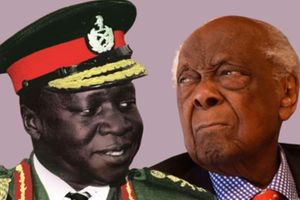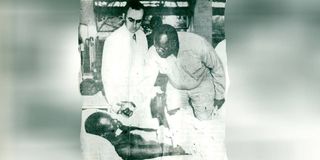
Ugandan President Idi Amin checks on one of his soldiers injured during the Israeli commando raid to free 104 hostages at Entebbe Airport in 1976.

Israel has released a tranche of previously highly restricted files that shed new light on the 1976 Operation Entebbe, with Kenya featuring prominently in minutes of confidential cabinet and security meetings.
Of particular note is the file of the discussions of a small ministerial team formed by the then Israeli Prime Minister Yitzhak Rabin on the day of the hijacking. It features discussions on the role Kenya was to play in the operation and Israel’s attempts to protect Kenya from the ripple effects of the operation as Ugandan President Idi Amin threatened to attack.
The file also contains a letter the Israeli prime minister hurriedly sent to President Jomo Kenyatta on July 3, 1976, as the surprise operation was underway. “To facilitate the operation, our aircraft have to refuel on their way home from Entebbe, at a Kenyan airfield. I trust you will instruct the appropriate people to enable us to do so during this night, since the operation is now underway and our aircraft are already in the air,” Rabin informed Kenyatta.
He added: “I should like to assure you that we shall stand by Kenya with all possible resources in case Kenya will face any outside threats as a result of recent events.”
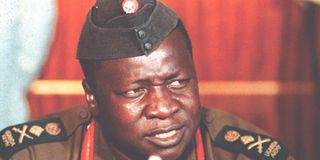
Former Ugandan president Idi Amin Dada.
Entebbe Raid, also known as Operation Thunderbolt, was a daring hostage rescue operation executed by the Israeli elite military units 50 years ago on the night of July 3-4, 1976, at Entebbe Airport, Uganda. It was carried out after members of the Palestinian Popular Front for Liberation and the German Revolutionary Cells hijacked an Air France Flight 139 flying from Tel Aviv. Because of Idi Amin’s personal sympathies for Palestine, hijackers commandeered the plane to Entebbe Airport, Uganda, where they detained the passengers in the airport’s terminal and demanded the release of pro-Palestinian militants in exchange for the hostages. Amin supported the hijackers by deploying Ugandan military around the airport to prevent outside interference, and also visited the hostages to project the image of a mediator.
According to the newly declassified documents, Israeli officials tried to negotiate with Amin, while also weighing military options. The first military option discussed was to parachute Israeli commandos at Kisumu, where they would then use rubber boats to sail across Lake Victoria, storm Entebbe and rescue hostages. Since it was feared the lake was infested with crocodiles, it was decided that a small team should be sent to Kenya to carry out secret reconnaissance of the lake and assess the feasibility of the option. “We are preparing one group, which can fly tonight under the command of Barrack Ehud, and Lt Col Hanina will be with him. We will continue to train the second group here, which will be intended for parachuting.”
While Lt-Gen Ehud Barrack arrived earlier and remained in Nairobi to coordinate the operations, Hanina Amishav Deputy Commander of Israeli Naval Commandos and a colleague were driven to Kisumu in a hired FIAT 127. They were under firm instructions not to talk in English or reveal their nationalities to locals along the lakeshore. What was not known to these scouts was that as they were busy surveying the lake back in Tel-Aviv, Prime Minister Yitzhak Rabin, Minister for Defence Shimon Peres and key planners had grown cold feet about this option after advice from Mossad agents who were already collecting intelligence information in Kenya.
The first reason was that Kenya could not permit such an operation to be carried out from its soil out of fear of reprisal attacks from Uganda. They thought of carrying out the operation from Kisumu without Kenya’s knowledge, but it was feared that this could compromise the entire operation and endanger the lives of those who were to be involved because Kenya had a good security system.
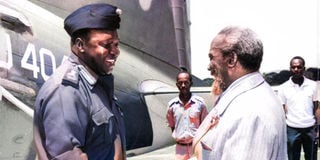
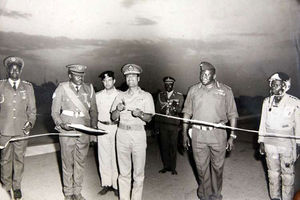
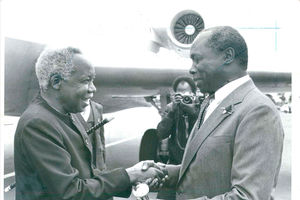
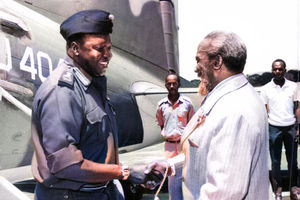
Uganda President Idi Amin is welcomed by President Jomo Kenyatta when he visited the country in the 1970s.
“You have to take into account the danger of being caught in Kenya,” Peres argued, to which he was supported by Rabin, who pointed out that such an operation could create a rift with Kenya if Nairobi came to learn about it. Peres went on, “It is in my assessment that in Kenya there’s a great deal of vigilance. If those 12 of our guys in Kenya are caught for a flat tyre, it will only worsen the situation, for reasons known to this meeting, and there’s no need to repeat it.” Prime Minister Rabin agreed with him and said, “Without coordination with Kenya, I do not suggest doing this,” the documents reveal.
One official was, however, against seeking permission from Kenya, arguing that, “Any coordination with another country pre-empts the matter because secrecy determines success.”
The option of Lake Victoria was subsequently dropped, and Israel decided to conduct an airborne assault by flying covertly to Entebbe and conducting a surprise rescue operation. This was to involve violating Ethiopian and Ugandan airspaces.
On July 3, 1976, in an early morning operational meeting chaired by Prime Minister Rabin and attended by senior Cabinet, military and Mossad officials, the ultra-long-range rescue mission was discussed in detail. After departing Israel, the military planes were to make a discreet stopover in an Israeli settlement in Sharm el-Sheikh, Egypt, to top up their tanks, then fly covertly to Uganda. The only limitation to the plan was that the planes could only carry enough fuel to fly to Uganda, meaning they needed a stopover for refuelling and for medical emergencies on their return journey.
Kenya was suggested as the most convenient refuelling stop, but the officials were not sure whether Kenya would agree. “The matter of refuelling is not in doubt, and therefore permission for landing in Kenya is necessary,” said one senior military official. Contributing to this, Rabin stated, “I don’t know how Kenya will respond to this, since we haven’t asked them directly.”
In response, the senior military officer replied, “The assessment was that if we landed, they wouldn’t bother us.”
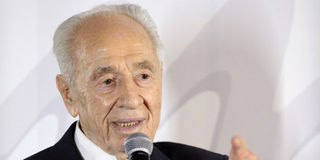
Former Israeli President Shimon Peres speaks at a meeting organised by the association "Le cercle des Medias" in Paris. AFP FILE PHOTO
The final proposal presented by Peres, who later became prime minister, was that two officials should be sent to Kenya to fix the landing issue with some Kenyan officials. “Our proposal is to send Uri and Nikhik to Kenya with the medical team. They will fix it,” Peres said. The two were to travel in a Boeing 707 outfitted as a mobile medical and command centre that was to arrive in Nairobi four hours before the operation to coordinate emergency care and to assist in the refuelling of military transport planes carrying the hostages on their return flight from Entebbe.
However, Rabin insisted the two officials should not reveal to them the nature of the operation. “I don’t want anything to be disclosed to the Kenyans before the operation takes place, because we would endanger it.”
In response, the Israeli Minister for Defence assured him that the two officials had been given firm instructions, “not to describe the operation to the Kenyans no matter what.”
While the Mossad kept in close touch with the power barons in the Kenyatta government, notably Bruce McKenzie who later roped in Charles Njonjo during the planning stage, it seems President Jomo Kenyatta only came to learn about it at the last minute. According to the documents the two officials travelling to Kenya had with them, a letter from Rabin to Mzee Kenyatta, requesting the Kenyan leader to allow Israeli planes to land in Nairobi. To avoid any leakage, they were under firm instructions to deliver the letter only after receiving a confirmation that the operation was underway at Entebbe.
The letter read: “His Excellency Jomo Kenyatta, the President of Kenya, I have requested my envoys to proceed at once to Kenya to bring you personally this message from me. Ever since the hijacking of the Air France aircraft and its arrival in Entebbe, evidence has been pouring in on the direct complicity of President Idi Amin in this barbarous act. We have no doubt that in view of Idi Amin’s past record, there is no sure chance of saving the lives of the innocent hostages, women and children through negotiation. Furthermore, any surrender to terrorist blackmail is certain to lead to further acts of piracy and international terror.
“In view of this we have decided to launch an air rescue operation in the hope of saving the lives of the defenceless hostages now being held at Entebbe airport. It is our intention to carry out the operation with maximum care for human life.
“To facilitate the operation, our aircraft have to refuel on their way home from Entebbe, at a Kenyan airfield. I trust you will instruct the appropriate people to enable us to do so during this night, since the operation is now underway and our aircraft are already in the air. In addition, in the event of casualties, we may need assistance in medical facilities, including possibly hospitalisation.
“Needless to emphasise, as I now write to you, I am now fully aware of this unique statesmanship which you have manifested to the world at large and of your moral stand against threats and terrorism. I should like to assure you that we shall stand by Kenya with all possible resources in case Kenya faces any outside threats as a result of recent events.”
It is probable the message in the letter was delivered verbally to Kenyatta by Njonjo over the phone since the operation was carried out late at night.
Nevertheless, on the night of July 3, 1976, Israeli planes with commandos on board flew extremely low to avoid hostile radar detection, made a surprise landing at Entebbe airport and carried out a daring rescue operation to free hostages after an intense firefight with Ugandan forces. In just an hour, the planes were back in the air, this time cruising towards Kenya where they made a short stopover to refuel and for the injured to receive medical treatment.
Immediately the planes landed in Nairobi, US Secretary of State Henry Kissinger, who had been following the operation keenly with regular updates from Tel-Aviv, instructed the US Ambassador in Nairobi to deliver a special message of appreciation to Mzee Jomo Kenyatta and incase the president was not available, “to (Mbiyu) Koinange or possibly (Charles) Njonjo, whoever has Kenyatta’s absolute confidence and was probably involved in Israel operations.” Kissinger informed Kenyatta: “I have just learned with satisfaction of the rescue of passengers on the Air France flight hijacked earlier this week. I wanted you to know that M. President, should Kenya be in need of support in the days ahead, the United States stands ready to cooperate fully.”
Humiliated by the Israeli operation, Amin accused Nairobi of colluding with Tel-Aviv and threatened to launch a cross-border attack. In one interesting letter which forms part of the declassified documents, he also threatened to attack Israel if it didn’t compensate Uganda for the damage caused during the raid.
“Following the destruction of life and property on 14th July 1976 at Entebbe Airport by Israeli forces, I am sending this message and giving you seven days with effect from tomorrow, 19th August 1976, to inform me whether Israel will compensate Uganda. I wish you to understand that I am not joking like the Arabs who, because of the quarrels among themselves, have lost sight of their enemy and are now killing themselves in Lebanon,” the Ugandan leader told the Israeli prime minister.
He continued, “You should give this matter all the consideration it deserves and communicate by cable to me, Field Marshal Idi Amin Dada, life president of the Republic of Uganda, directly because we reserve the right and are determined to do everything within our power, including shedding our blood in order to pay back. As of now, I cannot tell you how and when we intend to pay back, but it is you to inform me expeditiously and directly whether Israel will compensate Uganda.”
The document also reveals how in the aftermath of the operation, Israel found itself mulling over how to shield Kenya after information started leaking about Nairobi 's role in the operation as Amin threatened to launch attacks. The Israeli feared that if something bad were to happen to Kenya for assisting in the operation, then the Arab countries would capitalise on the situation by pointing out to other countries that there was no benefit in supporting Israel.
Furthermore, Kenya was the only country in Africa that provided Israel's national carrier (El-Al) planes heading to South Africa with landing rights. The Israelis, therefore, feared that if Kenya was to suffer because of its role in the Entebbe raid, then Mzee Kenyatta’s would terminate the landing rights, making it difficult for Israeli passenger planes to reach South Africa.
In this regard, Rabin held a secret meeting with newspaper editors and warned them not to publicise anything about Kenyan involvement in the operation. He went on to tell the editors that Israel only made arrangements with Kenya to refuel planes, and that Kenya knew nothing about the operation.
“If something bad happens to Kenya, the one who will pay the price in the long-run is Israel. I am telling you this in order to maintain your cooperation so that you will not write about it. I believe you in this matter," Rabin told the editors.
In another confidential cabinet meeting, Rabin emphasised the importance of Kenya in Israel’s security goals. This was the time when many African countries, including Kenya, had terminated diplomatic ties with Israel in solidarity with Egypt over the 1973 Yom Kippur war. But even in the absence of diplomatic ties, Kenya was accommodative enough to grant the Israeli permission to land in Nairobi during the Entebbe raid.
Prime Minister Rabin highlighted this kind Kenyan gesture to top government officials by revealing that if he was to choose between Kenya that had no diplomatic ties with Israel and European countries that still maintained diplomatic ties with Israel, then he would choose Kenya as the most important ally.
"Between what Kenya did for us and diplomatic relations, I prefer a hundred times what Kenya did for us," Rabin told his Cabinet. "I know European countries with diplomatic ties with us, but didn't help us during the Yom Kippur War. Compared that to a country that has no diplomatic relations with us but did something vital to Israel by allowing our planes to refuel there."
At this point, one official interrupted Rabin by asking him, "Would the operation have been possible without Kenya?”, to which Rabin replied emphatically, "No, in my opinion it would have been impossible to fly to Entebbe and back without Kenya. "
The crucial assistance Kenya gave to Israel during the Entebbe operation strengthened ties between the two countries, and resulted in the Jewish state recognising Kenya as its strategic ally in East Africa.
Follow our WhatsApp channel for breaking news updates and more stories like this.