Every time I read about Kenya’s pending bills, I remember a file I stumbled upon at the National Archives in Nairobi. It contained correspondence about Jomo Kenyatta’s unpaid accounts: a Mercedes-Benz, cedar poles, roofing tiles, veterinary services and refreshments consumed at Parliament.
In all that, goods had been delivered and services had been rendered. What remained was the delicate business of asking the country’s most powerful man to pay.
More than six decades later, that predicament remains painfully familiar. In January 2026, Parliament reported calls for the settlement of Sh458 billion owed to contractors, suppliers and small enterprises, warning that delayed payments were crippling businesses. In some cases, MPs were being approached by suppliers seeking help to recover their money.
There is something profoundly wrong when a person who has fulfilled a contract must find a politician to help secure payment. Where an obligation becomes a favour, and the creditor becomes a supplicant.
But let me take you back to Kenyatta, though I am not saying that he is to blame for the current predicament facing some traders. His son, Uhuru Kenyatta is to blame, and so is President Ruto.
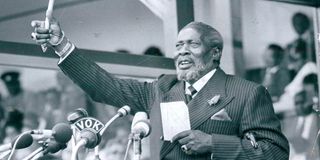
In the early years of Jomo’s leadership, he contacted R.B. Moreton, DT Dobie’s general sales manager, about acquiring a Mercedes-Benz 300SE Long. He had initially ordered a 220SE, but a more luxurious model had caught his attention later.
On December 31, 1963, the company sent a quotation putting the normal Nairobi cost of the 300SE Long at Sh83,046.
“This document is for information of the Prime Minister only to show normal cost of his car in Nairobi,” an accompanying note explained.
Kenyatta wanted some extras for his new vehicle, after all he was a man of taste: leather upholstery, a glass partition, a Becker Mexico radio with a shortwave adapter, an automatic aerial, a rear loudspeaker and air conditioning.
While Jomo knew what he wanted, the difficulty was establishing when the dealer would receive its money. Kenyatta still owed Sh14,000 on the earlier Mercedes, and it seems he was not in a hurry to settle the bill.
On January 3, 1964, DT Dobie proposed that the 220SE be traded in against the new vehicle. When confirmation failed to arrive, the company wrote again.
“We presume that, as we have heard nothing from you, the Prime Minister wishes to keep his Mercedes 220SE and that payment for the Mercedes 300SE will be as per our invoice of December 31, 1963.”
Enclosed was a statement showing the out balance on the previous car. Consider the position of the dealer. It had to interpret Jomo’s silence, establish whether he intended to retain both vehicles and remind his office that the first purchase remained partly unpaid.
The uncertainty, like the unpaid balance, belonged to the supplier. On February 5, the company appealed to Kenyatta’s personal secretary, Ruth Njiiri, the Black American wife of former Kigumo MP, Kariuki Njiiri – the man who vacated his parliamentary seat for Kenyatta to enter the Legislative Council.
“We fully appreciate how busy the Prime Minister must be at this juncture but would be grateful if you could bring this matter to his attention as it is the end of our financial year.”
Kenyatta’s personal secretary, Ruth Njiiri.
Photo credit: File | Nation Media Group
Read that sentence slowly. Before asking for payment, the company acknowledged the importance of the debtor’s other business. Its own financial year could not end without another respectful approach to his office.
Courtesy is normal in commercial correspondence. What makes these letters revealing is the repetition: the reminder, the unanswered approach, the need to find someone who might place the account before the powerful customer.
The dealer had supplied a car and now had to supply patience. And that’s the predicament many traders who do business with politicos or with government encounter.
Elsewhere, Kenyatta’s correspondence was considerably warmer when it was on free things since the PM was not paying for the extras that he wanted for his new Merc.
On February 13, 1964, he thanked Max Egon Becker “for your superb gift of a car radio complete with aerial and loudspeaker”.
“The instrument has excellent performance, and I will treasure it among my most valued possessions,” he wrote.
That same day, he thanked Julius Behr for the air conditioning supplied for the car. “The instrument works perfectly and has proved invaluable in our tropical weather conditions.”
The gifts received gracious acknowledgement. The bills generated further reminders and silence. That contrast does not tell us which demands Kenyatta personally read. It does, however, show an office capable of expressing appreciation for the pleasures of ownership while creditors struggled to obtain a response about its obligations.
Outstanding fee of Sh78,130
On February 28, Moreton spoke directly to Kenyatta. His subsequent letter recorded a total outstanding fee of Sh78,130. It also referred to Kenyatta’s statement that he expected a refund of the Sh12,216 duty paid on the 300SE.
The correspondence does not establish whether the debt was eventually settled. However, we should not turn an incomplete record into a claim that it never was. What it establishes is troubling enough: Kenyatta enjoyed use of the vehicle while the dealer pursued the account.
In January 1964, Ngugi Mbiyu sought Sh1,637 for cedar poles delivered to Kenyatta’s home at Ngando. “The above bill represents 525 cedar poles supplied to your home at Ngando and shown to Mrs Jomo Kenyatta (Wahu),” he wrote.
Here was a supplier carefully documenting his compliance. He identified the goods, their destination and the person to whom they had been shown. He had done what was required of him.
Veterinary surgeon J. Tameno was pursuing Sh120 for treating Kenyatta’s heifers. M. Gonella and Company wanted Sh1,363 for Mangalore tiles and standard ridges delivered on January 20, 1962. Its demand, dated April 27, 1963, came more than a year later.
That last account predates Kenyatta’s premiership. The demands of running a newly independent government cannot explain every unpaid bill.
These might appear to be petty debts when measured against the stature of the debtor. To the people owed, they represented goods, labour, expenses and income. A small account does not become unimportant because the customer is a great man.
A later account involving Cabinet minister Paul Ngei illustrates a more brazen version of that entitlement. Published reports describe how he took a Mercedes from D.T. Dobie, retained it and instructed the dealer to send the bill to the government. The government reportedly declined to pay because the vehicle had been acquired for his personal use. The car was for many years still in Ngei’s Garden Estate home.
Former Cabinet Minister Mr Paul Ngei.
Photo credit: File | Nation Media Group
This is a reported episode, distinct from the correspondence in Kenyatta’s file. But the assumption it describes is unmistakable: the minister could enjoy the car while somebody else sorted out responsibility for paying.
Today, we have cases where those who receive the goods, either personal, county, or national government, can leave those who supplied them carrying the cost.
We call the result “pending bills”, a phrase that sounds almost harmless.
For a supplier who has borrowed to fulfil an order, however, waiting can mean mounting interest, unpaid workers and the prospect of losing property. The government’s delay becomes the business owner’s emergency.
The old letters help us recognise the indignity within that relationship. Ngugi Mbiyu had to explain that his poles had arrived. DT Dobie had to remind the Prime Minister’s office that its financial year was ending. Slade had to suggest that perhaps Kenyatta did not know he owed money for refreshments.
That is the lesson from history: political entitlement grows when the powerful are allowed to treat other people’s rights as requests they may attend to at their convenience.
Kenyatta’s creditors were asking for something modest. The man who commanded national respect should also respect their accounts. The same can be said of the government: The fish rots from the head because the head helps establish what everyone else must tolerate.
And when the leader’s comfort comes before the creditor’s payment, the lesson travels: the powerful enjoy the goods; everybody else learns how politely to ask for their money.
John Kamau is a PhD candidate in History, University of Toronto; Email: [email protected]