With a year left in his first term, President William Ruto ordered foreigners engaged in hawking and small-scale retail trade to close their businesses before clarifying that they were welcome to stay but needed to get their papers in order within 90 days.
Less than two years before Jomo Kenyatta sought re-election in 1969, he intensified a Kenyanisation campaign targeting Asian traders, some of whom he described as “swarms of locusts.”
Both Mzee Kenyatta and Dr Ruto were under re-election pressure and adopted a familiar political script: portray foreign traders as the problem and the President as defender of ordinary Kenyans struggling for space at the lower end of the economy.
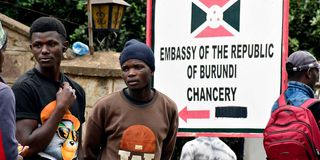
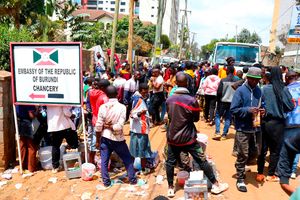
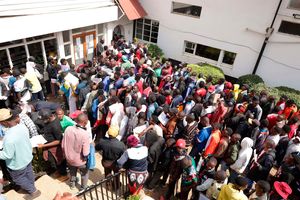
Burundians queue at Nairobi Embassy to register after Ruto order
“We have not built investor confidence so that hawkers can come to Kenya,” Ruto declared. “The investor confidence we have built is for investors to come to Kenya, not hawkers and traders.”
Mzee Kenyatta had drawn much the same line on February 8, 1968. He accused some Asian traders of spreading across the country like “swarms of locusts” and exploiting poor Kenyans. His language was harsher, but the political message was similar: foreigners could invest in Kenya, but should not displace citizens from small trading opportunities.
Within days of Ruto’s remarks, the consequences were visible. Hundreds of Burundians gathered outside their embassy in Nairobi seeking documents to return home. he government moved quickly to contain the fallout and clarified that the directive applied only to foreigners operating without valid work permits and licences, announcing a 90-day period for undocumented East Africans to regularise their status.
Kenyatta, too, had tried to reassure foreigners after issuing his warning.
“Those who despise the people, merely because they are poor and wear tattered clothes, will be told to pack up and go wherever they want,” he said.
Foreigners, he added, were welcome to remain in Kenya, provided they obeyed the law and respected the government and its people. But neither Kenyatta’s assurance nor Ruto’s clarification could recall the original words.
The Trade Licensing Act progressively excluded non-citizens from rural commerce and reserved specified goods for citizen traders. In July 1968, non-citizens trading outside the main urban centres were given six months to wind up. On January 1, 1969, some 3,000 traders, mainly Indians, were ordered to close and hand over their shops to Africans.
The Nairobi City Council withdrew licences held by Asians in the city market. Kenyans of Asian heritage who had lived there all their lives faced uncertainty over whether they could remain or earn a living. By October, a British minister acknowledged a “panic exodus” as some attempted to flee to UK. It is estimated that at least 50,000 Asians left during the first five years of independence, taking capital and commercial expertise with them.
The Kenyanisation Bureau, which operated in the 1960s and 1970s, monitored companies and the labour market, seeking to ensure that foreigners were not employed in jobs Kenyans could perform or be trained to do. Foreign lawyers, except those from Uganda and Tanzania, were barred from practising.
While the new law demanded that all business companies have an African shareholder, Kenyatta denounced Africans who lent their names to businesses secretly controlled by non-citizens as “business prostitutes.”
A Burundian national sits outside the Burundi Embassy with her luggage on September 09, 2026 as she awaits clearance and travel documents to return home following a government directive requiring foreign nationals to regularise their travel documents.
Photo credit: Francis Nderitu | Nation Media Group
Kenya saw the pattern again in 1972, when Idi Amin ordered tens of thousands of Asians to leave Uganda. Nairobi was determined that those expelled should neither settle in Kenya nor linger while in transit. In September, Kenya sealed its border with Uganda to stem the influx.
Vice-President Daniel arap Moi declared that the government would not allow Asian British passport holders from Uganda to “flock into the country,” because Kenya was “not a dumping ground for people from other countries to come and loiter about.”
In 1976, Kenyans targeted Ugandans in Nairobi as relations between the two countries deteriorated sharply after Israel’s Entebbe Airport raid to rescue hostages. In 1985, President Daniel Moi again targeted Ugandan nationals following deteriorating relations between Nairobi and Kampala. He ordered a crackdown on “illegal aliens” and accused them of involvement in crime. More than 2,000 foreigners appeared before Nairobi courts, and more than 600 Ugandans were reportedly deported.
But the community that has endured most discrimination is the Somali, including Somalis who were Kenyan citizens. In November 1989, the Moi government introduced screening that required ethnic Somalis aged over 18 years to report to the authorities and obtain special identification documents. The declared purpose was to identify illegal immigrants.
In practice, it turned citizenship upside down and Somalis were routinely required to prove that they belonged. Protesters in Nairobi’s Eastleigh area demonstrated on November 16, but the President termed the demonstration an insult and said: “By protesting, the illegal aliens of Somali origin wanted to cover up their illegal stay and activities and hence attract undeserved sympathy.”
Some people born in Kenya and carrying Kenyan documents were questioned about their clans, grandparents, language and geographical knowledge before officials decided whether they were citizens. By then, xenophobia had mutated into something even more disturbing: the manufacture of a foreigner from within.
That suspicion survived Moi and, after terrorist attacks linked to Al-Shabaab, Uhuru Kenyatta’s government launched Operation Usalama Watch in 2014. Thousands of police officers were deployed, initially concentrating on Eastleigh and targeting the Somali community.
Human Rights Watch documented arbitrary arrests, detention, extortion and abuse affecting refugees, undocumented migrants and ethnic Somali Kenyans alike. Almost 4,000 people were reportedly arrested during the operation’s early phase.
Two years later, Uhuru Kenyatta ordered the closure of Dadaab refugee camp, which was housing mainly Somalis.
“The decision was difficult,” Uhuru said in his 2016 Madaraka Day address, “but our security, and our national interests, dictated it. Kenya comes first.”
The High Court later quashed the directive, finding that the decision targeting Somali refugees amounted to group persecution and was discriminatory and unconstitutional. The old economic argument returned with Chinese traders.
In 2019, Kenyan traders complained that Chinese nationals had entered Gikomba, Nyamakima and Kamukunji and were competing at the retail level. Then Interior Cabinet Secretary Fred Matiang’i ordered several deported, saying Kenya had no category of foreign investor whose purpose was hawking or petty trade. Those found in Gikomba, he said, would be escorted to the airport to “ensure they take supper in their homes.”
A Burundian national guards her luggage outside the Embassy of Burundi Chancery in Nairobi on September 8, 2026, after joining others seeking to regularise their travel documents.
Photo credit: Evans Habil | Nation Media Group
In February 2023, then Trade Cabinet Secretary Moses Kuria targeted China Square, the Chinese-owned discount store at Kenyatta University’s Unicity Mall. His declaration was that Kenya welcomes Chinese investors “as manufacturers, not traders.”
Kuria said he had asked Kenyatta University’s vice-chancellor to buy out China Square’s lease and hand the premises to traders from Gikomba, Nyamakima, Muthurwa and Eastleigh. He later described the store’s popularity as a “middle-class conspiracy” and argued that Kenya should not become a dumping ground for imported goods. Thus, Kuria was drawing a policy line between the foreign manufacturer, whom Kenya welcomed, and the foreign retailer, whom he regarded as an intruder into economic territory reserved for Kenyans.
Kenya has also practised an internal version of the same politics. During the ethnic clashes of the 1990s, citizens who had lived for decades in parts of the Rift Valley and Coast were labelled “outsiders” and told to return to their supposed ancestral homelands. No international border had been crossed. Yet the vocabulary was recognisably xenophobic: land, jobs and political rights were said to belong first to those claiming to be indigenous.
Seven years later, Ruto has revived essentially the same argument. Governments have a right to regulate immigration, enforce work-permit rules and reserve sectors for citizens. Kenya is entitled to ask whether a person admitted as an investor should operate a stall in direct competition with a Kenyan hawker.
While President Ruto has fashioned himself as an apostle of Pan-Africanism, open borders, continental trade and East African integration, he has forgotten that Burundi belongs to the East African Community, whose central ambition is the freer movement of people, labour, capital, goods and services.
At the moment, Kenya is still more comfortable with a multinational extracting billions in materials than an East African national who sells vegetables, repairs shoes or opens a small shop in Nyamakima. From Kenyatta’s “swarms of locusts”, through the Asian exodus, Moi’s Ugandan crackdown and the Somali screening cards, the targets have changed but the political method has endured. It appears that when the economy fails to provide sufficient opportunity, the state points to an outsider competing for scraps.