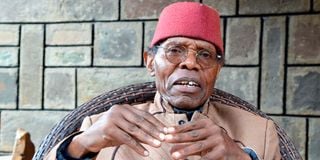
If there is one living politician who can vividly narrate the agony, courage, and unbreakable spirit of Raila Odinga during Kenya’s darkest hours of repression, it is none other than Koigi wa Wamwere – the man who, like Raila, walked through the valley of torture and came out with scars that time could never heal.
At his serene Engashura farm in Bahati, Nakuru County, the ageing freedom fighter’s voice trembled with emotion as he relived the long nights and brutal days they both endured behind bars – men whose only crime was to dream of a freer Kenya.
“It is extremely sad that Raila died with a permanent eye injury he picked up at the Nyayo House torture chamber,” Koigi began, his eyes glistening with grief.
“A policeman hit him with a broken wooden chair during interrogation. That brutal attack left him with a damaged right eye that he carried to his grave – a painful reminder of what Raila endured for this country,” said Koigi.
That one scar, Koigi said, tells the story of a man whose spirit was tested but never broken.
“That eye wound defined Raila – not as a victim, but as a living symbol of Kenya’s second liberation.”
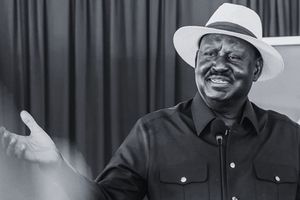
ODM leader Raila Odinga wiping his eye as he addressed journalists at Jaramogi Oginga Odinga Foundation in Nairobi on May 16, 2023
Photo credit: Evans Habil | Nation Media Group
“I also developed permanent eye problems at Kamiti Maximum Prison. They kept us under constant light – twenty-four hours of burning brightness – until, when I looked at the walls, I could only see stars. That is when I started wearing glasses,” he recalled softly, his trembling tone heavy with the shared pain of those years.
In his autobiography The Flame of Freedom, Raila described how officers led by Josiah Kipkurui Rono attacked him with a broken table leg, leaving him bleeding and barely conscious.
Years later, during the 2017 presidential debate, Raila admitted that his eyes often watered because of the damage inflicted upon him – but few ever knew the cruel details behind that pain.
“In detention,” Koigi recalled, “it was terror, torture, dictatorship, and total isolation.”
He remembers how Raila was first held at Kamiti Maximum Prison before being transferred to Naivasha, then to Manyani, Shimo la Tewa, and Hola – prisons synonymous with unspeakable cruelty.
“At Kamiti,” he said, “we reconnected after his return from Naivasha. That reunion was bittersweet. We were broken men, yet unbroken in spirit.”
“Raila told me that if I wanted to survive, I must not misdefine the enemy. He said it’s easy to think the enemy is the prison walls, the guards, or the chains. But the real enemy, he told me, was the system – those who organised it against us. If I failed to see that, I would break before I even realised it.”
He said that in those long, lonely hours of isolation, Raila became not just a fellow detainee, but a philosopher of endurance.
Nyayo House in Nairobi. The building hosted torture chambers in its basement floors.
Photo credit: File | Nation Media Group
“During our fifteen minutes of sunlight each day,” Koigi remembered, “Raila would tell us: ‘Freedom is not given – it is taken. Fear is what the oppressor counts on. If we overcome fear, we will overcome everything.’”
Even in despair, Raila was a source of strength. He refused to break down.
“Detention was impossible to bear,” Koigi said. “But Raila never gave up. He lived on hope that sooner or later, he would triumph – and he did.”
After their release, the two freedom fighters found themselves once again on the run – this time, across borders.
“We chose Norway,” Koigi said, “because we wanted a safe base to continue the second liberation. Uganda was unsafe – the Kenyan government had already begun tracking us. Tanzania and Zimbabwe were difficult to access. But Norway, a country of peace and social democracy, opened its doors.”
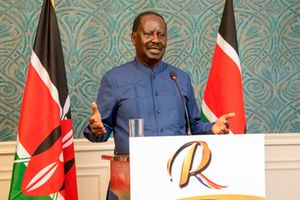
Former Prime Minister Raila Odinga.
Photo credit: File | Nation Media Group
In exile, they learned as much as they healed.
“What impressed me most,” Koigi reflected, “was how social democracy in Norway worked – how it developed the nation while ensuring everyone benefited. Raila admired that model deeply.”
“Raila always said, ‘My brother, I miss my country. No foreign land, however beautiful, can fill that void.’”
Both men were branded radicals, dissidents, enemies of the state – yet their conviction never wavered.
“What kept Raila going,” Koigi said, “was pure love for Kenya. He was not a mercenary. He fought not for power or wealth, but for justice, democracy, and equality.”
He described Raila as “a strategist with long-term goals,” saying his famous handshakes with Presidents Moi, Kibaki, Uhuru, and Ruto were misunderstood by many.
“Short-term manoeuvres to achieve his long-term goal – a peaceful, democratic Kenya. People often misread them, but Raila understood that politics is not just about defiance; it’s also about strategy.”
As the nation mourns, Koigi says he feels a quiet satisfaction watching Raila finally being celebrated on television screens and national tributes.
“When history writes about Raila Odinga, it will praise him for sacrificing himself for the collective good of Kenya. He may not be with us, but his dream, his courage, and his vision will live forever.”
Koigi spoke of their bond that can only be forged in suffering – a brotherhood born not of blood, but of shared pain and purpose.
“We were both prisoners of conscience,” he whispered. “We shared tears, hunger, and fear – but also laughter, songs, and dreams. Raila’s courage rubbed off on all of us. He made us believe that even in chains, the soul can remain free.”
For Koigi, Raila’s story is not one of death, but of legacy – the enduring flame that burns in every Kenyan who believes in justice and democracy.
“Raila is gone,” he said, “but what he stood for will live forever – in books, in memories, and in the spirit of every Kenyan who dares to speak truth to power.”
“Raila died with his scars,” Koigi murmured finally, “but those scars are Kenya’s badges of freedom.”