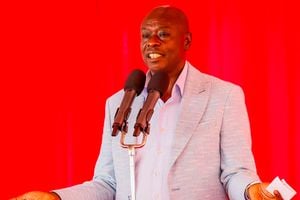
President William Ruto’s tirade over deep-pocketed businesspeople colluding with rogue lawmakers to pass “favourable” laws and policies has reignited the debate on bribery in the National Assembly and Senate.
The President lifted the lid on MPs being turned into puppets of moneyed individuals.
The criticism by Dr Ruto, himself a former MP, puts into question the integrity of the lawmakers, bringing into focus their independence and oversight credibility.
President Ruto said Parliament, including its leadership, is used to sneak amendments into bills – especially at committee stage – which usually end up altering what has been agreed between the Executive and representatives of the business community.
“I must tell you that many Kenya Private Sector Alliance members bribe parliamentary committees. That is the reality. In the process, you short-circuit these engagements with the business community. We end up with skewed legislation, policies and taxes. That eventually distorts everything we are attempting to do,” the President said.
Kuria: I was waving my own money, not Kimunya's
There have been reports of bribery and underhand tactics being part and parcel of Parliament, with even the Executive often on the spotlight for arm-twisting lawmakers to pass the Bills it favours.
In March this year, Makueni Senator Dan Maanzo said he was offered Sh4 million to vote in support of the impeachment of then‑Deputy President Rigathi Gachagua towards the end of last year.
Years ago, controversy rocked Parliament following revelations that lawmakers received envelopes containing Sh10,000 to Sh30,000 to vote against a report that revealed a loss of more than Sh10 billion in sugar-related taxes.
The bribes were aimed at derailing the committee report that had named Cabinet Secretaries responsible for the mega-scandal.
National Assembly Speaker Moses Wetang’ula during the Soy Constituency Women Empowerment Program held at Ziwa in Uasin Gishu County on June 27, 2025.
Photo credit: Jared Nyataya | Nation Media Group
After the Senate voted to throw out an impeachment trial against Isiolo Governor Abdi Guyo on a technicality last month, Senator Fatuma Dullo fell just short of saying her colleagues were given money to defeat the process.
“Before this motion, this House was crying for the blood of the Isiolo governor. We know one another and I know what transpired even 30 minutes ago. It will be good for the people of Isiolo and the public to know what happened. The so-called soko huru (open market) is taking over this House,” the Isiolo senator said.
Bribery allegations rocked the recruitment of the Clerk of the National Assembly in 2022, with Ugenya MP David Ochieng saying one candidate “has bought all members of the Parliamentary Service Commission and has been bragging to other employees that he will bag the job”.
Osoro: We gave Azimio MPs 'soup' to skip Finance Bill vote
“Many staff members who applied for the job have asked me what they should do because one person is said to have bought all the commissioners, including you, Mr Speaker,” Mr Ochieng told the House.
There were allegations of senior parliamentary officials pocketing Sh500,000 to Sh1 million to favour one candidate when Mr Michael Sialai’s term was ending.
“Parliament is an important institution that should not be hiring people on the basis of bribes. The position of the clerk should go to the most competent person who can guide members properly,” the lawmaker added.
In an interview with the Sunday Nation on Tuesday before President Ruto spoke, National Assembly Speaker Moses Wetang’ula denied the bribes-for-Bills claims.
“No one is bribed to pass Bills. This is a House of lobbying. People lobby for their Bills to be passed,” Mr Wetang’ula said.
“If you have a private Bill as a member, it is upon you to lobby other lawmakers to pass it.”
The Sunday Nation did not receive a response to a text message it sent to Ethics and Anti-Corruption Commission Chairperson David Oginde to his known number over the bribery, whether the agency has received such a report and what it is doing.
Parliamentary committees have been rocked with bribery allegations for many years, with those accused being let off the hook.
From the contaminated sugar report, the Ruaraka land saga, the Building Bridges (BBI) report, the 2015 Ababu Namwamba-led Public Accounts Committee to the Mutava Musyimi-chaired Budget and Appropriation Committee, corruption appears not ready to leave Parliament.
In the case of then-Agriculture and Livestock Development Cabinet Secretary Mithika Linturi, there were reports of members of a committee being given Sh5 million each to stop his imminent removal from office.
The bribery claims were made on the floor of the House by Rarieda MP Otiende Amollo, who urged the Speaker to halt consideration of the report tabled until the allegations were investigated.
Rarieda MP Otiende Amollo.
Photo credit: File | Nation Media Group
In 2018, bribery allegations also rocked a Joint Committee of Agriculture and Trade that was investigating the circumstances under which the government allowed uncontrolled importation of sugar the previous year during a duty-free window opened by the National Treasury.
At the heart of the inquiry was how some of the sugar – said to have been toxic and unfit for human consumption, found its way into the country.
It recommended that Mr Henry Rotich, who was the National Treasury CS, Industrialisation CS Adan Mohamed and Agriculture CS Willy Bett be held responsible for the mess.
Parliament rejected the report on the grounds that the joint committee ignored its terms of reference and did not take into consideration witness statements.
There were claims of MPs being bribed to reject the report when it was tabled on the floor of the House.
The issue was then referred to the Committee of Powers and Privileges that was headed by then-Speaker Justin Muturi.
Appearing before the committee, Kimilili MP Didmas Barasa said Ms Fatuma Gedi, who was the Wajir Woman Representative, approached him with an envelope containing Sh10,000 so as to shoot down the report.
“I saw her dishing out as little as Sh10,000. She even attempted to give me the money, but I refused,” Mr Barasa said.
Matayos MP Geoffrey Odanga told the committee that he was approached by then-Kuresoi South MP Joseph Tonui while he was having lunch. He said his colleague told him to go and get the money.
“I was at the restaurant when Mr Tonui approached. He told me to get the Sh20,000 and vote against the report,” Mr Odanga told the committee, adding that he did not take the cash.
In its report, the committee said some members may have been involved in impropriety.
In 2018, another bribery scandal rocked Parliament when four members of the Senate County Public Accounts Committee were accused of demanding Sh100 million from Mr Francis Mburu to write a favourable report on the investigations into the Sh1.5 billion Ruaraka land grab.
The Senate Powers and Privileges Committee took up the matter but did not investigate it fully, saying the affidavits by Mr Mburu were submitted outside the period prescribed.
In its report tabled in the House in November 2018, the committee said Mr Mburu’s affidavits did not contain details that would form adequate grounds for investigations.
“Arising from the foregoing, the Committee is unable to undertake an inquiry on its own motion as envisaged under the provisions of Section 15 (5) of the Parliamentary Powers and Privileges Act. The affidavits, which were filed outside the timelines given by the committee, did not contain details that would form sufficient grounds to warrant such an inquiry, as the allegations were unsubstantiated,” the Senate team said in its report.
In 2021, then-Gatundu South MP Moses Kuria said some of his colleagues received Sh100, 000 to pass a Constitution Amendment Bill, 2020 that was known as BBI.
“These things do not happen on camera, and I don’t expect them to admit it. They take place in the Majority Leader’s office,” Mr Kuria said.
On May 14, 2021, Mr Kuria carried loads of notes and displayed them while on the floor of the House, saying it was the money used to bribe lawmakers to vote for the Bill.
More embarrassing to the House was in 2015 when the Public Accounts Committee, which was chaired by then-Budalang’i MP Namwamba was disbanded after it emerged that members were using their positions to enrich themselves through extortion.
Among the issues that sent the committee home was a claim that Mr Mutea Iringo bribed the members to have his name expunged from a report on corruption during his term as Interior Ministry Principal Secretary.
Mr Iringo was also facing questions over a Sh2.8 billion confidential expenditure under the Office of the President vote in the 2012/2013 financial year.
According to the report of the Powers and Privileges committee that was chaired by then-Kuresoi MP Moses Cheboi, it was established that some members of the Public Accounts Committee breached the privileges accorded to them as MPs.