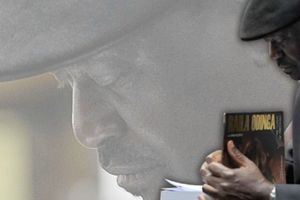
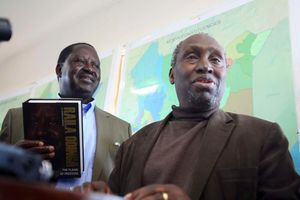
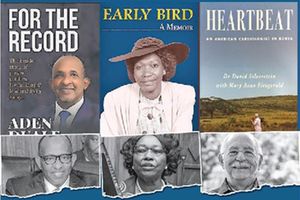
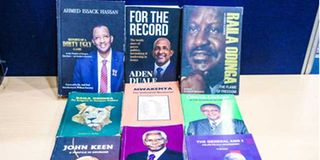
Some of the books released over the years that reveal various details about former Prime Minister Raila Odinga.
In books published so far, a lot of ink has been dedicated to recording interactions with or the story of former Prime Minister Raila Odinga.
We reviewed some, picking threads a reader can use to weave a more complete picture of the man who died on Wednesday.
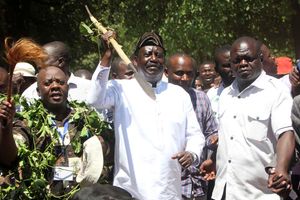
From the autobiography The Flame of Freedom, written with Sarah Elderkin, to his brother Oburu Oginga’s In the Shadow of My Father, one gets doses of the fallen leader’s positive traits.
Former Prime Minister Raila Odinga addresses guests during the launch of his autobiography "The Flame of Freedom" at the Aga-Khan Hall in Kisumu on December 21, 2013.
From Miguna Miguna’s Peeling Back the Mask, to Issack Hassan’s Referee of a Dirty Ugly Game, there is no shortage of critiques about some of Odinga’s decisions over the years.
Odinga and his father died after reconciling with the presidents of the time. In Dr Oginga’s autobiography released in 2021, uncanny similarities between the exits of Odinga and Jaramogi Oginga Odinga emerge.
“During his last days as a legislator, my father had closely worked with President Moi and even invited him to Bondo,” Dr Oginga writes.
However, other books say it wasn’t yet a cordial relationship as was the case with President William Ruto and Odinga. It was just a few years after the return of pluralism and the ruling Kanu party was weary of the opposition.
Jaramogi died in January 1994 aged 83. He headed Ford-Kenya, the official opposition party in Parliament, and was Bondo MP at the time.
He had contested the presidency against Daniel arap Moi in 1992, coming fourth. Jaramogi had been at odds with the Moi government, which had detained his son without trial for years.
Odinga died three years after the 2022 presidential election where he came second. By then, he had closed ranks with President Ruto.
Another similarity between the two deaths is that both men had talked with others on phone up to their final few hours. Dr Oginga writes that on the day Jaramogi died, the old man had rung and asked him to represent him in an East Africa Spectre Board meeting.
Former Prime Minister Raila Odinga signs a copy of his autobiography "The Flame of Freedom" in Nairobi on November 30, 2013.
“He did not sound as if he was very sick,” Dr Oginga writes. He thinks he was probably the last person to talk to his father.
In The Flame of Freedom, Odinga says when he attempted to reach his father by phone that day, he was told that he was being attended to by doctors.
After Odinga’s death was announced on Wednesday, several accounts by his allies said he spoke to some people on the phone up to his last 12 hours.
In The Flame of Freedom, Odinga says his father was diabetic. A doctor confirmed that.
The ODM leader writes that Jaramogi died of heart failure. For Odinga, it was cardiac arrest.
On the day he died, Jaramogi’s body was flown from Aga Khan Hospital, Kisumu, to Lee Funeral Home in Nairobi. That is where his son’s remains were preserved after being flown in from India. Jaramogi’s body was transported from Nairobi by road but Odinga’s was airlifted to Kisumu and Bondo yesterday.
“The government offered a chopper to take Jaramogi’s body home but the family and friends declined. Jaramogi was a man of the people and his body would be taken to its final resting place by road, making it possible for mourners who wanted to pay their last respects to line the highways and towns as the long convoy snaked its way to Kisumu,” Dr Oginga writes.
The cortege made stops in Nakuru and Kericho before entering Nyanza to a grand reception.
Another similarity is that crowds were a big problem at Jaramogi’s burial, just like Odinga’s. On the day of burial, the planners realised that they had grossly underestimated the magnitude of the crowd that would turn up. So big was the crowd that it overran the Kei apple fence in the homestead.
Former Prime Minister Raila Odinga addresses guests during the launch of his autobiography "The Flame of Freedom" at the Aga-Khan Hall in Kisumu on December 21, 2013.
The Flame of Freedom says the government was apprehensive about the crowds that would show up after Jaramogi’s death.
“Authorities had a great fear of the outpouring of support we were likely to receive if we took Jaramogi home by road, and they were determined to prevent this. After all they had put us through, we were determined to make it happen,” Odinga says, adding that on the day the body was taken to Uhuru Park before starting the journey to Nyanza, there were 60,000 faces, shouting, crying and desperately trying to get close to, or even see, the coffin.
It took more than three hours for the cortege to reach Jaramogi’s Lavington home, less than 10 kilometres away, for an overnight stay before heading to Nyanza the following day.
“It was slowed at every step by distressed mourners,” he says.
Moi attended Jaramogi’s burial, and Dr Oginga says in the book that it almost turned chaotic as Mr James Orengo – now the Siaya governor – made a speech that incited the university students. Dr Oginga had to act fast.
“I grabbed the microphone and castigated the students. I informed them that the president was our guest as long as he was in our compound,” he says.
The Flame of Freedom says Jaramogi’s body would have had a lying-in-state at Parliament, just like Odinga’s did on Friday, but the government cancelled the plan.
The government offered to have Jaramogi buried at Parliament Buildings or Uhuru Gardens. The family took up the offer but changed its mind later, settling on Nyamira village, Siaya County.
Senator Oginga’s book says Odinga did not automatically become the Luo kingpin as he faced political battles after his father’s death. Odinga, then the Lang’ata MP, found himself in a Ford-Kenya tug of war. Party leader Kijana Wamalwa wanted to clip Odingas’ wings.
“I discovered that he was advised to keep the Odinga sons as far away as possible from the high table,” writes Dr Oginga.
The book also reveals the naïve dealmaker that was Odinga in his early years in politics, though he quickly learnt the ropes.
In the 2006 book Raila Odinga: An Enigma in Kenyan Politics, Nigerian political scientist Babafemi Badejo says Odinga’s choice of Lang’ata for the 1992 elections was strategic.
“When Raila chose to run in Lang’ata constituency, he was taking a risk. He could easily have sought a secure parliamentary constituency in Luo Nyanza. But he demonstrated that he did not have to rely on ethnicity to serve Kenya. While virtually all Luos could be presumed to have voted for him in Lang’ata, it is safe to assume that he needed more than Luo votes to win. In this respect, he was and remains different from many Kenyan leaders who normally return to the security of their home base to contest elections,” Babafemi writes.
Odinga went on to represent Lang’ata in Parliament until 2013 when the Constitution did away with the requirement that one had to be an MP to be voted in as president. In 1994, he resigned from Ford-K and contested the Lang’ata seat on a National Development Party (NDP) ticket.
In a compliment and subtle critique, former Independent Electoral and Boundaries Commission (IEBC) chairman Ahmed Issack Hassan argued that even when he lost elections, Odinga was too strong in some respects compared to the country’s presidents.
“It was clear the duly-elected president, with all the instruments of power at his disposal, could not contain an opposition politician like Raila,” he writes in Referee of a Dirty Ugly Game.
“How then could an independent constitutional body like the IEBC or its chairperson stand up to this kind of person? I tried and persevered for close to four years but eventually, I had to go. May be I would have fared better if I had a ‘handshake’ of my own with Raila after the 2013 General Election.”
He made the remark while explaining why the winner-takes-all election system did not fit Kenya.
A back-handed compliment came from the explosive Miguna Miguna book Peeling Back the Mask released in 2012 and which sought to expose what it felt like to work with Odinga during and after the 2007 General Election.
Sarah Elderkin says that all the people Mr Miguna Miguna talks about in his book, Peeling Back The Mask: A Quest for Justice in Kenya, were qualified for the jobs. Photo/SALATON NJAU
“The country was mostly with him (Odinga) following the mismanagement of the elections. Even some of the people who hadn’t voted for him on December 27, 2007 now sympathised with him. But he failed to cash in on those credits. He was always well prepared before he went to meetings with Kibaki. Moreover, we constantly reminded him that we were ready to tag along and sit in adjacent rooms, in case he needed technical backup, even if he didn’t want any of us to be present in the room. He never took us up those offers,” Dr Miguna writes.
Dr Francis Muthaura (second right), with his wife Rose (right), together with Public Service Cabinet Secretary Mr Moses Kuria, former Public Service CS Prof Margaret Kobia and Dr Henry Chakava, the chairman of East African Educational Publishers (EAEP), during the launch of Dr Muthaura’s memoir, ‘A Moving Horizon,’ at the Nairobi Serena Hotel, on November 2, 2023.
The 2023 book, A Moving Horizon by Mr Francis Muthaura, one of Kibaki’s aides during the negotiations, says the deal eventually given to Mr Odinga “appeared too generous”.
“When I informed the President that his top team was disappointed by the compromise and that they wanted further consultations with him before the agreement was made public, President Kibaki told me that he had made a deal and that he could not go back on it,” writes Mr Muthaura.
This is the deal that led to the Grand Coalition government, and the provision that Kibaki’s circle disagreed with had provided for 50-50 sharing of the Cabinet, naming Odinga as prime minister, and consulting him on presidential appointments. It, however, was never honoured in its entirety.
Odinga didn’t join the Cabinet when he entered a working arrangement with President Ruto last year. Nor did he do the same when he shook hands with president Uhuru Kenyatta on March 9, 2018.
When NDP merged with Kanu in March 2002, he took up a ministerial position.
Moi Cabinets: Volume II, released by the Kenya Yearbook Editorial Board in 2020, states: “In the lead-up to the 2002 elections, he ditched a fragmented opposition to join Moi’s party, Kanu, in the hope that the President would anoint him as his successor. So, in March 2002, having joined the National Development Party (NDP), he merged with Kanu to form New Kanu.”
“To solemnise the marriage between the two parties, Moi gave Odinga and a few other NDP leaders Cabinet positions. He was appointed Minister for Energy. When Moi eventually revealed his preferred candidate for the New Kanu 2002 presidential contest, it turned out to be Uhuru Kenyatta,” the book says, adding that it led to Odinga’s resignation.
“On resigning from the Cabinet, he accused Moi of reneging on a pact reached when NDP joined Kanu,” the book adds.
More books will contain Odinga’s name, and the more one reads, the more it becomes apparent that he was truly the enigma.
Follow our WhatsApp channel for breaking news updates and more stories like this.