In political nomenclature, there is a tendency to conflate dissent with the political opposition. Political opposition, properly so-called, connotes a clash of oppositional and dialectical political formations driven by contrasting ideologies.
In mature polities, we have the Left and the Right as opposites, oil and vinegar in politics. The twain shall never mix. Nor is one a dumb copy of the other. The two, on most policy issues, are like night and day – two ships passing in the night.
That’s not to say they may not be united on certain national interests on which elites have formed a consensus. Americans say, for example, that partisan politics end at the shores edge. What’s the real difference?
In my view, a dissenter is essentially a refusenik, someone who refuses to abide by, or comply with, a societal norm or law. A group of dissenters might be organised into a cabal of refuseniks, but a political opposition they may not be.
A political opposition is built on tradition and philosophy about governance and the economic blueprint of a country. It’s not perforce something that’s whimsical, or fleeting.
It may be intellectually dynamic but it’s not a trivial musing of the politically ignorant. It requires an understanding of political party philosophy and why one party is different, or not, from another. Democracy requires this clarity of thought in theory and practice so that the electorate, the citizenry, can have a clear choice at the ballot.
Political party affiliations can be a do-or-die affairs. In the US, for example, a Democrat is largely ideologically different from a Republican. Nor would you expect a Democrat to easily become a Republican. They may cross party lines to vote for candidates of the opposite party, but that doesn’t mean the leopard has changed its spots.
I disagree with those who say Republicans aren’t different from Democrats because they all moored in the “Empire.” Nothing could be further from the truth. Just look at how different Donald Trump is miles apart from Joe Biden, or even how Bill Clinton was different from George W. Bush. The difference isn’t just on economic policy. They were oceans apart.
Which now brings me to Kenya, the “Pride of Africa.” At independence, there were two distinct nascent political tendencies. I call them tendencies because they didn’t get a chance to calcify. KANU — the nationalist party of the Jomo Kenyatta/Tom Mboya/Jaramogi Oginga Odinga axis, versus KADU — the alliance of Daniel Moi/Ronald Ngala/Masinde Muliro that was a favourite of the remnant colonial white settlers.
There was also APP that Paul Ngei founded after falling out with Mboya and Kenyatta, only later to reunite. My point is KADU and KANU were ideologically distinct, although that distinction was eviscerated when KADU was swallowed up by KANU. The only ideological difference was under KANU where Jaramogi Oginga Odinga, a social democrat, exited to form Kenya Peoples Union (KPU). Mzee Kenyatta crushed KPU shortly thereafter.
KPU and later Raila Odinga’s ODM came closest to the social democratic vision of parties of the political Left in the West. KANU, originally a nationalist party with pretensions of social justice, veered decidedly to the right towards an unapologetic market economy with an authoritarian government disdainful of democracy and popular will. It ruled with an iron fist with an unabashed tribal elite from Mt Kenya and later the Rift Valley.
Seen from this lens, I easily conclude that Kenya’s politics haven’t been governed by ideological political parties for the most part. And where they have, their manifestoes haven’t differed much. For example, both the UDA and ODM manifestoes for the 2022 elections are eerily similar and in sync on major economic and governance issues.
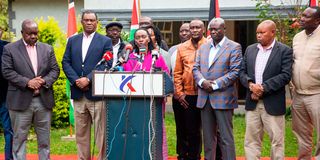
The Wiper Party of Kalonzo Musyoka doesn’t depart materially from ODM and UDA. This begs the question – what are these parties fighting for? Is it a struggle for power devoid of any ideological departures? Democracy for the Citizens Party (DCP), formed by disgraced ex-Deputy President Rigathi Gachagua , is itself indistinguishable from the others. So, why is he so bitter? What would he do differently were he in power? Is the struggle of the so-called United Opposition an attempt at a power grab without any superior moral or ideological anchor that’s different?
Haven’t these leaders been in power before? What did they do that was different so the people can believe their protestations against the current administration? It’s a fact that they have spent decades in government with nothing to show for it.
Those in the United Opposition are anything but opposition. They are dissenters who seek raw power without an iota of an idea of what they would do better. Often, their rhetoric attempts to soar, but when you listen carefully to their cadence you realise that they are snake oil salesmen. They are angry dissenters simply because they are out – out of power, and out in the cold, unable to reach the feeding trough.
Makau Mutua is SUNY Distinguished Professor and Margaret W. Wong Professor at Buffalo Law School, The State University of New York. He’s Senior Advisor on Constitutional Affairs to President William Ruto; @makaumutua.