Government agencies are facing a trail of court-ordered payments, compensation claims and disputed liabilities arising from decisions made in public business.
The cases range from police arrests and immigration actions to land allocations, road works, procurement, county debts and contracts involving State agencies.
A review of the cases reveals a less visible cost of government: the billions taxpayers may have to pay when public decisions are found unlawful, flawed or improperly executed.
Court records show compensation awards, salary arrears, contractual liabilities and refunds running into millions of shillings against ministries, police, counties and State corporations.
The cases cover wrongful arrests, extradition, detention, rendition, torture, unlawful dismissals, land administration, procurement and contracts.
Immigration and national-security decisions have imposed some significant costs on taxpayers in recent times. One of the clearest recent examples is Nigerian separatist leader Nnamdi Kanu, whose 2021 abduction and rendition from Nairobi became a direct financial liability for the State.
Nigeria’s Nnamdi Kanu, the fugitive secessionist leader of the proscribed Indigenous People of Biafra.
Photo credit: Courtesy
In June 2025, the High Court awarded Mr Kanu Sh10 million in general damages after finding that he was abducted, held incommunicado, tortured and subjected to inhuman and degrading conditions for eight days before being taken to Nigeria.
The court found that Mr Kanu was taken from Kenya without lawful extradition proceedings, held incommunicado and subjected to treatment that violated his constitutional rights. The Attorney-General was ordered to pay the damages, together with interest and costs.
The case is significant because the financial award followed a decision involving the State's handling of a foreign national rather than an ordinary immigration dispute.
Police and human-rights violations
In March 2026 the High Court ordered the police and the Attorney-General to pay Sh35.4 million to 28 victims and families affected by police operations during the 2023 Azimio protests. Justice Alfred Mabeya found violations arising from killings, shootings, assaults and torture in Kisumu, Migori and Ahero, with individual awards determined by the nature and severity of the harm suffered.
In another recent police-brutality case, the High Court awarded former JKUAT student Allan Omondi Sh8 million after finding that officers assaulted and unlawfully detained him during student unrest in 2019.
Justice Patricia Nyaundi found that the police violated his rights by subjecting him to cruel, inhuman and degrading treatment, adding another substantial compensation bill arising from police conduct during demonstrations.
Allan Omondi, who was allegedly attacked by police officers near Jomo Kenyatta University of Agriculture and Technology during 2019 protests as he walked to the hostels.
Photo credit: File | Nation Media Group
This week, the High Court awarded social media user and IT expert Ndiang’ui Kinyagia Sh5 million after finding that police unlawfully raided his home in Kinoo, searched the premises and seized his property during an investigation in June 2025.
Justice Nyaundi found that the Directorate of Criminal Investigations police had failed to establish a lawful basis for the warrantless search and held that the raid violated Mr Kinyagia’s constitutional rights.
State reparations for protest abuses
The government has separately begun paying compensation to victims of protest-related human-rights violations.
The payments cover deaths, serious and moderate injuries and other documented violations dating from 2013 to 2025.
The reparations programme could ultimately create a much larger public bill, with the government setting aside Sh2 billion for victims of protest-related rights abuses. The framework covers compensation and other forms of redress and therefore provides another measure of the financial consequences of State conduct.
The Senate is fighting a Sh50 million damages awarded to former Deputy President Rigathi Gachagua for violations of his constitutional rights during the impeachment proceedings.
Former Deputy President Rigathi Gachagua at Milimani Law Courts in Nairobi on May 13, 2026.
Photo credit: Billy Ogada | Nation Media Group
The three-judge bench upheld the impeachment itself but found that aspects of the process violated his right to a fair hearing.
Police and security liabilities
Another case involved Mr Michael Rubia who was awarded Sh17 million for unlawful detention and violations of constitutional rights.
In the June 2020 judgment, the High Court found that police unlawfully detained him for five days in 1987 and again for nine months from July 1990 to April 1991, subjected him to torture and inhuman treatment that contributed to serious health complications requiring treatment in London. It also awarded Sh226, 200 and £68,980.84 for medical treatment and accommodation in London.
Six former multi-party democracy detainees were also awarded Sh2.5 million each by the Supreme Court, upholding findings that State agents had violated their rights through unlawful detention and mistreatment, with the Government also ordered to bear the costs of the litigation.
Their case arose from their decision to join a hunger strike at Nairobi’s “Freedom Corner” in Uhuru Park in February 1992 to demand the release of political prisoners. The Supreme Court in January 2023 found that police and GSU officers violently attacked the protesters, subjected them to repeated assaults during their protest at All Saints Cathedral, and violated their freedom from inhuman treatment.
The Supreme Court's decision followed years of litigation over abuses committed during the single-party era and reaffirmed that compensation can follow even when the violations occurred under a previous constitutional order.
Another long-running case involved 1982 coup detainees. The Court of Appeal upheld awards to 284 former Kenya Air Force personnel who suffered unlawful dismissal, detention and torture.
The trial court had awarded aggravated damages of Sh1 million to each claimant, together with salary arrears, pension and other benefits. The aggregate computation was Sh6.25 billion, and the Court of Appeal upheld the awards.
The State has also faced compensation after police killings. In the case of Pakistani journalist Arshad Sharif, the High Court on July 8, 2024 found that police officers unlawfully shot and killed him at a roadblock in Kajiado on October 23, 2022, after officers fired at his vehicle in what police had described as a case of mistaken identity.
The late Pakistani journalist Arshad Sharif. He was shot dead at a police roadblock on the Nairobi-Magadi road.
Photo credit: File | AFP
The court awarded his widow, Javeria Siddique, Sh10 million in general damages, while directing the State to conduct a proper investigation into the circumstances of his death.
The cost of police operations is also reflected in the case of Ndunda Ndolo, who told the court that he was assaulted by an assistant chief and a police officer at Mbiuni Police Post after his son was accused of cutting trees on a neighbour’s farm.
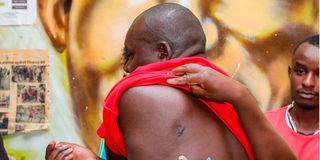
He suffered serious injuries to his back, hands and scrotum, later underwent surgery for a scrotal injury, and the High Court in its April 11, 2024 judgment awarded him Sh3 million for violations of his constitutional rights.
Sheila Hawa, a survivor of police brutality during the 2024 anti-government demonstrations, recounts her story during a press briefing at Mathare Social Justice Center in Nairobi on June 21, 2026.
Photo credit: Lucy Wanjiru | Nation Media Group
The courts have also put a price on more recent police actions. In Muslim for Human Rights' case over the killing of Omar Faraj, the High Court found that police officers unlawfully shot him inside his Mombasa home during an operation targeting a suspected terrorism suspect. The court found that the officers had invaded the home without a warrant and that the shooting was unjustified.
In its March 19, 2024 judgment, the court awarded Sh5 million in general damages and Sh1.5 million in exemplary damages, plus interest and costs. It declared that Faraj's “right to life” had been violated through his “unlawful killing through unjustifiable and unlawful shooting.”
The cases remain one of the clearest recent examples of how police conduct can result in a direct compensation order against the State.
Similarly, in a 2025 petition by seven petitioners against the Inspector-General of Police and other State officials, the petitioners sought Sh6.4 million in special damages arising from alleged wrongful arrest and detention.
The State has also continued being punished for abuses dating back decades. Peter Tonny Wambua and 17 others sued over their arrest, detention and torture following the attempted coup of August 1, 1982.
In a July 26, 2017 judgment, the High Court found that the circumstances of their arrest, detention and torture breached their rights under the repealed Constitution. It awarded 17 surviving petitioners between Sh650,000 and Sh6.1 million each, including Sh5.2 million to Wambua and Sh6.1 million to George Ondieki.
The court expressly declared that the treatment of the petitioners “constituted a breach of their rights”, bringing a financial consequence to abuses committed more than three decades earlier.
The financial consequences have been even larger in some cases involving political detention. In former Imenti Central MP Gitobu Imanyara's case, the Supreme Court in February 2022 enhanced the compensation payable to three former detainees to Sh60 million, after finding that State agencies had violated their rights through arrest, detention and mistreatment.
The award illustrates how constitutional claims arising from earlier State abuses can produce substantial liabilities many years after the events.
A similar case involving former military officer Peter Kariuki also resulted in a substantial State liability. The courts found that his constitutional rights had been violated during his detention and subsequent dismissal from the military, resulting in Sh15 million in constitutional damages and Sh22.9 million in salary arrears and related benefits.
The bills extend beyond policing. In the Kenya Railways dispute involving Johannes Akello Omboto, armed police officers demolished a perimeter wall on property occupied by the petitioners in Kisumu in August 2019.
The Environment and Land Court awarded him Sh5 million for violation of constitutional rights and Sh473,974 a month for lost rental income from August 14, 2019, until judgment.
The Court of Appeal upheld the award in March 2025, finding no reason to interfere with the damages. It noted that the property had been demolished without proper notice or compensation and that the appellant had not shown why the damages should be disturbed.
The National Police Service and National Police Service Commission have also been ordered to pay former police officer Naomi Wambui Sh4.36 million after failing to settle a constitutional damages award.
The original judgment awarded her Sh4 million after finding violations during the police vetting process, while the subsequent enforcement proceedings increased the amount through interest and costs and exposed the additional expense incurred when public agencies delay complying with court orders.
Procurement and contracts
Procurement failures have also produced another category of liability. In the Micro-City Computers and NSSF dispute, NSSF awarded Micro-City a contract to design and install CCTV and access-control systems, then withdrew after saying it faced budgetary constraints. The High Court initially awarded the company Sh16 million.
The Court of Appeal changed that figure substantially in April 2024. It awarded Sh103.4 million for anticipated profits and Sh9 million in tender preparation and consultancy costs, bringing the special-damages award to Sh112.5 million, while setting aside the earlier Sh10 million general-damages award.
The appellate court's decision made the case particularly important for the project because the liability arose after a public institution entered into a contract and later cited budgetary constraints for withdrawing from it.
Procurement decisions have produced another category of liability. At the Kenyatta International Convention Centre, a contractor challenged the cancellation of a tender for a proposed exhibition centre and secured a Sh39.9 million award from the High Court.
The judge found that KICC's termination of the tender award was arbitrary and lacked transparency, saying its conduct “does not demonstrate transparency or accountability in the handling of the procurement.”
The cancelled project was worth Sh799 million and that the contractor had provided a Sh39.95 million performance guarantee.
At the county level, John Mburu's long-running dispute with the Mombasa County Government concerned unpaid legal fees and the enforcement of a decree against the county.
A 2025 High Court judgment recorded that the existence of the decree was not contested, illustrating how an unpaid public obligation can remain enforceable years after the original dispute.