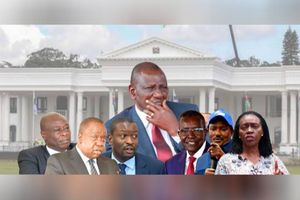
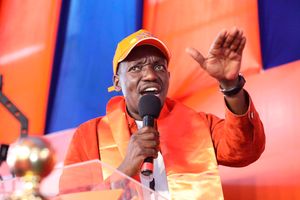
About a year to the 2027 General Election, President William Ruto is facing an increasingly delicate political balancing act as succession politics, regional rivalries and competing ambitions begin spilling into the open within his own Kenya Kwanza administration.
While the President continues to rally allies around his re-election bid, a series of public disagreements among senior government officials and ruling party politicians has exposed growing fault lines over internal strategies.
The debate has also snowballed into who should inherit political influence after Dr Ruto completes his constitutionally permitted second term in 2032—a battle that some have started years before that.
The disagreements, playing out particularly in vote-rich Mt Kenya, Dr Ruto's Rift Valley backyard, Western Kenya and the Coast region have transformed what was once whispered succession talk into an open contest even involving Cabinet Secretaries and influential political operatives.
Public Service Cabinet Secretary Geoffrey Ruku, whose remarks advocating for a political separation between Mt Kenya East and Mt Kenya West have triggered a storm, including unusual public rebukes from a fellow Cabinet colleague and even Deputy President Kithure Kindiki.
The debate has laid bare the competing calculations within Kenya Kwanza as leaders attempt to position themselves and their regions for the president’s re-election in 2027 and the post-Ruto era.
The latest tensions began after Mr Ruku argued that Mt Kenya East —Embu, Meru and Tharaka Nithi — should stop depending on support from Mt Kenya West (Central Kenya) and instead consolidate its own political strength behind Prof Kindiki.
The Cabinet Secretary has argued that the approximately two million votes from Mt Kenya East were sufficient to guarantee President Ruto's re-election without relying on the larger Mt Kenya West voting bloc.
He went further, outlining what he described as the region's long-term political roadmap.
Mr Ruku added that after helping President Ruto secure another five-year term, leaders from the eastern side of Mt Kenya should immediately embark on positioning Prof Kindiki for the presidency.
"In 2028, we shall have begun the journey of Kithure Kindiki becoming the President of Kenya because we also need to be on the resource-sharing side, not always on the receiving side," Mr Ruku quipped.
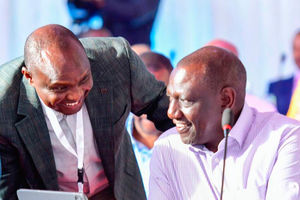
President William Ruto chats with Public Service CS Geoffrey Ruku at Runyenjes town in Embu County on April 4, 2025 during his tour of Mt Kenya region.
Photo credit: Joseph Kanyi | Nation Media Group
The remarks immediately generated political controversy, with critics accusing the Cabinet Secretary of promoting divisions in a region whose political bargaining power has traditionally depended on voting as one bloc.
The first public rebuttal came from Lands Cabinet Secretary Alice Wahome, herself one of President Ruto's key political allies in Mt Kenya.
Ms Wahome dismissed attempts to redraw political boundaries within the mountain region, arguing that such messaging directly contradicts President Ruto's repeated calls for national unity.
"If we now take a community and start subdividing the community, we are not building in the direction the Head of State has taken in this country of uniting the country irrespective of the region that opposed him," she said in one of her public events in Machakos County.
The disagreement deepened when DP Kindiki equally publicly rejected calls for the Mt Kenya region to be split into separate eastern and western political formations.
"I don't want our people to speak in different languages," he said. "We have done many things together; we have a long history and there is nothing that can divide us. As the Deputy President, I will ensure that the Mountain remains united."
The Deputy President simultaneously renewed his appeal for the region to remain firmly behind President Ruto in 2027.
According to Prof Kindiki, supporting President Ruto's re-election offers Mt Kenya its clearest path to producing Kenya's next president in 2032.
"I want us to have an honest conversation with our people. After William Ruto, it’s us."
Prof Kindiki has used a football analogy to explain why the region should rally behind him for the future.
"Like in football, the striker who is in front of goal receives the ball and scores. After President Ruto, I am the best-placed person to take over."
Even as Mt Kenya leaders publicly differ over strategy, President Ruto's own Rift Valley backyard is experiencing growing political turbulence.
The region, regarded as the President's political fortress, has increasingly become the scene of competing political camps preparing for life after 2032.
Although officially united behind President Ruto's re-election, influential leaders have quietly begun building separate political networks.
Deputy President Kithure Kindiki addresses about 20,000 grassroots leaders from the region at Nembure Stadium in Embu County.
Photo credit: DPCS
Political observers point to an emerging rivalry involving Interior Cabinet Secretary Kipchumba Murkomen and Head of Public Service Felix Koskei, with reports of growing tension between allies of the two senior officials.
Although neither has publicly acknowledged any fallout, their supporters are increasingly associated with rival political camps across the region, with Nandi Senator leading the tirade against Mr Murkomen.
Mr Koskei has been instrumental in mobilising the region to rally behind the President, including during the recent installation of Augustine Kisorio as Chairman of Nandi Kaburwo council of elders.
"The war ahead of the elections is no ordinary fight. We are at the forefront and you need to arm yourselves with your weapons to the last eligible person: the national Identification card and voters card," said Mr Koskei during the occasion at Baraton, Nandi County.
The rivalry comes amid broader succession contests involving Uasin Gishu Governor Jonathan Bii, Senator Jackson Mandago, Kapsaret MP Oscar Sudi, Soy MP David Kiplagat and several senators.
Mr Sudi had defended Governor Bii' performance and told off his critics led by Senator Mandago and his allies and asked the electorates to evaluate the leaders by their track records.
"They have branded me and my Governor Chelilim as Team A and they are Team B but I want you people to evaluate us and determine which team is delivering to you," said Mr Sudi.
However, the Soy MP has called for ceasefire over the 2032 succession politics so that all attention is directed towards the re-election of president Ruto.
"We need to put our political rivalry aside and focus on how to win the next General Elections and ensure President Ruto is re-elected. We shall deal with succession politics after 2029," said Mr Kiplagat during the installation of Mzee Kisorio.
The competition has already generated public exchanges over development, political loyalty and control of local political structures.
In Uasin Gishu, the rivalry between Governor Bii and Senator Mandago has evolved beyond county development into a contest over who commands greater political influence in the President's backyard.
Senator Jackson Mandago (left), Deputy Governor John Barorot (centre) and Governor Jonathan Bii (right) address journalists at Eldoret Sports Club on July 29, 2023.
Mr Mandago has repeatedly criticised Governor Bii over delayed completion of flagship infrastructure projects initiated during his own tenure as governor.
"I purchased modern machinery for roads-earth movers and graders while I was in office but are now grounded. Why are you spending over Sh600 million contracting NYS to fix road infrastructure while you have machineries? The MCAs need to play their oversight role well and ensure this administration delivers," said Mr Mandago.
Governor Bii has responded by accusing some of his critics of pursuing personal political interests while questioning their commitment to President Ruto's re-election.
"I will not be dragged into the political blame game. Senator Mandago should not interfering with my leadership and account for the ghost projects he initiated during his tenure," said Governor Bii' in previous forums noting that is focus was re-election of president Ruto for a second term and not 2032 succession politics.
He has repeatedly urged residents to judge him based on development rather than political propaganda.
Political analyst Joseph Kemboi argues that the public exchanges reflect early succession campaigns disguised as governance debates.
"What is happening is early campaigning disguised as oversight. The accusations boil down to who rules supreme in Rift Valley politics."
Another analyst, Mathew Sang, says rival leaders are quietly building alternative political networks ahead of the next electoral cycle.
Mr Koskei, the Head of Public Service, has also found himself drawn into succession politics after sections of leaders in Nandi accused him of using his office to influence local political contests.
The allegations, which he has not publicly addressed, have added another layer to the growing political contest in Rift Valley.
President William Ruto chats with Head of Public Service Felix Koskei at a past event.
Photo credit: File
Earlier this year, President Ruto's aide Farouk Kibet publicly declared that Western Kenya should produce the next president after Dr Ruto leaves office.
Speaking in Kakamega County, Mr Kibet endorsed Prime Cabinet Secretary Musalia Mudavadi and National Assembly Speaker Moses Wetang'ula as the region's preferred presidential candidates.
"We want the next president after Ruto to be a Luhya," he declared.
However, leaders from Western quickly differed over the proposal, with some arguing the region should not wait until 2032, while others backed the long-term arrangement.
Dr Oburu Oginga-led ODM has also introduced a different challenge from within President Ruto's broad-based arrangement.
Senior ODM leaders have publicly declared that the deputy presidency should now belong to their party if cooperation with UDA is to continue beyond the next election.
ODM co-deputy party leader Simba Arati says that if President Ruto seeks re-election on a UDA ticket, ODM should produce his running mate.
National Assembly Minority Leader Junet Mohamed has gone further, describing the position as a condition for sustaining the partnership between the two parties.
The party has floated several possible candidates, including Cabinet Secretaries Wycliffe Oparanya and Hassan Joho as well as ODM National Chairperson Gladys Wanga.
“I have not thought about it. That office already has someone I respect who is doing a very good job. I think it is premature to talk about it,” Mr Oparanya told the Nation.
He argues that ODM was yet to hold official discussions on the matter, even as he faces stiff opposition from Dr Ruto’s Western campaign team led by Bungoma Governor Ken Lusaka, who favour Prof Kindiki.
ODM party leader Dr Oburu Oginga.
Photo credit: Pool
But even as ODM positions Mr Oparanya as its preferred candidate for the DP’s post, the emergence of former ODM Secretary-General Edwin Sifuna as a potential presidential candidate has added pressure on Luhya leaders.
It now leaves Mr Oparanya, Mr Mudavadi and Mr Wetang’ula facing a delicate political balancing act as they seek to secure and deliver the region’s support to the Ruto side in 2027.
At the Coast, Dr Ruto’s allies have also experienced what analysts have described as “dangerous friendly fires.”
UDA Secretary General Hassan Omar has dismissed the push by some Coast leaders to throw their weight behind Mr Joho for the DP post in 2027, arguing that; “there is no way we can replace a whole Professor,” with the Mining Cabinet Secretary.
Mr Omar has also criticised ODM’s push for zoning, saying the party must be ready to face its opponents at the ballot, further straining the relationship among broad based partners in the region.
“I’m telling our broad-based brothers and sisters to be ready to face off at the ballot. They should mobilize their supporters as we have already started,” he said.
United Democratic Alliance (UDA) secretary general Hassan Omar speaks to the media in Nairobi on May 19, 2026.
Photo credit: Bonface Bogita | Nation Media Group
For President Ruto, political analysts say, the emerging rivalries, especially in Mt Kenya, Rift Valley, Western and Coast, present a complicated political challenge.
On the one hand, succession debates energise allies and reassure regions hoping to benefit after 2032. On the other, they risk fuelling divisions at a time when the President wants his coalition singularly focused on securing victory in 2027.
Political analyst Prof Gitile Naituli argues that attempts to divide Mt Kenya could ultimately weaken DP Kindiki's own presidential ambitions.
"If you want to contest any national office in Kenya, nobody will take you seriously if you have not consolidated your own base," he says.
According to Prof Naituli, eastern and western Mt Kenya remain socially, economically and politically intertwined, making any attempt to separate them politically both impractical and counterproductive.
President Ruto's allies however, insist that all political activity remains geared towards one objective of winning the 2027 election.
Yet despite the public declarations of unity, regional leaders are already positioning themselves for the contest that follows.
Political analyst John Anditi argues that the challenge for the President will be to prevent “the competing ambitions from hardening into rival factions capable of weakening Kenya Kwanza's electoral machine before voters go to the polls next year”.
He adds that as the countdown to 2027 gathers momentum, the greatest threat to President Ruto may not come solely from an increasingly organised opposition, but from managing the competing ambitions of allies already looking beyond his presidency.