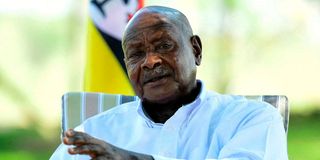
Last week’s re-election of Yoweri Museveni to his seventh term as Uganda’s president was unsurprising. Museveni had a massive upper hand over his harassed, curtailed and cornered competitor, Robert Kyagulanyi, better known as Bobi Wine. One gets the sense that Kenyans, from the citizenry to official levels, had long concluded that Museveni would extend his rule beyond the forty-year mark.
President Yoweri Museveni.
Photo credit: File | Nation Media Group
Museveni’s longevity in power sustains old patterns of relations with Kenya, while introducing new scenarios. The idealistic Museveni of the 1980s, 1990s and 2000s has given way to Museveni the realist of the 2010s and 2020s.
For instance, it is unlikely that Museveni, at 81, will be vociferous in pushing for an East African political federation, as he was when he became president at 41.
At any rate, Museveni and the elite in Uganda must have long realised that their political system is quite different from that of Kenya. What with the changes in leadership in Kenya every ten years! Ugandans have now internalised the fact that Museveni is president for life. Kenya’s competitive politics mean that every president must campaign hard to be re-elected.
Uganda's President and the leader of the ruling National Resistance Movement (NRM) party, Yoweri Museveni, casts his vote during the general election, at Kaaro Secondary School in Rwakitura, Kiruhura district, Uganda January 15, 2026.
Photo credit: REUTERS/Stringer
The possibility of a one-term presidency is not far-fetched, as we have seen in the last four elections. Many believe Uganda is an autocracy and Kenya a democracy, imperfect as it is. Based on this alone, a political union that includes Kenya and Uganda is quite improbable. Museveni must be alive to this.
Influence electoral processes
For the same reasons, it is unlikely that Museveni will seek to influence electoral processes in Kenya, including the 2027 poll — at least not directly. Some may argue that this hypothesis is erroneous, given recent developments. For instance, in February, officials from President William Ruto’s United Democratic Alliance (UDA) party visited Uganda on a learning mission with Uganda’s governing party, the National Resistance Movement (NRM). In May, it was the turn of NRM officials to visit their UDA counterparts and government officials. While the exchanges are a form of pact between Museveni’s NRM and Ruto’s UDA, do they also constitute an outright endorsement of Ruto’s second-term bid?
Well, not quite. One has to consider the fact that Museveni has been pragmatic in hedging between Kenyan presidential candidates and parties. He has embraced Kenyan leaders fully after they win elections and settle in as presidents, not before.
Even in the case of Raila Odinga, Museveni did not go full throttle to campaign against him in any of the elections he contested. Odinga was Museveni’s chief rival in regional supremacy. They enjoyed a chequered relationship. Instead, Museveni always waited in the wings and only forged relations with Mwai Kibaki, Uhuru Kenyatta and William Ruto after they had won their respective elections.
Indeed, in the lead-up to Kenya’s 2022 elections, the NRM stridently denied insinuations that it was supporting Ruto against Odinga. If Museveni favours Ruto over competitors in the 2027 elections, he will not openly show his hand. Should he openly support Ruto, he will suffer attacks from the Kenyan opposition, thus denting his elder statesman ambitions.
A clear scenario is that Uganda will rely on Kenyan leaders when Museveni’s leadership at home is under threat. The most explicit example is the abduction and rendition from Kenya of his political nemesis, Kizza Besigye, and his aide, Hajj Obeid Lutale, in late 2024. In July 2024, a number of Ugandans affiliated with the Forum for Democratic Change were seized in Kisumu and spirited to Kampala, where they were charged with terrorism offences.
President Yoweri Museveni during his inauguration for a sixth term on May 12, 2021.
Photo credit: File
Indeed, any Ugandan opposition figures or human rights activists who attempt to organise against Museveni and the National Resistance Movement from Kenyan soil will have to think twice. Not only will Uganda’s security forces target critics operating from Kenya, but they will coordinate with their Kenyan counterparts, as is alleged to have been the case in the seizure of Besigye and Lutale.
In July last year, Besigye and Lutale sued the Kenyan government in Kenya’s High Court for alleged complicity in what they termed an illegal abduction and violation of their rights under Kenyan law. The petition sought to declare Kenyan officials, including Prime Cabinet Secretary Musalia Mudavadi , Defence Cabinet Secretary Soipan Tuya and Interior Cabinet Secretary Kipchumba Murkomen, unfit to hold office for violating the Kenyan Constitution. To the extent that Ugandan political prisoners are suing Kenyan officials, this is a foreign policy problem for Kenya.
Regardless of how the Kenyan courts rule on the matter, Museveni will be undaunted about seizing political opponents operating in Kenya. In this, the Kenyan ruling elites have a conundrum. If they yield to Uganda, they court objection from the robust civil liberties community and indeed from large segments of the population represented by woke Gen Z. Already, Kenya has suffered an image problem in facilitating the arrest of foreign nationals being pursued by their countries on political grounds. If Kenyan officials turn down requests to apprehend Museveni’s adversaries, they risk retribution from Ugandan officials who possess several economic and political trump cards.
Neither will Museveni brook tolerance for democracy-promotion tendencies by human rights defenders from Kenya. The arrest and detention of Kenyan activists Bob Njagi and Nicholas Oyoo of the Free Kenya Movement in October 2025 are a stark reminder. Kenyan civil liberties campaigners who dare cross the border will be fair game for the regime. The upshot is that partnerships between Kenyan human rights defenders and their counterparts will either fizzle out or be undertaken only by the super-intrepid. The democracy-promotion agendas of Kenyan human rights defenders towards Uganda will come to a halt. This is indeed the case with Tanzania too.
A source of tension between Uganda and Kenya in the next five years will be Uganda’s access to the Mombasa Port. In November, while speaking on a radio show, President Museveni demanded Uganda’s unfettered access to the Indian Ocean coastline in Kenya. He warned of a future war between Kenya and Uganda due to landlocked Uganda’s lack of territorial ownership of the coastline. Museveni had hinted at maritime access for landlocked African countries as a major non-tariff barrier to trade in Africa during his official visit to Kenya in July.
Some have dismissed Museveni’s threat of war as mere rhetoric in the context of the just-concluded elections. The Kenyan government took it seriously, though. Shortly after Museveni’s sensational comments, Foreign Affairs CS Musalia Mudavadi led a delegation to Uganda to apparently assure Uganda of its right of access to the Indian Ocean. Some felt that Kenya should have robustly repudiated Uganda. After all, international law is quite clear on access to seas by landlocked countries.
In Nairobi’s calculations, however, mollycoddling Museveni seems a far better strategy, even when Museveni takes a provocative stance. At any rate, the handling of Uganda’s export and import cargo through the Northern Corridor will remain a key point of tension for the foreseeable future.
Dr Wekesa is Director, African Centre for the Study of the United States, University of the Witwatersrand, [email protected] .