Breaking News: KPA boss William Ruto injured, daughter dies in road crash
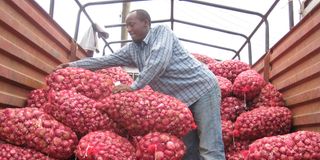
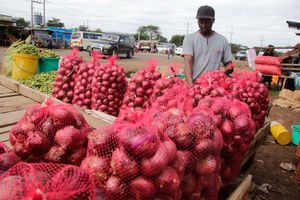
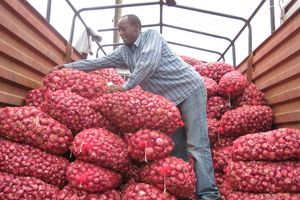
A trader unloads onions to sell.

How would you describe the current state of onion farming in Kenya?
Onion farming in Kenya has expanded in terms of market over the years, emerging as one of the country’s most promising horticultural enterprises.
Farmers have increasingly embraced hybrid seed varieties amid climate change shocks, positioning Kenya among the leading consumers of hybrid onion seed in East Africa. The shift from traditional to improved varieties has significantly boosted yields, enhanced bulb uniformity, and improved overall quality.
Additionally, growers are actively participating in agricultural training and exhibitions, sharpening their expertise in nursery management, fertilization, pest and disease control, and post-harvest handling. As a result, Kenyan onion farmers are becoming increasingly competitive within the region.
Is local onion production sufficient to meet demand, or do we still rely on imports?
Local production has improved and supplies a large portion of domestic demand. However, due to the free movement of goods within the East African Community, imports cannot be completely restricted.
The onion market operates under demand and supply forces.

Mishack Wachira, a horticultural crops agronomist.
Also Read: Budget, seed variety key to onion farming
During periods of local shortage, imports supplement supply, while in seasons of surplus, neighboring countries also source onions from Kenya. The trade is therefore seasonal and market-driven.
Can onion farming be a viable venture for young entrepreneurs?
Yes, it is highly viable for young entrepreneurs because it requires relatively moderate capital compared to many agribusiness ventures and offers consistent demand throughout the year.
Onions are a staple in households, hotels, and food industries. With proper management and strategic marketing, onion farming provides strong profit margins and scalable opportunities for youth in agriculture.
Can it make someone a millionaire? Kindly explain using practical figures.
Absolutely, when managed professionally. For example, one kilogram of hybrid (F1) seed is sufficient to plant one acre. Under good agronomic management and practices, an acre can produce between 18 and 25 tonnes.
The average production cost per acre is approximately Sh150,000, while market prices range between Sh30 and Sh120 per kilogramme depending on the season.
Let us do it arithmetically: If a farmer, for example, harvests 20 tonnes (20,000 kilogrammes) and sells at Sh50 per kilogramme, the gross income would be Sh1 million.
After subtracting the production cost which amounts to about Sh150,000, the farmer remains with approximately Sh850,000 in profit.
If the same produce is sold during a scarcity season at Sh120 per kilogramme, the gross income rises to Sh2.4 million, leaving a net profit of about Sh2.25 million. These figures clearly demonstrate the income potential in onion farming when yield and timing are optimized.
What best agronomic practices should farmers follow, and how many tonnes can one acre produce?
Farmers should begin with high-quality hybrid seed and establish a well-managed nursery. Proper spacing during transplanting, balanced fertilization guided by soil fertility, effective pest and disease control, adequate irrigation, and good weed management are essential.
Timely harvesting and proper curing, on the other hand improve bulb quality and storage life. When these practices are followed, yields of 18 to 25 tonnes per acre are achievable.
How is climate change affecting onion production, and how can farmers adapt?
Also Read: Maturity and curing of the bulb onions
Climate change has introduced erratic rainfall patterns, prolonged dry spells, and temperature fluctuations, all of which negatively affect bulb formation and yield stability.
To adapt, farmers should invest in irrigation systems, practicing mulching to conserve soil moisture, and adjusting planting calendars.
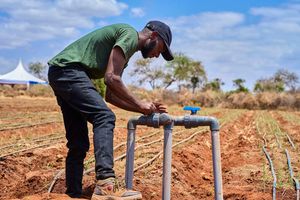
More farmers are embracing irrigation, and the technology has proven effective in increasing production and ensuring consistent yields throughout the year. A key climate-smart innovation supporting adaptation is the use of soil water retention technology such as Reon.
Reon is a granular, corn starch–based bio-solution designed to improve water efficiency in crop production.
When applied in the soil during planting, it absorbs significant amounts of water and nutrients, expands in size, and slowly releases moisture and nutrients to plant roots over time. This reduces water stress during dry periods and minimises nutrient leaching.
By improving soil water-holding capacity, it stabilizes moisture levels around the root zone, which is critical for onion bulb development.
Such technologies enhance crop resilience and reduce the frequency of irrigation, making them valuable tools for mitigating drought impacts.

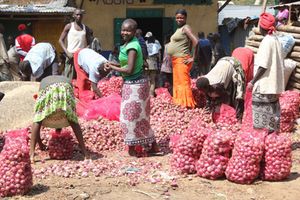
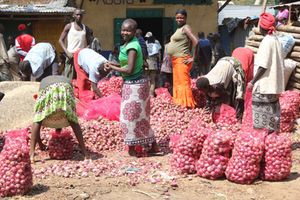
Women pack onions into nets in Ortum, West Pokot County, before the produce is transported to other towns for sale.
What major challenges are onion farmers facing today?
Onion farmers face several challenges, including drought, limited agronomic knowledge among some producers, poor seed selection, pest and disease pressure, and fluctuating market prices.
The influx of imports during certain seasons also affects local market stability. Additionally, exploitation by middlemen remains a significant issue, particularly when farmers lack storage facilities and are forced to sell immediately after harvest at low prices.
To evade market frustrations, they should explore value addition to prolong shelf life and fetch a lucrative price.
What technological innovations are improving onion farming and productivity?
Several technologies are improving productivity in the onion sector. Hybrid (F1) seed varieties have significantly increased yield potential and uniformity. Drip irrigation systems enhance water-use efficiency, while soil testing enables precise fertilizer application.
In addition, mechanized spraying equipment improves pest and disease management efficiency. Soil moisture conservation technologies such as Reon are praised to improve drought resilience and nutrient efficiency. Digital market information platforms also support better marketing decisions. Together, these technologies increase yields, reduce production risks, and improve profitability.
Also Read: Downey mildew in the onion crop
What value addition opportunities exist in the onion value chain?
Value addition offers substantial opportunities for increased profitability. Processing onions into dehydrated flakes or onion powder opens access to industrial and export markets. Direct supply to supermarkets, hotels, and processors further improves margins. It is good to note that value addition reduces post-harvest losses and strengthens farmers’ market positioning.
What policy or market interventions are needed to strengthen the onion sector?
To strengthen the onion sector, Kenya needs supportive policies that shield farmers from unfair import competition while preserving regional trade balance. Extension services should also be enhanced to improve farmers’ knowledge, productivity and adoption of best practices.
Better access to reliable market information, alongside promotion of contract farming, is another key strategy that would help stabilize prices and reduce uncertainty.
Most importantly, strong farmer cooperatives are essential. Through cooperatives, farmers can aggregate produce, negotiate better prices, invest in storage facilities, access affordable credit and minimize exploitation by middlemen. When organized, farmers gain greater bargaining power, better control of supply, and stronger influence over market prices.
Follow our WhatsApp channel for breaking news updates and more stories like this.