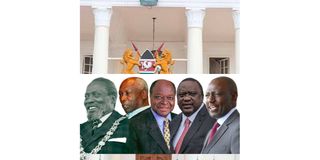
As Kenya wrestles once again with calls to rework its Constitution, the ghosts of the early republic loom large. The first two presidents – Jomo Kenyatta and Daniel arap Moi – treated the supreme law not as a sacred covenant of governance but a pliable script, edited and revised to suit their needs.
For them, changes were rarely about the nation’s collective good. They were weapons and shields: swords against rivals, armour for allies and lifelines for personal survival.
At independence in 1963, the majimbo (federal) system was meant to safeguard fragile ethnic balances. It distributed authority to regional assemblies, calming fears of domination by large groups. To Mzee, majimbo was an encumbrance. He dreamed of a single, centralised republic – one state, one centre and one president: himself.
Almost immediately he assumed power, his government moved to dismantle the majimbo constitution by first weakening the regional assemblies and siphoning their powers to the central government. Majimbo would soon be reduced to a footnote.
To achieve that, Mzee couched his moves in the language of unity. But the real motive was consolidation – to neutralise rivals, centralise patronage and ensure power flowed to State House rather than outward to the provinces.
Late President Daniel arap Moi.
Photo credit: File
He completed the burial of federalism in May 1965. Regions were renamed provinces, regional assemblies were downgraded to provincial councils with no pay and local control over land was erased. What had been sold as a compromise for unity was gutted, leaving the presidency at the centre – an issue that would become the basis for the clamour of the 2010 Constitution. Jomo cloaked these changes in technical language, but in truth, he was clearing the field of any competing authority.
In 1966, when Jaramogi Oginga Odinga and his allies broke from Kanu to form the Kenya People’s Union (KPU), Mzee’s response was not tolerance but entrenchment. The Fifth Amendment of April 1966 was quickly formulated and forced defecting MPs to seek re-election rather than cross the floor of the House. This was mischievous for two years earlier, Jomo had absorbed defectors from Kadu into his camp without changing the law.
Mzee Jomo Kenyatta (left) with then Vice President Jaramogi Oginga Odinga.
Photo credit: File | Nation Media Group
When defections worked against him, the constitution was rewritten overnight to protect the president and his power. Parliament passed the law by overwhelming margins, and what followed – the “Little General Election” – was less a democratic experiment than a trapdoor that swallowed the opposition whole.
Mzee pressed forward, intent on consolidating the instruments of state power in his hands. The Fourth and Seventh Amendments of 1966 marked a turning point. Civil servants were stripped of institutional independence and rendered mere extensions of the Executive, obliged to serve solely “at the pleasure of the President”. In the same breath, the Senate – an organ that might have offered even a modest counterweight – was dissolved, erasing one of the last formal checks upon the presidency.
After Jaramogi formed KPU, Mzee’s government reached for a weapon used by colonialists to extinguish dissent. It found one in the Preservation of Public Security Act, 1966. Draped in the solemn language of national safety, the Act concealed within it the architecture of repression. It granted the state extraordinary powers – the authority to detain without trial, impose curfews, censor the press, silence voices of opposition and curtail citizens’ movement at will.
These were not instruments of justice but the blunt machinery of domination – law turned inwards against the people it was meant to protect. Following the stoning of Mzee’s motorcade in 1969, KPU leaders were detained without trial. Powers once reserved for quelling the shifta insurgency in the northeast were redirected against political adversaries.
Worse still, an accompanying constitutional amendment etched into law a chilling paradox – if the president chose to detain individuals, such acts would not be deemed violations of their constitutional rights. Legality was rewritten to sanctify repression.
The constitution – imagined at independence as the supreme charter of liberty – was thus recast as a citadel of presidential power. It no longer stood as a shield for the citizenry, but as a fortress for the regime, designed not to guard freedom but to smother it.
President Jomo Kenyatta with Vice-President and Home Affairs Minister Daniel Toroitich arap Moi.
Photo credit: File | Nation Media Group
By the mid-1970s, the constitution had become Jomo’s personal toolbox. The most brazen manipulation came in 1975 with the 15th Amendment. When Paul Ngei, a Kenyatta ally, lost his parliamentary seat after being convicted of election offences, the president refused to let him fall. In just two days, Parliament passed an amendment allowing the president to pardon electoral offenders.
Jomo quickly exercised it to reinstate Ngei, who returned to Parliament and Cabinet. When the law threatened a friend, the law had to be changed.
There was a move in 1978 to change the constitution to prevent Moi from automatically becoming president. This was frustrated by Attorney-General Charles Njonjo who favoured Moi for his own survival.
If Mzee had wielded the constitution to centralise authority, Moi – after assuming power in 1978 – perfected the art of personal rule. The decisive moment arrived in 1982 when the 19th Amendment inscribed into law the notorious Section 2A: “There shall be in Kenya only one political party, the Kenya African National Union.” Kenya was transformed into a de jure one-party state.
Moi’s allies defended the move with patriotic flourish, insisting it was nothing more than a formalisation of reality: after all, Kanu had long stood unchallenged. In practice, Section 2A criminalised opposition. It outlawed rival parties and the very idea of political pluralism. Dissent ceased to be a matter of opinion – it became treason. Kenya was no longer held in Moi’s grip by practice alone; it was now bound by law.
Moi also used constitutional tinkering to settle scores. In 1986, the 22nd Amendment abolished the office of chief secretary – held by Simeon Nyachae – after a falling out with the president. It also stripped the attorney-general and auditor-general of security of tenure, making them answerable to the president. Once again, law was reshaped to punish enemies and reward loyalty.
In 1988, another amendment abolished the security of tenure for judges. This had less to do with governance than with a petty quarrel between Chief Justice Cecil Miller and a judge over a transfer. Unable to dismiss him under existing rules, Moi changed the constitution to make it possible.
In a twist of irony, the same Parliament, guided by the same attorney-general, quietly reversed course in November 1990. A new change restored the security of tenure of judges, the AG, the controller and the auditor-general. What had been stripped away in haste was reinstated without resistance, as though the earlier upheaval had never happened.
By then, Parliament had been reduced to what Nandi lawmaker Jean-Marie Seroney had earlier derided as a “Reichstag,” a space MPs rubber-stamped proposed changes without hesitation.
The constitution had ceased to be a bulwark for justice; it was the president’s plaything. As Seroney remarked in 1966: “the facility with which the government gets all kind of legislation through this House, with pliant backbenchers, ministers and assistant ministers, sometimes makes me wonder whether it is worthwhile having such a House as this, or having a House at all.”
That observation would echo through the chambers for many years. When a proposal to extend the period during which police could detain suspects of capital crimes – from 24 hours to 14 days – few dissenting voices came from the clergy and the legal fraternity. A young Baptist priest, Mutava Musyimi – who would later rise as a leading figure in the anti-government church movement – was among the first to sound the alarm. Kiraitu Murungi, Gitobu Imanyara, Paul Muite, Kamau Kuria, John Khaminwa and other lawyers also opposed the bill. Yet fear prevailed in Parliament. Politicians, unwilling to risk the president’s wrath, voted in lockstep.
By the 1990s, Moi’s authoritarian edifice began to crack. Mounting domestic unrest, international pressure and the withdrawal of Western aid forced his hand. In December 1991, Section 2A was repealed and multiparty politics restored. Yet even this reform carried the mark of survival politics. Moi resisted until the last moment, only conceding when isolation made it unavoidable.
The Inter-Parties Parliamentary Group reforms of 1997 introduced many changes, including the end of preventive detention and reforms to electoral laws. These came not from presidential generosity, but from a negotiation in which Moi sought to retain as much control as possible while averting full-scale political collapse.
For Jomo and Moi, the constitution was never sacrosanct. It was bent, amended and mutilated in the service of personal power. Both claimed to act for unity, stability or progress. In reality, their constitutional amendments safeguarded themselves and their friends while weakening institutions meant to protect people.
As debates stir over possible changes to the current Constitution, haunting questions linger: will history repeat itself? Will the supreme law be wielded as a weapon of convenience rather than a covenant of trust? Only time will tell.