The stench reached them first. Then the truth.
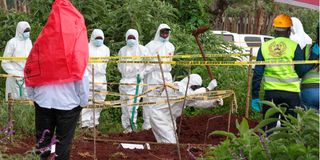
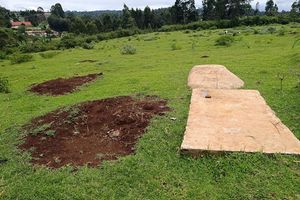
Three young gravediggers—street boys hired for Sh1,000 each—had spent the night of March 19 burying 32 bodies at Makaburini Cemetery in Kericho. Most were children. There were no families, no priests, no mourners. Just masks, a vehicle with government plates, and cash for silence.
Two days later, they walked into Kericho Police Station and broke the pact. Their testimony triggered a court-ordered exhumation that revealed 25 children among the dead and a Nyamira County public health officer now under arrest.
Had they stayed silent, no one would have known. The bodies would still be there—unmarked, unrecorded, vanished. Investigations are now under way, with authorities promising answers.
But what happened in Kericho reflects how bodies disappear in Kenya: not through elaborate conspiracies, but through a death-disposal system shaped by fear, cultural taboos and a decades-old legal vacuum that makes oversight nearly impossible.
A government commission warned of this in October 2014, documenting Kenya’s lack of comprehensive burial legislation.
“There is currently no clear legal provision on the procedure for handling, disposition, or settling of disputes relating to dead bodies,” the Kenya Law Reform Commission noted.
More than a decade later, little has changed. And the bodies keep turning up.
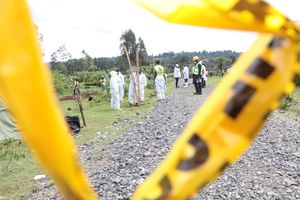
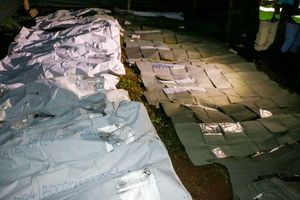
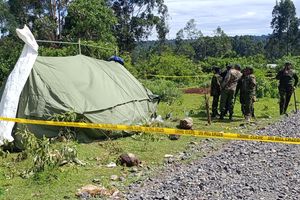
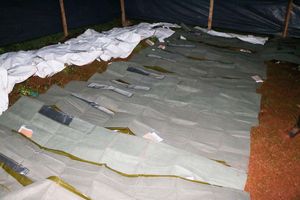
The 32 bodies that were exhumed from a mass grave in Makaburini in Kericho on March 24, 2026 by homicide detectives.
Photo credit: Boniface Mwangi | Nation Media Group
In April 2023, authorities began exhuming bodies from shallow graves scattered across Shakahola Forest in Kilifi County. By September, 429 bodies had been recovered—men, women and children who had starved to death under cult leader Paul Mackenzie’s instruction. The Kenya Red Cross reported more than 600 people still missing.
Autopsies revealed starvation, strangulation, suffocation and blunt trauma. A March 2024 Kenya National Commission on Human Rights report documented systemic failure: police ignored missing persons reports, dismissed warnings of radicalisation and overlooked community concerns. Security officers in Malindi were found to have committed “gross abdication of duty and negligence”.
Mackenzie had been arrested multiple times between 2019 and 2021. Families reported missing relatives. Yet burials continued undetected across 800 acres of private land—no permits, no death certificates, no county oversight—until the death toll reached the hundreds.
Beneath the bureaucratic gaps lies something older and more powerful: the cultural architecture of death.
Across many Kenyan communities, contact with corpses is associated with ritual pollution. Death work is necessary but feared. Families often avoid opening caskets—even to confirm identity. They rely on others to handle the dead: mortuary attendants, gravediggers, cemetery workers.
County inspectors rarely visit burial grounds. Public health officers seldom challenge mortuary practices. Politicians do not tour cemeteries. The dead occupy a space apart—physically, culturally and administratively.
This distance creates a quiet impunity. Those who handle bodies operate in spaces most people avoid, performing work few are willing to confront.
Government pathologist Dr Richard Njoroge addresses the media after exhumation of 32 bodies from Makaburini cemetery in Kericho on March 24, 2026.
Photo credit: Boniface Mwangi | Nation Media Group
The Makaburini gravediggers understood this. They were chosen precisely because of their invisibility—young men with no ties, paid in cash to work in the dark. At Shakahola, communities suspected wrongdoing, but cultural reluctance to interfere with burial practices delayed action.
In July 2024, two weeks after protests against the Finance Bill turned violent, volunteers discovered bodies stuffed in gunny bags at an abandoned quarry in Kware, Nairobi.
Six families identified their relatives: Josephine Mulongo Owino, missing since June 26; Roseline Akoth, missing since June 28; Rosemary Achieng Otieno, missing since June 23; and Wilkister Night Ososo, missing since June 19. All were found weeks later, their bodies dumped.
DCI homicide detectives put sacks with human bodies recovered from the Kware dumpsite into body bags.
Photo credit: Bonface Bogita | Nation Media Group
A November 2024 Human Rights Watch report documented a broader pattern: bodies of missing persons found in rivers, forests, quarries and mortuaries, many showing signs of torture, mutilation or dismemberment.
More than 60 protesters were killed during the demonstrations. By January 2025, over 130 people remained unaccounted for. The Kenya National Commission on Human Rights reported nearly 60 missing during the protests alone.
These are not just casualties. They are bodies entering a system with no tracking, no oversight and no accountability—bodies that can end up in unmarked graves, rivers or crematoriums, or disappear entirely. And if burial lacks oversight, cremation is even less regulated.
There is no public registry of cremations, no requirement to report how many bodies are processed, no standard protocols for handling ashes and no independent verification of identity. Bodies arrive, are burned, and remains collected—or not.
The 32 bodies that were exhumed from a mass grave in Makaburini in Kericho on March 24, 2026 by homicide detectives.
Photo credit: Boniface Mwangi | Nation Media Group
The cemetery is managed by the National Council of Churches of Kenya, which says procedures require burial permits and proof of kinship. Yet those procedures were bypassed.
Kericho County officials said there was no agreement for cross-border burials from Nyamira. Courts are now examining whether legal orders were properly followed. Investigators only acted after whistle-blowers spoke out.
What is missing is basic: a national burial registry linking deaths to disposal sites, mapped graves, routine audits, regulated crematoriums and protections for those who report abuse.
Instead, oversight fell to three young men paid Sh1,000 each.
The 2014 warning remains unaddressed. Meanwhile, bodies continue to surface—in forests, quarries and shallow graves.
The Makaburini victims were children. The Shakahola dead were families. The Kware victims were citizens who vanished during protests.
More than 130 people from the 2024 demonstrations remain missing. Their families search mortuaries, rivers, forests and quarries—anywhere a body might end up in a system without records or accountability.
Kenya’s death-disposal system runs on silence—on fear of the dead, institutional gaps and political inaction. It depends on families who do not question, officials who do not inspect, workers who cannot speak and laws that do not exist. The three gravediggers broke that silence. Parliament must do the same.
Until then, the question remains: Who watches the graves? And the answer, more than a decade after the warning, hundreds of bodies later, and scores still missing, is still the same. No one.