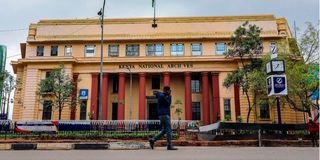
During the recent riots in Nairobi, goons stoned the Kenya National Archives, shattered windowpanes and even attempted to burn it. This is a structure that is not only a repository of our history but also a gazetted national monument.
My heart sank when I received the footage from a friend, I watched in disbelief the damage done as stones rained on one of the most sacred sites of our collective memory. Embers flickered near windows. All I could think was: What kind of society are we becoming?
There are many things we can disagree about as Kenyans. We can even riot. We can demand justice, protest inequality, shout in the streets and challenge power. That is democracy and freedom. But we cannot and should not desecrate the soul of our collective memory. The Kenya National Archives is not just a building of old files. It is a living memory of this country’s complex journey – through colonisation, struggle, independence and into the present. It houses documents that speak for those long dead, truths that power tried to suppress and stories that still shape our identity.
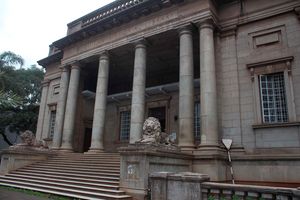
On the ground floor are the irreplaceable Joseph Murumbi artefacts – gifts, cultural relics, art and collections of one of Kenya’s most ardent preservationists of African heritage. Alongside them are other irreplaceable national mementoes. These are not just exhibits; they are fragments of our history, memory and pride.
To threaten the Archives is to flirt with historical amnesia. And we, as a nation, simply cannot afford to forget or burn these to score a political point.
Kenya National Archives along Moi avenue, Nairobi holds relics of the diverse Kenyan tribal culture, historical documents, paintings and photographs from the collection of Kenya's second vice president, Joseph Murumbi. PHOTO| TOM MWIRARIA
Under international humanitarian law, particularly the 1954 Hague Convention for the Protection of Cultural Property in the Event of Armed Conflict and its protocols, archives are protected as cultural property due to their role in preserving a nation’s heritage, history and identity. Combatants and occupying forces are obligated to respect and safeguard such sites.
Theft, looting or illicit trafficking of archival materials during conflict is prohibited. That is why the archives are protected from foreseeable harm, and identified by the Blue Shield emblem, which serves as a clear symbol of their protected status.
Goons and their masters should know better. Attempting to burn the Kenya National Archives is like hacking off one’s nose to spite one’s face. Anger must have limits. When we target the archives, we are not confronting a regime, nor are we undermining the Gen Z uprising – we are burning the bridge between our past and future. We are not fighting the state but erasing ourselves.
Rage should be disciplined with reflections: That in our most chaotic moments, we must protect what holds us together. Nothing holds us together more than our history.
Let this be a wake-up call – not just to secure our archives better, but to teach Kenyans why it matters. If we don’t know, if we don’t care, then the next stone might not just break glass. It might shatter our memory forever.
The Kenya National Archives is not just a building. It is a vault of the nation’s soul – a repository of who we are, where we’ve come from and what we’ve endured. Its stacks hold the truth about our liberation, records of our oppressions, the blueprints of our development and the whispers of those long silenced. It holds files that colonial governments tried to burn, testimonies of Mau Mau detainees, maps that redrew entire communities and letters that tell us how we became a republic. These are not just papers. They are pieces of our being.
To attack the National Archives is to attack our history. To threaten it with fire is to flirt with amnesia. We as a country cannot afford to forget. We cannot afford to erase ourselves.
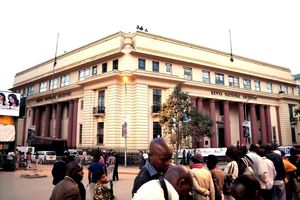
Let us also confront an uncomfortable truth. I have asked repeatedly why the Kenya National Archives sits so vulnerably at one of Nairobi’s most volatile intersections. It is boxed in by traffic, swallowed by congestion, and constantly at the mercy of protests, pickpockets, tear gas and now – attempted arson. It sits on the fault line of civil unrest, exposed to the chaos of Tom Mboya Street and Moi Avenue. What more warning do we need?
Kenya National Archives building in Nairobi on July 7, 2025.
Photo credit: Lucy Wanjiru | Nation Media Group
This is a shame. No other country leaves its memory on the frontline. You won’t find the British Library on a street corner next to insecure district. You won’t find the US National Archives sharing a wall with a shoe hawker and a street preacher. Countries that understand the value of memory invest in protecting it – not just from physical danger, but from the symbolic indignity of being treated like an afterthought.
The National Museums of Kenya is on an expansive secure compound, ringed by fences, greenery and security personnel. It is buffered from the noise and strain of daily city life, allowing visitors to engage with Kenya’s cultural and natural heritage in a space of calm and reflection. The Kenya National Library too has a modern building in Upper Hill – a growing administrative and professional district. It is dignified, quiet and secure. You do not have to push through a crowd of boda bodas to access books.
Yet the archives – arguably the most important of them all – is still crammed in the city’s belly, surviving more by luck than planning. It is as though we have forgotten that once memory is lost, it cannot be reconstructed. Fire doesn’t just burn paper; it incinerates history.
Dear Mr President, we need to move the archives – not just to protect it from unrest, but to give it the dignity it deserves. We need a purpose-built, climate-controlled, fireproof facility in a secure location – somewhere like Nairobi’s Upper Hill or beyond, where memory can breathe. A place researchers, students, journalists, artists and everyday Kenyans can connect with their past without stepping over broken glass or ducking from street skirmishes. A place that reflects our commitment to history, not our neglect of it.
We owe it to our children and the freedom fighters whose files are stored there. We owe it to ourselves.
One wishes that the President – who is spending hundreds of millions of shillings to build a church at State House – would instead channel that money into constructing a proper national archive. Not because churches don’t matter, but because memory does too. In fact, a functioning society requires faith and memory, but it cannot thrive on faith alone while its history is left to rot in the fumes of Tom Mboya Street.
But we live in an era of growing disdain for history. Our leaders do not consult the past; they try to outrun it. They treat archives as dusty repositories for academics, not as living institutions that shape national consciousness. The story of Kenya – its trials, revolutions, betrayals and triumphs – sits gathering dust in fragile files. Some have no digital backup. Many are vulnerable to fire, water, pests and theft. And yet, there is no urgency.
This disregard is not just institutional; it is ideological and runs from Jomo Kenyatta to William Ruto. A leadership that understands the value of history would know that archives are not luxuries. They are the foundation of law, identity, justice and accountability. You cannot talk of fighting corruption while ignoring institutions that hold the records. You cannot promise to heal a divided country while neglecting the documents that could help us understand how we got here.
A proper national archives is not just a building; it is a statement. It is a monument to the idea that history matters, that truth is worth preserving, that memory should not be held hostage by political whims or urban anarchy. If we can spend public funds on sanctuaries of prayer, surely we can invest in sanctuaries of memory.
When history is forgotten, it does not disappear. It repeats itself more violently, blindly and more destructively. By the time we realise what we’ve lost, it may be too late to recover it.
To the young, to the restless, to the angry, to the goons: the archives is not your enemy. It is your inheritance. It is the one building that belongs to us all. When the smoke clears, when the noise fades, when leaders are gone and parties forgotten, the archives will still be the only place your story lives.
We must protect it with urgency, with respect and with the knowledge that once history is lost, it never comes back.
John Kamau is a PhD candidate at the Department of History, University of Toronto, Canada. Email: [email protected] ; On X: @Johnkamau1