In the book I am currently reading; Not Yet Uhuru, Jaramogi Oginga Odinga made an observation about the Emergency years that seems to escape Kenyan politicians: the colonial state’s relentless use of force against its own people did not defeat resistance but it gave that resistance its military character.
A people denied every legitimate avenue will eventually seek alternative methods. William Ruto’s government is conducting the same experiment, apparently expecting different results.
The Gen Z uprising of 2024 was the clearest demonstration of this in a generation. Young Kenyans came armed with phones, placards, wit and fury, demanding accountability over a Finance Bill that would have bled them dry. The government answered with live bullets.
More than 60 people were killed, but the state only succeeded in radicalising a movement it could neither buy nor frighten. In the process, it surrendered whatever remained of its moral authority. Two years later, the suppression continues, and its targets have only widened.
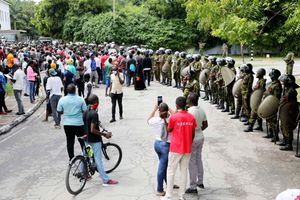
On June 8, 2026, riot police fired tear gas and arrested at least nine peaceful protesters outside the main entrance of Nairobi National Park. Among those bundled into a police lorry was former Chief Justice David Maraga, arrested for standing on a road with a placard opposing a plan to hive off 76 acres of protected parkland for the Bomas of Kenya expansion, a Sh42 billion project being pushed through without meaningful public participation.
The images from that protest showed black protesters being loaded into police lorries, while white and Asian protesters who were with them were allowed to walk home. Sixty-three years after independence, it’s as if the colonisers never left and the police still act with the same mindset.
The colonial government knew it could never defeat the people as long as they remained united. So what did they do? The Home Guard movement was created to turn men into collaborators, to turn father against son, brother against brother, neighbour against neighbour. Some joined to protect their immediate families and soon found themselves helping to betray and kill their own people.
Home Guard intelligence led to arrests, detentions and deaths. Dedan Kimathi, the most celebrated freedom fighter of them all, fell partly because of an informer’s intelligence. Treachery was well rewarded.
The Emergency, therefore, produced courageous martyrs, but it also produced despicable collaborators. When independence came, those collaborators did not step aside.
They stepped forward. The Africanisation of the White Highlands was carried out not as redistribution to the landless poor who had bled for it, but as a commercial transfer that allowed the new African political class, including loyalists who had enriched themselves through collaboration, to purchase thousands of acres from departing settlers. They inserted themselves into the structure the British had built.
Jomo Kenyatta, whose family is today estimated to control vast tracts of prime land across Kenya, became the supreme example of this inheritance. The Kikuyu displaced during the Emergency, whose fathers rotted in detention camps while loyalists seized their plots, never got their land back.
That is Kenya’s original betrayal. The collaborators inherited the state, changed its colours and kept its logic. Since 1963, Kenya has lived inside a management buyout of the colonial enterprise, with Black faces at the helm and the same engine underneath: extraction, selective justice, land hunger, state violence and the reflex to meet legitimate demand with detention rather than dialogue.
Ruto would do well to read Odinga carefully. The British were not defeated merely on the battlefield. They were undone by the self-defeating nature of their own methods. Every atrocity recruited more fighters.
Every Home Guard who betrayed a neighbour created a family whose grievance would outlive the Emergency. Every detention camp became a school of political consciousness. A state that rules exclusively by fear eventually exhausts its capacity to frighten.
The Gen Z generation has already shown that tear gas, mass arrests, abductions and state-sponsored ridicule have lost their deterrent power.
The arrest of Maraga on Langata Road proved the point. It drew more people to the conservation cause than any petition ever could. By treating peaceful protest as a crime, the state transformed a land and environment question into a national symbol of impunity.
Odinga’s pages carry a warning that Kenyan governments ignore at their peril. A state that refuses to answer legitimate demands, that sends police to sort protesters by race on a public road, that carves up a national park for a car park while millions remain landless, is digging its own grave.
The colonial government learnt this the hard way. The question is whether Ruto will wait to learn it the same way, or whether the cost of that lesson will again be paid, as it always is in Kenya, by the people least responsible for the conditions that made it necessary.
Sixty-three years after independence, we are still waiting for the Republic to stop behaving like the colony it replaced.
Mr Amenya is a whistleblower, strategy consultant and startup mentor. www.nelsonamenya.com