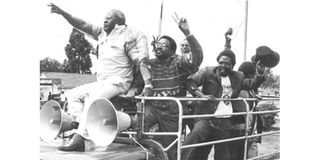
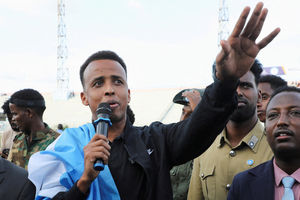
The 36th anniversary of the Saba Saba protests (July 7, 1990) invites a sober reckoning with Kenya’s “Second Liberation” — the popular movement that began dismantling Daniel arap Moi’s one-party Kanu State and pressed for multiparty democracy.
Saba Saba refuses to fade into the archives; it remains alive in the public imagination, perhaps the only post-Cold War African movement still remembered with such clarity.
Prominent opposition politicians, including Kenneth Matiba, Charles Rubia, and Raila Odinga, called for a massive public rally at the Kamukunji grounds in Nairobi on July 7, 1990, to demand multiparty democracy and an end to human rights abuses.
The government declared the rally illegal. Days before it could happen, several key organisers were arrested and detained without trial. Despite the ban and a heavy police presence, thousands of ordinary Kenyans flooded the streets of Nairobi and other major towns to protest.
Sustained pressure from Saba Saba compelled Moi’s government to relent a year later. In December 1991, Parliament repealed Section 2A, formally reopening space to multiple parties and setting Kenya on a path, many argue, that culminated in the progressive 2010 Constitution.
Yet history is rarely so neat. To understand Saba Saba’s meaning is to place it within a wider African tide.
Saba Saba formed part of a continental wave after the Cold War that, over the next decade, toppled or transformed numerous regimes. In Cape Verde, the opposition won the first multiparty parliamentary elections on January 13, 1991, marking a peaceful transfer of power.
Across West and Southern Africa, entrenched one-party or military rulers faced mass protests, strikes and negotiated transitions. In Benin, popular pressure ended the Marxist-Leninist rule of General Mathieu Kérékou, who had governed since 1972.
Zambia’s long-serving Kenneth Kaunda was swept from power after the 1990 protests over rising food prices united trade unions, students and civic groups in a mass movement that ended single-party rule. In Mali, widespread uprisings and a pro-democracy faction within the military removed General Moussa Traoré in early 1991, and a national conference produced a multiparty system by 1992.
Madagascar’s militant protests forced Admiral Didier Ratsiraka to share power with a transitional government in August 1991, leading to a new constitution and multiparty elections in 1992–93, which he lost. Malawi’s tyrannical Hastings Kamuzu Banda, who styled himself “President for Life”, faced growing unrest and donor pressure. A June 1993 referendum abolished the one-party State and paved the way for multiparty elections in 1994.
In the Central African Republic, strikes and protests compelled General André Kolingba to legalise opposition parties and hold elections in 1993.
The watershed in South Africa was larger still. In February 1990, F.W. de Klerk unbanned the African National Congress and released Nelson Mandela. Years of mass resistance and armed struggle culminated in the historic 1994 elections that ended apartheid and established multiracial democracy.
Not every outcome was inevitable or uniformly progressive. In Cameroon and Togo, mass protests in 1991 met violent repression. Presidents Paul Biya and Gnassingbé Eyadéma conceded nominal multipartyism but manipulated the transitions to remain in power. Biya, 93, is still in office today.
While some changes came through upheaval and street pressure, others emerged through elite bargains and what political scientists call “transitions from above” or “managed transitions”. These grew out of military pacts, controlled legal reforms or the voluntary withdrawal of founding leaders.
In Nigeria, the sudden death of Sani Abacha in 1998 opened the way for Abdulsalami Abubakar to negotiate an elite pact that protected the military and returned the country to civilian rule in 1999. Tanzania’s ruling party, CCM, voluntarily legalised opposition parties in 1992 under the influence of founding leader Julius Nyerere.
Cape Verde’s leadership abandoned its political monopoly in 1990 and peacefully handed over power after losing the 1991 election. In Ghana, military leader Jerry Rawlings oversaw a top-down transition, introducing a 1992 Constitution before winning civilian elections.
It is tempting to assume that democracies won through bloody sacrifice are richer in outcome. However, the evidence from the 1990s says differently. Orderly, managed transitions often produced stronger institutions. Cape Verde and Ghana, where change unfolded without violent action, now rank among Africa’s more stable democracies.
By contrast, countries where regimes collapsed amid chaotic uprisings often left behind power vacuums that invited instability. Mali and Niger, where democratic institutions were hurriedly assembled after explosive protests, have since suffered repeated military coups.
Kenya is a hybrid. While Saba Saba began as a street protest, the transition stretched over two decades before culminating in the negotiated 2010 Constitution.
Remembering Saba Saba is, therefore, more than commemorating a day of confrontation. It is recognising a chapter in a continental story about how democracies are remade — sometimes in the streets, sometimes in quiet rooms where elites decide to step aside — and why both paths matter in shaping the politics that follow.
The author is a journalist, writer and curator of the Wall of Great Africans. X@cobbo3