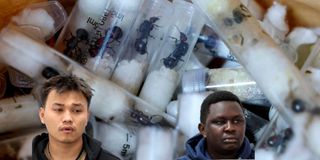
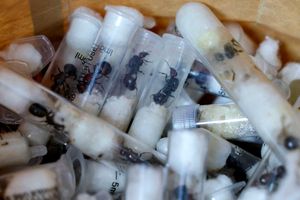
Kequn’s arrest follows an April 2025 bust at JKIA in which Belgians Lornoy David and Seppe Lodewijckx, Vietnamese national Duh Hung Nguyen and Kenyan Dennis Ng’ang’a were nabbed with more than 5,000 African harvester ants in a guest house in the Rift Valley town of Naivasha.
That story went big internationally and got Kenyan and African ecological nativists and nationalists stirred up. The authorities treated it as “biopiracy”. A Kenyan court sentenced the men to one year in prison or a fine of $7,700.
The ant smugglers (sounds like a film title) deserved to be punished. Still, for anyone with market sense, there was something else entirely in the arrest, a glaring opportunity we are missing in our noble conservation rage.
The ants are not finite items like gold or diamonds. They are biological assets that can be bred and farmed, and their production can be scaled up to thousands a day. Yet we treat them like stolen artefacts, like rare 18th-century Makonde carvings.
For Kenya, the cases of Kequn and the European ant thieves actually highlight a missed $250 million global market for queen ants, where individual insects fetch between $100 and $250 in the hobbyist “formicarium” (artificial ants’ nest) trade. Instead of stopping at criminalising collectors, why hasn’t a single African ministry set up a licensed insectary? A state-of-the-art facility in Naivasha could legally export millions of queens a year, which could be a better deal than volatile crops such as coffee or tea, and clearly occupy only a tiny fraction of land.
Ants are among the most successful biomasses on Earth. In the time it took to write a police report about Kequn’s 2,240 live queen ants heist, 10 times that amount could easily have been born beneath the airport car park.
This municipal thinking extends to larger livestock in Africa. In early 2024, the African Union jumped into the fray and imposed a moratorium on donkey skin exports, yet demand remains insatiable. In Nigeria, there was a lot of drama when customs officers seized 4,410 skins in Lagos in February 2025, followed by another haul in Owerri (those who didn’t read earlier Nigerian literature will have encountered Owerri in Chimamanda Ngozi Adichie’s Half of a Yellow Sun), the capital city of Imo State in southeastern Nigeria, in June.
Most shocking was the discovery of 10,603 pieces of donkey genitals in a single 40-foot container along the Kaduna–Abuja Expressway in the same month. If one removed their conservation gaze from this and wore a business hat, they would see us sitting on an $8 billion industry driven by China’s “ejiao” (“donkey-hide glue, a staple of Traditional Chinese Medicine) market, which requires six million skins annually. If a commodity is so valuable that a single shipment is worth millions of dollars, the smart solution is not to arrest the buyer. It is to farm the animal.
The collapse of its donkey population drives China’s external demand. Between 1992 and today, the population fell from over 11 million to under two million, a staggering 82 per cent decline. Meanwhile, domestic demand for donkey products shot through the roof. By banning trade to China, African governments only ensure that a “Donkey Mafia” thrives, while we miss the chance to establish mega ranches. If we can breed hundreds of thousands of cattle for beef, we can do the same for donkeys for hides, although admittedly, donkeys are harder to breed, especially in captivity.
In Uganda, the government has poured millions into the Fisheries Protection Unit, arresting thousands from 2024 into early 2026. Soldiers have stormed gutting sheds in Munyonyo and other Kampala suburbs, where crews slice open Nile perch to yank out the swim bladders. Yet the fish maw trade rolls on untouched. With a global market valuation now sitting between $1.44 billion and $2.3 billion, the incentive to smuggle these organs outweighs the risk of a jail cell.
In East Asia, fish maw fetches up to $1,000 per kilogramme. The maw is roughly 40 to 1,500 times more expensive than the fish meat, depending on where you are in the supply chain.
Enforcement cannot compete with that kind of money. When smugglers risk prison for ants, skins or fish parts, they are providing a valuation. We must focus on protecting the few animals we have, yes, but we should put more effort into producing the millions the market requires. If the world wants our ants, our skins and our fish parts, we should not be handing out handcuffs. We should be handing out invoices.
Smuggling, for all its illegality, is crude market research. It shows us where value lies. If I were an African strongman president, I would commission a weekly report on the items people smuggle through airports and land borders, and develop a plan to flood the market with those products. After 10 years, mine would be the richest country on the continent.
The author is a journalist, writer and curator of the Wall of Great Africans. X@cobbo3