On the surface, it would seem that the Sh365 million Kenya paid to Washington-based lobbyists to butter up the country’s image in the United States is working, or is it?
Last month’s proposal to review Kenya’s non-Nato ally status was omitted from the list of amendments recently put forward by the US Senate Foreign Relations Committee.
That outcome must have brought a big sigh of relief to Kenya, given the sudden frightful appearance of impeached deputy president Rigathi Gachagua in the US, threatening to spill the beans on Nairobi’s dalliances with the region’s bad boys.
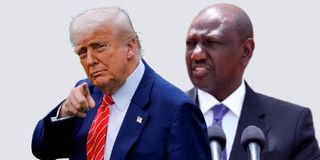
President William Ruto is heading to New York for the United Nations General Assembly, and one of the lobbyists’ deliverables will be a photo opportunity with US President Donald Trump.
Earlier this month, Foreign Minister Musalia Mudavadi provided a historical justification for paying a king’s ransom to American lobbyists to open doors to Congress – a roll call of past presidents and presidential aspirants who have all hired fixers to ingratiate them to powers in Washington and sell their image in the US.
Raila Odinga , Ruto, Jimmy Wanjigi and Fred Matiang’i are only the most recent examples of customers who have been parted from their money by American image makers.
The desperation for attention is quite understandable, given how low Kenya has fallen on the US list of priorities. Since US Ambassador Meg Whitman resigned and left Kenya in November last year following the election of Trump as president, there has been no substantive replacement. It would not come as a surprise if no US ambassador to Kenya is appointed before March next year. In fact, American observers note that the US Department of State has lost its influence with the President.
Conversely, Kenya’s ambassador to the US, Daniel Kerich, spends many of his waking hours meeting and engaging Kenyan students in America and about what they will do when they return home.
It is evident that the usual diplomatic channels might not suffice to place Kenya and its leaders on the formal agenda in the US. For struggling governments, US support plays a legitimising role; for opposition politicians, it signals global acceptability.
The ongoing frantic efforts to attract American attention, however, fail to appreciate the power dynamics in Washington: Republicans control the Senate and enjoy a slim majority in the House of Representatives, which strengthens Trump’s hand.
Lobbyists have previously focused on getting their clients access to key congressional leaders, but much of foreign policy – and public policy in the US – is dictated by one man: Donald Trump. His mantra is America First; those who hold a contrary view are required to fall on their sword.
President Trump responds most positively to flattery, acquiescence and capitulation. The spotlight, when it shines, should have one star – him – and it cannot be shared. Given the US President’s personality as a consummate attention seeker, he could not have been thrilled by Ruto’s attempt to upstage him in hosting the Democratic Republic of Congo peace talks.
In the end, it was Washington that delivered coup de grace in a peace deal between the DRC and Rwanda – sans Nairobi’s input. Ruto’s original sin of competing for the spotlight has not been forgiven.
The attitude of the Trump administration towards Africa has been paternalistic at its most benign and rapacious when honest. The US president believes that Africa has historically been a drain on American resources, and its value needs to be reassessed in terms of the mineral resources it can give up on the one hand and boots on the ground to protect those mining interests. It is, however, doubtful that any of the lobbyists contracted by Kenyan aspiring politicians are lobbying for an extension of the law that allows Kenya to export clothing and macadamia nuts to the US.
In the absence of a coherent US policy on Kenya, and its general retreat from shared values on sustainable development, green energy and climate change, one would expect that the country would pivot its foreign policy when approaching the world’s most belligerent superpower. Here then, is the contradiction between Ruto’s attendance of Unga and a photo op with Trump.
Even without radical reorientation, general housekeeping alone has some urgent business. On September 30, the Africa Growth and Opportunity Act (Agoa), which gives eligible sub-Saharan African countries – Kenya among them – duty-free market access to the US, will expire. Its replacement, the Agoa Renewal and Improvement Act, 2024, was put before Congress and referred to the Committee on Finance.
A 2021 assessment report on Agoa shows that South Africa, Kenya, Lesotho, Madagascar, and Ethiopia represented 81.7 per cent of US non-crude petroleum imports. Imports from Kenya – mostly apparel and macadamia nuts – accounted for 10.5 per cent Sh67.5 billion, of imports under the programme. In fact, apparel exports from Kenya absorbed some of Ethiopia’s share of the US market.
So when Kenyan politicians hire lobbyists who understand Trump’s mind like Carlos Trujillo, the expectation is that they would be prosecuting the country’s agenda. A lot of times, it will be burnishing the images of individuals in power or seeking it.
The writer is a board member of the Kenya Human Rights Commission and writes in his individual capacity (@kwamchetsi; [email protected] ).