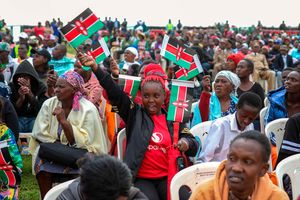
Kenyan voters wait in line to cast their ballots on August 9, 2022.

The year is 1945 in the United Kingdom. The country and its allies has just won a blistering Second World War against Germany but has suffered a heavy toll. Elections are called within the context that in the previous six or so years the UK has had a war Cabinet comprising a coalition of the main parties without an electoral mandate.
Everyone thinks incumbent Prime Minister Winston Churchill of the Conservative Party would win given his strong leadership and popularity during the war. The elections are held with the momentum in Churchill’s favour after leading the UK against Germany’s Adolf Hitler. But the Prime Minister loses miserably against a dour and colourless Labour Party leader Clement Atlee.
But how did this happen? Due to post-war euphoria, many had missed the true public pulse that wanted a good future for the country. To the voters, Churchill represented a war hero, not a peacetime leader.
In Kenya, it would help all political combatants to understand the public psyche as we head towards the 2027 elections. A good learner “throws” his or her eyes ahead, so says a Kikuyu proverb.
So, will political history be repeating itself in 2027 or will Kenya usher in a new radical paradigm shift?
Sir Winston Churchill once said those who do not learn from history are doomed to repeat it. Karl Marx had earlier stated history repeats itself, first as a tragedy, and second as a farce. But looking ahead in 2027 General Election, one sees new shifts in the public psyche.
Maybe those shifts might have historical antecedents but they can be newfangled innovations. What makes them real is the fact that their signs are discernable to those who are keen observers. To borrow the lyrics of a popular Bob Marley song, “there is a natural mystic that is blowing through the air; if you listen carefully now you will hear; this could be the first trumpet; it might as well be the last...”
I think the first shift will be the expanded impact of social media in shaping political discourse. This will be new but will be more intense. In 2013, Uhuru Kenyatta declared his candidature for the presidency. Social media largely lambasted him and his running mate William Ruto as International Criminal Court suspects. Peter Kenneth declared his intention for the presidency as well and social media went gaga. Uhuru won notwithstanding the online criticism.
That “ground versus social media” mismatch might not be there in 2027. That online-offline congruence has been brought about by an increase in the number of people with Internet access, mostly using their smartphones. That makes social media largely representative of the population unlike in 2013 when it was skewed in favour of a narrow set of elites. The emergence of video-based social media has increased the convincing power of digital media. Audiovisuals are more impactful on the human psyche than texts. Sharper politicians should invest more in social media campaigns in 2027.
We should also expect an oversized impact of the youth in the coming elections. This shift is new because elections worldwide tend to be the business of older persons. Senior citizens are generally more impacted by public policy like social security and healthcare. Long-time residencies also create stronger social bonds that foster voting intentions as opposed to the younger generation which has a migratory mindset. The act of voting takes considerable time and effort. Young people have tasks competing for precious time, including hustling and employment.
However, the coming elections in Kenya might induce a higher voting participation rate among the youth. Unemployment has attracted youth to public policy and social media has triggered dreams of a new world. Elections where youths are at the forefront tend to spring up surprises.
Also, expect an election where ethnicity does not hold as much sway as it has previously done. The ethnic and regional hold on politics will significantly erode, but not necessarily vanish forever. Since the re-introduction of multi-party politics in 1991, with the first elections in 1992, voting in Kenya has been basically an ethnic census. But the 2027 vibe will be different. National politics will be about who can make the mwananchi life feel better at a practical level — not necessarily where that candidate comes from. That assessment will be hinged on a candidate’s record in public service.
The voter of 2027 will be very progressive and forward-looking besides being sophisticated politically. Years of civic education and political engagement have probably yielded a discernable electorate.
I think kitchen-table issues will largely decide the elections. The strategy should, therefore, be how to devise electoral slogans that capture the prevailing public mood as previous successful American presidential candidates did — “Happy Days are Here Again” (Franklin Roosevelt in 1932), “Keep cool and Keep Coolidge” (Calvin Coolidge in 1924) or “It’s morning again in America” (Ronald Reagan in 1984). My point is, just come up with a slogan that mirrors the public mood.
Dr Kang’ata is the Governor of Murang’a County; [email protected]