There are moments in a nation’s life when a document stops being “a report” and becomes a mirror. Not the flattering one we keep for visitors but the brutal one that shows the dirt under our nails, the bruises on our ribs and the exact point we normalised pain.
Most of us have been trying to explain Kenya’s suffering using the wrong language. We keep calling it “hard times”, “tough economy”, “global headwinds”, as if we are victims of weather. This People’s Audit insists on a sharper framing: what we are living through is not bad luck. It is designed and a deliberate system of extraction.
The IMF has effectively forced the question of governance onto the table through a Governance and Corruption Diagnostic conversation – the kind of diagnostic that acknowledges what polite economics often avoids: debt is politics and it is morality. Kenya requested this diagnostic path “to identify institutional vulnerabilities and propose reforms”.
But external diagnostics, however “technically rigorous”, still miss the lived cost – the rage in the streets, the quiet despair at the kitchen table, the humiliation of paying more and receiving less.
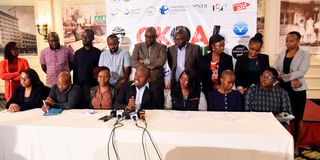
So Kenyans did what free people do when the state and its partners keep speaking over them. They did their own audit under the umbrella of Okoa Uchumi convened by The Institute for Social Accountability.
Read it, and you start to see the pattern that connects everything we treat as separate scandals – hunger, joblessness, collapsing schools, hospitals that feel like inevitable waiting rooms for death, a police state that shows up faster than an ambulance. The audit does not romanticise these as governance challenges. It names them as outcomes or predictable results of stolen budgets and captured institutions.
We got here the way nations always get here: slowly at first, then everything, all at once. We got here by normalising theft as politics; accepting that public money is “their turn”, not our lifeline; and watching Parliament abdicate oversight and become a rubber stamp for impunity. We got here by allowing the Executive and Legislature to collude, bully watchdogs and starve oversight agencies into ceremonial irrelevance.
Failed structural benchmarks
Then we turbocharged the whole thing with debt. Between 2014 and 2025, public debt ballooned from Sh2.4 trillion to Sh12.05 trillion. The audit’s question is simple and vicious: if we borrowed like a country building a future, why are we not living in that built future?
In the 2024/25 financial year, debt repayment and interest swallowed more than half of the tax collected. We work, they borrow, then we work again to repay – then queue for services that never arrive.
When the numbers start to tighten, the state does what captured states always do: it squeezes the citizen, not the cartel.
Taxation becomes a whip. Subsidies disappear, levies multiply. The IMF programme – running since 2021 – is described as a collision between fiscal stabilisation and social justice: deficit targets and tax increases landing hardest on ordinary people, while politically connected elites remain cushioned.
The audit even notes the programme’s collapse under missed targets and failed structural benchmarks – not merely a technical failure but a moral and governance catastrophe that exposed the rot at the centre.
That rot shows up everywhere once you know how to look. You see it in agriculture – a country with the capacity to feed itself, yet millions go a full day without a meal, not because the land failed, but because governance did.
You see it in youth programmes that become slush funds; in education where ghost schools eat capitation while children walk long distances to classrooms that look like apologies.
In health, systems are launched at breathtaking cost, then immediately turn into the next marketplace for fraudulent claims. You see it in the most grotesque detail. While Kenyans debate how to fund health, the audit notes that the government spends at least Sh17 million a day on drinks and snacks – waste that, over a year, could fund annual health cover for more than a million Kenyans. That is not “misallocation”. It is contempt.
Now add the final ingredient – repression. A government that loots must also silence since transparency is existential threat. The audit connects fiscal capture to civic repression explicitly: Protests in 2024 and 2025 resulting in more than 200 deaths, and a pattern the state substitutes participation with coercion. It also tracks the creep into digital control: the cyber law amendments signed on October 15 expanding powers to block content and tighten the noose around online dissent. When accountability migrates online, capture follows it there.
This is why The People’s Audit is not simply information – it is a political weapon. The clean kind and evidence.
Historically, societies don’t change because everyone “became informed.” They change because someone produced a document that made denial impossible.
The Magna Carta in England (1215 AD) was a limit placed on a king. Common Sense was a match thrown into a colonial room full of gas. The Pentagon Papers didn’t create government lies – they exposed the architecture of them. South Africa’s Truth and Reconciliation Commission did not manufacture pain – it documented it in a way history couldn’t unsee.
This audit is our version of that genre. And that is not because it is perfect but because it is timed; because it is written from the citizen’s wound and not the government’s press release.
So here’s the challenge to Kenyans – find time to read it. Do not skim. Read. If you can binge a season, you can read the document of our time.
Read the audit because it anchors itself on a constitutional reality we love to quote and rarely practise: sovereignty belongs to the people and every person has a duty to defend the Constitution. This is that defence – in black and white.