Hello

Your subscription is almost coming to an end. Don’t miss out on the great content on Nation.Africa

Ready to continue your informative journey with us?

Hello

Your premium access has ended, but the best of Nation.Africa is still within reach. Renew now to unlock exclusive stories and in-depth features.

Reclaim your full access. Click below to renew.

Caption for the landscape image:

How to select projects to achieve growth

Scroll down to read the article

Construction works by Kenya Rural Roads Authority.

Photo credit: File | Nation Media Group

Leaders have different approaches, particularly when it comes to identifying development projects. And every approach should be respected.

But is there a criterion or a set of rules that leaders should deploy to properly identify projects in a way that can move Kenya forward?
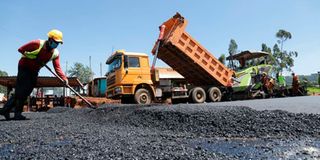
 It should not be just an act of doing the work. As an African saying goes, it should not be a case of grinding water with a pestle and mortar. Projects should have a real impact on the people.

There are some political seats where the issues of development carry a lot of weight; others less.

Assume the public has an evaluation matrix of social skills, development and politics. Social skills is where one attends social events such as weddings and funerals, and has interpersonal skills such as likeability. Development means schools, electricity, bursaries and roads, among others. Politics means making good speeches, aligning oneself with the correct political wind of one's region, good debates on TV and radio stations and excellent skills in Parliament (if one is an MP).

For example, for the MCA seat, the public tends to give social skills higher weight in their scoring. One must attend weddings and burials. This is probably a 50 per cent weight.

For an MP post, development expectation in terms of the National Government Constituency Development Fund management carries a huge weight, together with proper practice of politics. If you are from Nyanza, for example, being seen in Parliament defending Raila could grant an MP good marks.

This is unless one has exceptional developmental and social skills and credentials, such as Shakeel Shabbir, of Kisumu Town East constituency, who is now doing an uninterrupted 20 years as an MP on a very unique path outside ODM.

Pursuing political wind

For the Senate, the weight of pursuing political wind and vigorously debating both in Parliament and the media is huge. Therefore, this is a feeble attempt based on historical analysis to give a set of criteria of project identification for those desiring to pursue a developmentalist path towards political legitimacy.

The first issue is the proper identification of areas of emphasis. Developmental money can never be enough at any given time; hence, the rule of "opportunity cost" must apply.

Opportunity cost refers to the value of the next best alternative that is given up when a choice is made. It's the potential benefit that could have been gained if a different option had been chosen. Opportunity cost is not limited to financial costs; it can also include time, other resources, or other benefits.

 It is a fundamental concept in economics, decision-making, and resource allocation. Opportunity cost helps individuals and organisations evaluate trade-offs and make informed decisions.

Suppose you decide to spend more money on health instead of planting trees. The opportunity cost of better health would be the enjoyment of better environment. To calculate this, you need to identify the next best alternative and estimate its potential benefits.

Leaders must allocate resources effectively, considering the opportunity costs of different options. Investing in health and education generally has better outcomes.

 A healthy population is more productive, has a higher life expectancy, which can lead to economic growth, increased tax revenues, and reduced healthcare costs in the long run. Leaders should invest in education since it is a key driver of economic growth, as it increases the productivity and competitiveness of the workforce.

Marginalised groups

Investing in education can help reduce inequality by providing opportunities for marginalised groups to access quality education and improve their socio-economic status.

Finally, leaders’ developmental interventions should target as large a number of citizens as possible at the most dispersed rate. Dispersal rate refers to the rate at which individuals or particles move away from their original location.

If development is skewed only in favour of those few near a leader, this concept is negated. Marginal communities, at the fringes of a political unit, should feel development at an equal rate with those near a leader.

And the number of beneficiaries should be as huge as possible, depending on available resources — otherwise, a single developmental project in the middle of a political unit will be more of a museum as opposed to practical development. In utilitarian terms, the greatest happiness for the greatest number.

Dr Kangata is the governor of Murang’a County; Email [email protected].