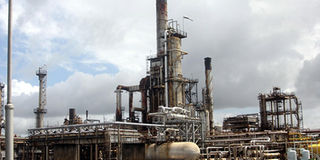
The Kenya Petroleum Refineries Ltd facility at the Coast. FILE PHOTO |

Last week, a top government official called to harangue me over an article I wrote recently questioning the lack of transparency in a deal in which land belonging to the State-owned Kenya Petroleum Refineries Ltd (KPRL) has been leased to a company owned by little-known Nigerian investors.
Two weeks ago, Parliament’s Energy committee summoned both the Petroleum Principal Secretary Mohammed Liban and Kenya Pipeline Company CEO Joe Sang to appear before it to explain whether due process was followed in granting the lease to the Nigerians.
We are all waiting to see what the interrogation of this subject by the parliamentary oversight committee in the energy sector will reveal. The controversy around the transactions raises broad public policy questions on the policy of privatisation, especially the leasing of public land to investors.
Implemented well, privatisation is not a bad thing, whether you are leasing public land or whether it comes clothed in fancy lingo such as private-public partnerships, buy operate and transfer, buy operate and own, or outright auctions of public assets or sale of shares owned by the government in commercial enterprises.
Responsibility evasion
In Kenya, experience and trends suggest that to me that we are very poor at managing and implementing privatisation transactions. In the name of privatisation, what the government ends up doing is to engage in responsibility evasion. Privatisation as practiced here amounts to shying way from accountability and outsourcing State responsibility. We opt for privatisation because of low ambition.
Allow me to use the leasing of KPRL land to the Nigerians as an example. The land we are leasing out was supposed to be used by the State-owned Kenya Pipeline to build a 30,000 tonne liquefied petroleum gas (LPG) facility.
KPC conducted a feasibility study, including designs. The company has a healthy enough balance sheet to fund the project. I ask: if the State can do it, why are we gifting a 31-year lease on public land to a private party to do the same job? The answer: privatisation of ambition and hope. Displacement of aspiration and State responsibility.
My second question. Since we aspire to be a crude oil producer and exporter, why are we giving away rights on land we may need at a later date to a third party? We forget that when the Uhuru Kenyatta administration experimented with that hair-brained idea we baptised the early oil initiative, it is the infrastructure at KPRL that we had to rely on.
High ambition
We had high ambition to build a pipeline from Lokichar to Lamu and to make sure that pipeline is completed before the Ugandans reach with their pipeline. We said that the KPRL infrastructure would be critical in making it possible for us to hit the international oil supplies chain before our neighbour.
The point here is this: when you rump up investment in transport, in LPG port terminals and other logistics infrastructure, you start at an advantage in the battle for geostrategic significance with your neighbours. Our ambition should be spending more public money on the existing KPRL infrastructure because this is how we are going to entrench Mombasa’s position as the reference port and hub for handling refined oil imports to the region.
More public investment in LPG terminals and other port terminal infrastructure is how we can entrench ourselves as the pre-eminent regional economic and trade hub in East Africa.
Make no mistake. I am not against private sector participation in this space. My point is that public investment in this area must remain high because our ambition is to put Kenya ahead of the rest in terms of land interfaces, terminal infrastructure, transport nodes and value chains along the Northern Corridor.
Fastest growing
And massive public investment is what will anchor the exponential growth in the cooking gas market and consequently drive consumer prices down. Today, the cooking gas market is the fastest growing part of the petroleum sector. National consumption was at 93,000 tonnes in 1992. In 2020, consumption hit 320,000 tonnes. In 2012, there were only nine LPG filling plants in the country, today, the number has grown to more than 100.
I recently came across a study by the Japanese firm Toyota Tshusho that found that LPG consumer prices in Kenya were more expensive by at least 30 per cent compared to prices in Asian countries.
The sector has progressed to a level where the state-owned National Oil Corporation and Toyota Tshusho have been planning to go into what is called LPG reticulation—networks where LPG is supplied to individual flats from a centralised built storage facility as opposed to using the conventional gas cylinder.
Let us not privatise ambition and national aspirations.