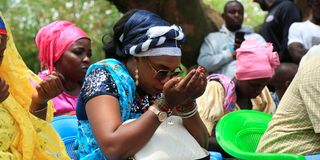
Members of Nubian community recite prayers in Kisumu in 2023.

Building a nation is a huge challenge. It does not matter the continent of domicile. Even countries that we thought had successfully built a nation have at times come apart. In my own conscious lifetime, I have seen states and countries I thought beyond collapse come apart.
In Africa, Sudan split into two while Eritrea broke off from Ethiopia. Somalia has struggled to recreate itself as one single state in the midst of assertions of quasi-sovereignty by mini-states where once a unitary state existed.
In the Democratic Republic of Congo, sprawling territories have fallen out of central government control. Similar examples abound on other continents. At the centre of these spasms are unresolved ethnic, religious, racial, and other identity chasms.
No modern state today is homogeneous. Diversity along all major cleavages is found everywhere. This means every state must struggle to create one nation out of disparate groups. As the American motto says, “e pluribus unum,” the Latin phrase meaning “out of many, one.” For the United States, the phrase is particularly poignant because unlike many other countries, America is an idea.
That level of national ideology and zeitgeist is not common. Once a nation becomes an idea, it acquires a high level of permanency and irreversibility. That’s the challenge of nationhood – creating a country in which citizenship is an idea and not an ethnic, racial, religious, or linguistic identity. A country built on a common moral and political compass and structure.
Bill of Rights
If a country is an idea, and not simply a mass of geography, it means in its many diversities, each citizen will see some kindred spirit no matter their cultural background and their native identities. Nativity in this sense becomes the idea itself.
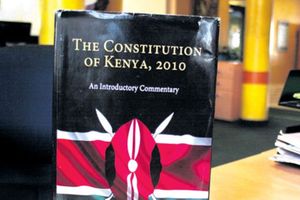
That is why countries forged in the fire of the struggle or cataclysmic events have a better chance of cohering into irreversible nations — so that what is a country becomes a nation with a state and a government that carry the soul of the whole society. In a democracy, the Bill of Rights in the constitution epitomises the State, country, and nation as an idea because it bequeaths each single individual with inalienable rights in that society.
Allow me to bring you down to earth to a country called Kenya. Question – is that country we call Kenya a nation, or is it simply an address on the global map? Does it have coherence? Is it an idea? The answer is complicated. Like most post-colonies, Kenya was an artificial concoction of British colonialists. Ever since the people we call Kenyans freed themselves from the British colonial yoke, they’ve struggled to become one nation. Forging all of our pre-colonial nations into one nation has been our Achilles Heel.
Our struggle for independence brought us together, but it wasn’t enough beat into our noggins Kenya as an idea. This was partly because of our ravenous and unpatriotic elites that thrive on dividing us along our pre-colonial ethnic identities.
Some Kenyan ethnic groups believe they are superior to others, and that Kenya belongs to them more than it does to others. Dominant ethnic groups have “othered” groups they consider subordinate to them. Let me single out a few. Generally, ethnic groups in Kenya’s northern corridor — Somali, Samburu, Turkana, the Borana, and kindred groups — are considered “others.” .” They have historically been marginalised and excluded from the largesse and full citizenship of the Kenyan State since independence. Even among the marginalised, there are those who suffer more exclusions and indignities. Here, I want to single out Kenyan Nubians. In my view, this small minority has borne one of the most devastating burdens of history. They hang in an identity purgatory.
Wonderful music
An identity purgatory is no man’s land, a place where your citizenship and belonging are misty and incomplete. Last week, the Nubian Council of Elders hosted me in Kibra, the home of Nubians, in my capacity as the Senior Advisor on Constitutional Affairs and Human Rights to the President.
In a moving and insightful session peppered with wonderful music and dance, we discussed the torturous existence of Nubians in Kenya. Brought here by the British colonialists to fight the wars of Empire, the Nubians have been left in limbo by successive governments since independence. Their numbers aren’t large, but their pain is deep. Like Somalis, they are on the outside looking in. They face severe hurdles being recognized as Kenyans with full rights of citizenship.
Kenya’s journey of nationhood is incomplete without recognising Nubians. Obtaining identity documents is a herculean task for them. Access to education, employment, land ownership, healthcare, and even credit – which other Kenyans take for granted – are gargantuan barriers. Thankfully, President William Ruto believes no one should be left behind. He’s vowed to address the concerns of Nubians, including their formal recognition as a distinct Kenyan ethnic group. Inclusion is a key index of full citizenship. The President’s commitment on this central tenet is ironclad.
Makau Mutua is SUNY Distinguished Professor and Margaret W. Wong Professor at Buffalo Law School, The State University of New York. He’s Senior Advisor on Constitutional Affairs to President William Ruto. On X: @makaumutua.