Fifteen years ago, on August 27th 2010, Kenya birthed a new dawn. The Katiba, our Constitution, emerged from the womb of collective anguish, a post-election violence that threatened to rip our country apart, the ghosts of the KANU regime, and the unhealed scars of the post-independence plunder of national resources by a few individuals.
It was a poetic promise: a covenant etched in ink and blood, promising equality, devolution, and accountability. We danced, our voices rising like a choral symphony, proclaiming, "This is our shield, our sword, our salvation."But oh, how the melody has soured, 15 years on! The Katiba stands, not as a towering oak but as a mutilated relic, hacked at by the very axes we handed to its butchers.
The political class, those perennial hyenas of our savanna, have systematically eviscerated our sacred text.
The very same ones who necessitated its birth—through decades of embezzlement, tribal incitement, and constitutional rape under the old order—now sit as its custodians. We, in our naivety, entrusted the fox to guard the henhouse.
In the pre-2010 era, presidents wielded god-like powers, dissolving parliament at will, and detaining dissenters in Nyayo House's dungeons.
The Katiba was our rebellion against that abyss, a blueprint for checks and balances, for independent institutions such as the Judiciary and the electoral commission.
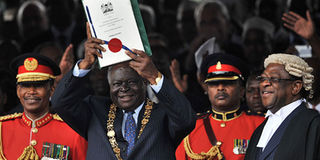
The late President Mwai Kibaki during the promulgation of the Constitution on August 27, 2010.
Photo credit: File | Nation Media Group
Yet, we allowed the same architects of chaos—the Moi-era barons, the Kibaki-era manipulators, and the two key suspects in our nation’s darkest hour—to don new robes and parade as reformers. It's the biblical folly of new wine in old skins.
The old wineskins, sullied from years of corruption's fermentation, burst under the pressure of fresh ideals. We poured devolution's nectar into vessels rotten with greed.
The Constitution envisioned an educated youth, empowered by equitable distribution, rising as the image of a new Kenya.
Counties were to be hotspots of local innovation, where national resources would snake through forgotten villages, hospitals in arid lands, and schools nurture minds untainted by nepotism. Instead, we have ghost projects, inflated tenders, and governors' bellies swelling by the day.
Billions vanish into ethereal audits, with accountability lines as vague as morning mist. More palms to grease, more stomachs to fill—that's the refrain of our devolved despair.
Pre-Katiba, looting was centralised in Nairobi's corridors of power. Now this rot is democratised, splintered across 47 fiefdoms.
Corruption is the only thing we can say, for sure, that we were able to fully devolve, and even exceed expectations.
Then President the late Mwai Kibaki displays the 2010 Constitution document during its historic promulgation at the Uhuru Park, Nairobi on August 27, 2010.
Photo credit: Photo | File
Educated young Kenyans queue for handouts while the old guard's offspring jet off to Ivy Leagues on pilfered public coin. We've multiplied the avenues for theft: county assemblies rubber-stamping budgets that read like fiction, procurement scandals blooming like weeds in fertile soil.
The Auditor General's reports pile up like unread eulogies, ignored in the cacophony of the political charade this country has turned into.
And the pinnacle of our absurdity? Electing to the presidency a man who campaigned against this very Constitution, who publicly fought it during the 2010 referendum. William Ruto, the No campaign's fiery orator, branded the Katiba a document that would balkanize Kenya and entrench foreign influences. Yet, in 2022, we crowned him its chief custodian. How ironic—this shepherd who once scattered the flock now pretends to lead it. Under his watch, blatant executive overreach has slowly crept back.
Bills sail through Parliament, amending the Katiba with surgical precision, excising clauses on integrity, on term limits, on resource equity. We've watched as politicians tried to rewrite our covenant, only to be felled by the courts—yet the spirit lingers, a ghost haunting State House.
This is no mere policy critique; it's a lament for our soul. Fifteen years have unfolded like a tragedy: hope giving way to betrayal. We've seen protests managed with live bullets, the police used to manage politics, independent institutions operating at the instruction of the executive and inequality widening.
The educated youth, the ones Katiba envisioned would carry the torch into a new dawn, now languish in unemployment's purgatory. Devolution’s resources, meant to quench grassroots thirst, have been dammed by corruption's levees, leaving counties parched and people embittered.
But hear me, Wanjiku, Fatuma and Omondi. This is Kenya's manifesto for action, a clarion call that should be treated with urgency. We must feel the weight of our abdication, the heavy chains of not safeguarding our Katiba. For too long, we've waited for messiahs: foreign donors, activist lawyers, even divine intervention. Nobody is coming to save us.
The Hague, no benevolent billionaire from abroad. The only fortress that can protect us is the Constitution itself—its articles our ramparts, its bill of rights our moat.
Yet, this protection is reciprocal. The only force that can shield the Katiba is us, the people. Let’s treat the mutilation of the Katiba as the mutilation of all of us.
We must believe in a better Kenya. We must see that vision and see it clearly. We must, at the risk of being delusional even, refuse to accept any different version of reality as a tenable future. We have a chance in 2027. A real one. We will be there!