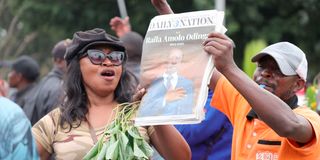
For us millennials who grew up at the height of Raila Odinga’s career, his death feels deeply personal. He was the soundtrack of our democracy, the rallying cry on our radios, the face on our TV screens—the voice that filled the streets every election season. Whether you agreed with him or not, Raila was impossible to ignore. He defined the opposition, shaped national debate, and gave meaning to defiance. His death at 80 marks the end of an era when politics felt like a calling, not just a career.
He fought dictators yet dined with them, demanded justice yet settled for peace, led revolutions only to negotiate them away. He was both the spark and the extinguisher of Kenya’s most defining struggles.
Raila’s political baptism came in the shadow of the 1982 coup attempt against President Moi. Accused of complicity, he was arrested, tortured, and detained without trial for nearly a decade—an ordeal documented in the Njonjo Commission’s aftermath. Those years in Kamiti and Naivasha hardened him into an unyielding symbol of resistance. When Kenya returned to multiparty democracy in 1991, Raila emerged as the face of the “second liberation,” fighting to finish what his father, Jaramogi Oginga Odinga, had begun: transferring power from the few to the many.
That long struggle culminated in the 2010 Constitution—a collective triumph born of decades of sacrifice by reformers, lawyers, civil society, clergy, and political prisoners alike. As Prime Minister in the Grand Coalition Government formed after the 2007–08 post-election violence, Raila oversaw the process that devolved power to counties and enshrined the Bill of Rights. It remains Kenya’s most enduring reform.
Confrontation, then compromise
Yet even that victory was forged in tragedy. The 2007 election left more than 1,200 people dead and over 600,000 displaced. The country teetered on the brink of civil war before Kofi Annan’s mediation birthed the “nusu mkate” power-sharing deal—a compromise that restored calm but buried justice.
From Moi to Kibaki, Uhuru to Ruto, Raila’s story followed the same rhythm: confrontation, then compromise. He called it statesmanship; his critics called it surrender. Handshake politics became both his signature and Kenya’s dependency—an elite ritual that soothed tempers while sustaining inequality.
In 2018, after the disputed 2017 election, Raila swore himself in as the “People’s President,” shaking the state to its core. Yet weeks later, he stood on the steps of Harambee House beside Uhuru Kenyatta, sealing the handshake that ended hostilities and gave birth to the Building Bridges Initiative (BBI).
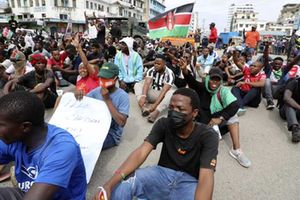
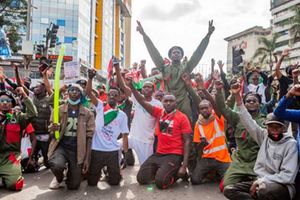
Then came 2024. A generation raised on his rhetoric finally rose. When the Finance Bill protests erupted, Raila’s absence was deliberate, not accidental. Young Kenyans did not want him on the streets. They had seen this movie before—how every uprising ended in a handshake that benefited the powerful. So they told him bluntly: Baba, kaa nyumbani. Stay home. We don’t need another saviour who trades our pain for peace.
Their revolution was leaderless by design, tribeless by conviction, and driven by a moral clarity unseen in decades. They respected Raila’s struggle but rejected his style. They inherited his courage but refused his caution. They wanted systems, not symbols; accountability, not alliances.
Enigma of Kenyan politics
His final years were steeped in irony. The man who defied Moi defended the Adani airport deal. The revolutionary who braved Kamiti stood beside a government that shot young protesters. The freedom fighter who built a movement against capture ended up legitimising it. His continental roles, too, ended in frustration—his mediation in Ivory Coast and South Sudan yielded little, and his 2025 African Union Commission bid collapsed despite Ruto’s backing. Yet Raila’s imprint on Kenya is indelible. Without him, there might be no 2010 Constitution, no open dissent. The Gen Z movement that shunned him was, paradoxically, his ultimate creation.
Now Kenya faces questions without easy answers. Can the nation finally outgrow handshake politics and build institutions strong enough to make backroom deals obsolete? Raila’s death leaves not only an emotional void but a structural one. For the first time in two decades, there is no single figure to rally the discontented. Power has diffused into movements, not parties.
Raila Odinga died having never entered State House—yet few have shaped the road to it more profoundly. He gave everything but could not let go. He dismantled tyranny but never trusted democracy to govern itself.
Kenya has lost its most persistent presidential candidate and longest-serving opposition leader. Whether history remembers him as a liberator or a compromiser will depend on what follows. If Gen Z reforms the system he left behind, they will have fulfilled his mission better than he did. If they fail, his handshakes will seem, in retrospect, like wisdom.
For now, the enigma of Kenyan politics has achieved in death what he never could in life: stepping aside to let a new generation define liberation on its own terms.
Rest in peace, Baba. You taught us everything—even what not to become.
The writer is a whistleblower, Strategy consultant, and a Startup Mentor, www.nelsonamenya.com