Hello

Your subscription is almost coming to an end. Don’t miss out on the great content on Nation.Africa

Ready to continue your informative journey with us?

Hello

Your premium access has ended, but the best of Nation.Africa is still within reach. Renew now to unlock exclusive stories and in-depth features.

Reclaim your full access. Click below to renew.

Gunmen
Caption for the landscape image:

The dangerous path of arming political militia

Scroll down to read the article

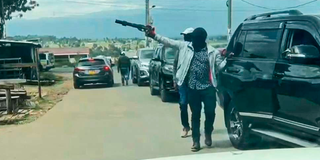
A screengrab of a video shows hooded men brandishing guns and hurling tear gas canisters at residents and journalists during the Ol Kalou by-elections on July 16, 2026.

Photo credit: Pool

You can arm a political militia, but you cannot disarm one. Governments that outsource violence usually make the same discovery too late — a militia is not a tool you own but a debt you owe. Zimbabwe and Sudan each learned it after the fact. 

On the day of the Ol Kalou by-election in Nyandarua County last Thursday, hooded men arrived in high-end vehicles, fired bullets in the air and lobbed tear gas at voters. Uniformed police officers stood in the crowds they attacked and watched helplessly. Journalists filmed the whole thing, and still nobody was arrested. Two men died — James Muigai Mwathi, beaten at a polling centre, and Zachariah Gakinya Mukora, a truck driver who had travelled home to vote. The police named no suspects; an NTV investigation did the work instead, putting names to some of the faces and tracing one vehicle to a sitting Member of Parliament.
With no arrests since, Kenyans on social media have taken over the work the state has declined to do. Photographs of the identified attackers are circulating, and users are digging up their identities, home areas and political connections. It is a parallel accountability system, built because the official one has gone missing. Ironically, demonstrators who took to the streets in 2025 were charged under terrorism laws within weeks, while the men who terrorised Ol Kalou voters in broad daylight, in front of cameras and uniformed officers, remain free.

Cabinet Secretary Kipchumba Murkomen has led the Interior ministry since December 2024, and the record of his tenure has been written less by his ministry than by the Independent Policing Oversight Authority. The authority has logged dozens of protest deaths on his watch, spread across the June 2025 Gen Z memorial, the Saba Saba marches and the May 2026 fuel protests, and almost none of those cases has produced a conviction. 

Hired goons

An older case still haunts him, that of Albert Ojwang’, a blogger who was killed in a cell at Nairobi’s Central Police Station. Prosecutors say his killing was planned and that officers then wiped the CCTV, and the complaint that put him there had been filed by Deputy Inspector-General Eliud Lagat. A year later, no officer has been convicted. The day after the June 2025 deaths, Murkomen said police should shoot anyone approaching a police station. The Law Society said he had no such authority, and rights groups petitioned the High Court to have him declared unfit for office.

What happened at Ol Kalou is not an isolated incident. During the 2025 protests, the LSK said the demonstrations were infiltrated by armed, hired goons and the KNCHR accused police of cooperating with machete-wielding gangs. The state’s own National Crime Research Centre has quantified it — 90 per cent of organised criminal gangs in Kenya are financed and deployed by politicians. 

Murkomen has acknowledged this, blamed politicians for recruiting gangs and conceded he cannot stop them all. His critics reply that naming a crime you decline to prosecute is not a security policy. 

The consequences have been mapped by Sabine Carey and Neil Mitchell of the University of Mannheim, who built the most comprehensive database of pro-government militias in existence and found that states deploying such groups consistently raise their risk of civil war. A 2019 study in the Journal of Peace Research, co-authored by Carey, cast these militias as “spoilers of peace” — locked out of political settlements yet holding a stake in continued violence, they rarely disarm, because nobody with authority demands it and the money flows while the guns are out. 

Goons roam free

Zimbabwe’s ZANU-PF trained the Green Bombers from 2001 to terrorise MDC supporters, and the militia bought Mugabe time but not survival, since his own military removed him in 2017. Sudan’s al-Bashir armed the Janjaweed in Darfur, later formalising them as the Rapid Support Forces, and by 2023 the RSF had turned its guns on the national army and ignited a civil war that emptied Khartoum. In both cases the militia outlived its usefulness, acquired patrons and appetites of its own, and could no longer be put back.

In Kenya, the state prosecutes protesters while the goons who attack them are identified on television and left for civilians on X to chase down. The Kofi Annan Foundation puts the probability of election violence in 2027 at 84 per cent, second only to Nigeria worldwide. Hired youth gangs drove the violence that killed more than 1,100 people after the 2007 election, and that vote is only about 13 months away. Nobody can pretend the intelligence is missing. 

When Gen Z take to the streets for better governance and an end to corruption, they are told they will burn the country down and plunge it into the chaos that swallowed Sudan, or Egypt after the Arab Spring. The warning is invoked selectively, and it never mentions Bangladesh in 2024 or Nepal in 2025, where young people toppled entrenched governments and reached for the ballot rather than the abyss. Yet the guns, the convoys and the machetes belong to the men issuing the warning. Perhaps the projection was always the point, and the real arsonists are those shouting loudest about the fire. Who, then, is fooling who?

Mr Amenya is a whistleblower, strategy consultant and start-up mentor. www.nelsonamenya.com