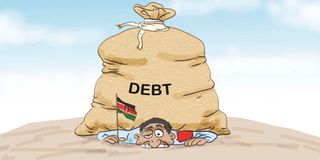
Economic collapse is usually the forerunner of significant political change, and all the signs are that Kenya is approaching such a defining moment.
Governments that lack the skill to navigate through economic turbulence are sooner than later booted out of office with little or no regard to their smooth spiel and expertise in shadowboxing imaginary enemies.
The recent flurry of statements from government factotums on the state’s inability to fund education belies a burgeoning crisis around displaced social spending in the budget. All three supplementary estimates seeking to correct the Sh4.2 trillion 2024/25 budget reduced spending on education and health.
At some point, money for security printing of examinations was knocked off the budget, and the financial support to keep each student in school is disbursed in hiccups, leading to some institutions being torched and closed before the end of term.
Although the Treasury is preaching austerity, it has been splurging on spies, bullets and teargas. Some 12 days before the previous financial year elapsed, a third supplementary budget was presented to Parliament for approval in which the Treasury increased the allocation to the security sector by Sh5.2 billion.
Of this, Sh3 billion had been earmarked for the National Intelligence Service to support “security operations”, Sh1.3 billion allocated to the State Department of Internal Security and National Administration for “operational activities”, and Sh0.9 billion was directed to the National Police Service to strengthen its “security response” efforts.
Supplementary estimates are published to respond to circumstances or crises not anticipated at the time of drawing up the budget—a process that runs all year. In the extraordinary case of Kenya’s third supplementary budget—the only other time the country took this route was during the Covid-19 pandemic—it cut spending on development, hence reduced its threshold far below what is legally permitted.
The Public Finance Management Act requires that at least 30 per cent of all budget spending go to development. In the present circumstances, where Sh900 million pays the salaries of civil servants and Sh1.2 trillion services debt, the only way to reach the spending threshold on development is to fudge the numbers by claiming that the revenues will be good. Tax targets are set with the objective that they will be missed with notorious religiosity. This way, the overestimation of revenue allows space to budget for money that will be borrowed as an “emergency”.
The recent emergencies include reallocation of billions of shillings to State House renovation in the face of pressing social spending. It makes all the claims about austerity and fiscal discipline hollow. Importantly, this profligacy is being performed away from any form of oversight or control after the government walked away from conditional lending by the International Monetary Fund in March. The obscure public wage bill, currently at 45 per cent in the face of shrinking private sector employment, is probably one of the reasons the IMF loan talks collapsed.
The government is going big into employment. Only this month, 4,000 internship slots were advertised under the Affordable Housing programme and the Climate Worx environmental cleanup programme seeks to hire some 110,000 youths this year. Even as these government jobs continue to trickle in, real wages are contracting, and people’s ability to meet daily needs is severely constrained, especially in the face of declining public spending on education and the shaky transition in health insurance. It is not the time to discuss wage bill reductions and staff rationalisation.
Meanwhile, the $750 million World Bank loan expected last month is no longer coming. This means the government will be selling more Treasury bonds and bills to feed its spendthrift habit. In fact, if the World Bank was hoping to reintroduce its usual conversations about balancing budgets and reducing deficits two years before an election, that discussion is off the table.
Domestic debt drinks up nearly half of all the tax revenue collected in the country. A few commercial banks have been making super profits off Kenyans by buying government paper, and Parliament has been on the game.
Once parliamentary authority has been obtained to spend, the mandarins in the Treasury never look back. They borrow, especially from the local banks, to ensure the gravy train runs. Counties are routinely encouraged to borrow from commercial banks to pay salaries as they await disbursements from the Treasury.
During his vetting as nominee for Cabinet secretary to the Treasury, John Mbadi candidly told Parliament that he had held Sh13 million in Treasury bonds, which were giving him a handsome annual return of 16 per cent. At the time, he undertook to reduce commercial loans to just 5 per cent of the government debt portfolio, down from obtaining 30 per cent.
Many other members of the National Assembly are waiting for their T-bill and T-bond yields to check in even as they approve higher borrowing. They see no contradiction between their public roles and their private wealth. The interest on commercial loans, which continues to grow, is the elephant in the room.
The writer is a board member of the Kenya Human Rights Commission and writes in his individual capacity (@kwamchetsi; [email protected] ).