Hello

Your subscription is almost coming to an end. Don’t miss out on the great content on Nation.Africa

Ready to continue your informative journey with us?

Hello

Your premium access has ended, but the best of Nation.Africa is still within reach. Renew now to unlock exclusive stories and in-depth features.

Reclaim your full access. Click below to renew.

William Ruto
Caption for the landscape image:

Why political class can’t be architects of a better society

Scroll down to read the article

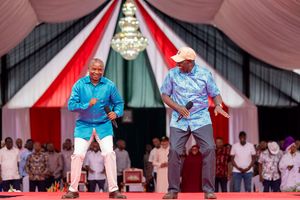
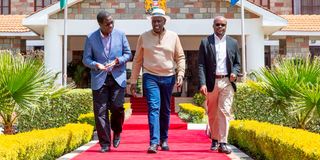
President William Ruto, Energy Cabinet Secretary Opiyo Wandayi (left) and Interior PS Raymond Omollo (right) arrive for a meeting with members of the Siaya County Assembly at the Eldoret State Lodge, Uasin Gishu County on January 10, 2026.

Photo credit: PCS

This week, Interior Principal Secretary Raymond Omollo took to X to announce a government project. The Ngong-Suswa Highway, a 70-kilometre road, was fully operational, a game changer for regional connectivity, his post claimed.

Instead of a standard highway, we saw what appeared to be a bare strip of tarmac without road markings, safety signage, shoulders, lighting or drainage. One photo showed a pole in the centre of the carriageway, as though the engineers had not noticed it, or had noticed and decided it was someone else’s problem. Within hours the post drew thousands of responses, most of them damning but devastatingly precise.
What made this different was not merely online public uproar because, frankly, we have been outraged many times before. This time, commenters enumerated every missing element: no guard rails, no drainage structures, no lighting. These comments were engineering audits in public, in real time.

The Ngong-Suswa project is a Sh4 billion investment launched in June 2018, with a 42-month delivery timeline. The contractor abandoned the site in 2020. The road stalled for years and limped to completion in December 2025, seven years late, and was immediately declared a triumph. The government proudly described it as a favourite for road-trip enthusiasts.

On the same day, Kenyan timelines filled with images from Ethiopia. Addis Ababa’s Corridor Development Project, launched in 2022, has delivered 96 kilometres of pedestrian walkways, 100 kilometres of dedicated cycle lanes and repaved boulevards with smart traffic systems across 75 Ethiopian cities. Kenya could not finish one 70-kilometre road in seven years. Ethiopia reshaped its capital in four, roughly the time Johnson Sakaja has been governor of Nairobi.

There will be those who call this unfair. That argument will, however, not hold when you consider that Ethiopia spent four years building more than what Kenya spent seven years failing to finish. The gap has nothing to do with budgets nor capacity, but everything to do with political philosophy, or the complete absence of one.

Colonial powers looted this continent brutally. But even in that brutality, there was internal logic: extracted wealth financed cities in Europe, and some was reinvested here. Alliance High School was built in 1926, Nairobi School in 1902. The stone government buildings along what was then Government Road still stand. They built institutions that remain, a century later.

When our leaders steal, the destination is Dubai. The money leaves, builds nothing here, and sometimes disappears into offshore accounts so completely that a leader’s own heirs cannot trace it.

Africa loses over $88 billion in illicit capital flows every year. That figure is the hole where the highway shoulders should have been. Fanon warned of exactly this, an elite that inherits the machinery of extraction and redirects it toward personal enrichment rather than national construction.

What afflicts Kenya’s political class is worse than cynicism; the complete absence of civilisational imagination. They have never pictured a Nairobi of wide boulevards, efficient transit and roads that survive the rain. The State has only ever been a feeding trough, never an instrument for building something lasting.

The British built Alliance High School because they had a civilisational project, however self-serving. Our current leaders have no such project, not even one that might accidentally benefit the public. When President William Ruto’s son, George, entered the matatu business, nobody in State House appears to have asked why the son of a sitting president was investing in an industry that remains one of the most dangerous and disorganised in the region. The answer is that they do not see it as a problem. They see it as an opportunity. That is the distance between a leader and an architect of civilisation.

TikTok and X have created something Kenya’s political class did not anticipate. Scientists studying the wildebeest migration describe what happens as swarm intelligence: thousands of individuals, with no central command, acting on simple shared instincts to produce coordinated behaviour that outperforms any single actor. When Dr Omollo posted those photographs, he expected the usual silence. Instead, thousands of Kenyans, each reacting independently to what they saw, assembled a public engineering audit on platforms that do not forget.

This is the national consciousness forming under swarm intelligence. It carries no party card and no manifesto. It is something more dangerous to the political class than any opposition: a shared standard. Kenyans at home and in the diaspora are comparing Addis Ababa and Kigali with what they are asked to celebrate here. The gap is no longer ambiguous. It can be seen; it can be pointed out from the noise and propaganda.

Our leaders are indifferent, confident they can outlast the outrage. They are wrong. Citizens who understand what their taxes could build, and who know where the rest went, do not return to silence.

Follow our WhatsApp channel for breaking news updates and more stories like this.

Mr Amenya is a whistleblower, strategy consultant and start-up mentor. www.nelsonamenya.com.