In 1789, when the crowds of Paris stormed the Bastille, a royal fortress and prison that had come to symbolise the absolute power of the French monarchy, and brought the old order crashing down, what followed should have been the republic the poor had bled for. Instead, France descended into what became known as the Reign of Terror, during which the revolution consumed its own architects in an orgy of guillotines and paranoia.
Then came the Directory, a corrupt and directionless interregnum. Then Napoleon, who resolved the chaos by abolishing it and installing himself as emperor. It took three additional revolutions, a military defeat, and eighty-two years before France arrived at a durable republic.
The educated, propertied bourgeoisie that had read Rousseau and Montesquieu, whose ideas had inspired the entire uprising, proved, when tested, to be divided, factional, and ultimately unable to agree on anything beyond tearing the old order down.
This is a cautionary tale, one that Kenya, in the aftermath of its own political rupture, urgently needs to hear.
Frantz Fanon saw the pattern long before it repeated itself across post-colonial Africa. In The Wretched of the Earth, he described the unpreparedness of the educated classes, their lack of practical links with the mass of the people, and their cowardice at the decisive moment of the struggle. But Fanon was naming a structural problem as much as a moral one. A class that depends on the state for its contracts, its promotions, and its social position does not need to be cowardly to stay quiet. Self-interest shall suffice.
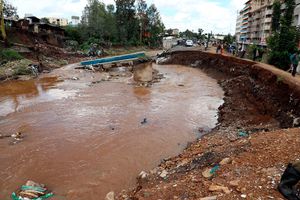
Kenya’s middle class sits precisely in that trap. The lawyer who knows that Governor Johnson Sakaja has presided over three years of perennial flooding and billions in unaccounted public funds, so unaccounted that police were sent to City Hall this week to find the governor after a Senate committee ordered his arrest, still calculates carefully before speaking. Her firm’s next tender may depend on City Hall goodwill.
The engineer who understands that the city’s drainage was built for 500,000 people and now serves five million will note the problem on X and return to his work. And so the class with the knowledge and means to demand better keeps finding reasons to defer.
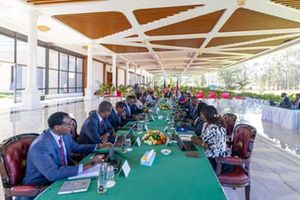
The result is what Fanon predicted: populist leaders who fill rally grounds but cannot articulate an economic programme. Ruto campaigned on “Freedom is coming.” Sakaja campaigned on “Lazima iwork.”
When pressed on the economic programme of the state they were clamouring to control, both were incapable of replying because, as Fanon wrote, they possessed no more than an approximate, bookish acquaintance with the actual resources of their own territory. Three years of a flooded capital is the architectural result of electing someone who, when asked why he has not fixed the drainage in Nairobi, retorts that you cannot expect him to fix a hundred-year problem in three years.
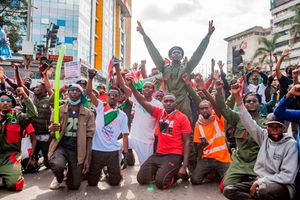
What gave that uprising unusual force was the middle class marching alongside the young and the poor, so conspicuously that politicians took to mocking them: that after the maandamano they order KFC and take Ubers home.
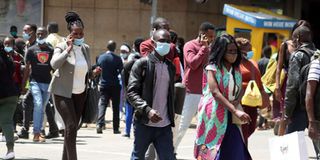
The jibe was meant to delegitimise. However, it confirmed that for the first time in a generation, the comfortable had joined walalahoi on the streets. Professionals had concluded that the political class’s incompetence was no longer an abstraction. It was flooding their neighbourhoods, bankrupting their households, and making their degrees worthless in an economy run on patronage. The structural conflict of interest that normally keeps this class quiet was briefly overwhelmed by a starker calculation: the system is also destroying us.
The French warning is instructive here. The 1789 bourgeoisie had the vocabulary of liberty and rights. What they lacked was a shared programme and the discipline to subordinate factional interest to collective purpose. Without those things, ideas became weapons for internal warfare rather than tools for building. Kenya’s educated class has more graduates per capita than any previous generation in the country’s history. What it has not yet produced is the political organisation to translate that education into durable reform.
Kenya’s middle class must decide which story it belongs to. That decision cannot wait for 2027. It must begin now, in the ward offices and constituency forums most educated Kenyans treat as beneath them, in the civic organisations that need engineers and economists as urgently as they need lawyers, in the voting queues where this class must finally explain to its neighbour why a candidate’s economic programme matters more than their tribe or the Sh200 in their palm.
Ruto’s freedom never came and Sakaja’s Nairobi haikuwork. The next set of slogans is already being printed. The middle class that allows another cycle of beautiful promises to take power in 2027, because it was too comfortable or too compromised to organise, will have made its choice. History will record it accordingly.
The writer is a whistleblower, Strategy consultant, and a Startup Mentor, www.nelsonamenya.com