Hello

Your subscription is almost coming to an end. Don’t miss out on the great content on Nation.Africa

Ready to continue your informative journey with us?

Hello

Your premium access has ended, but the best of Nation.Africa is still within reach. Renew now to unlock exclusive stories and in-depth features.

Reclaim your full access. Click below to renew.

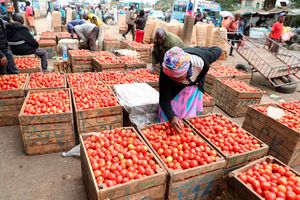
Wakulima market
Caption for the landscape image:

Agriculture primed to propel economic growth in 2026

Scroll down to read the article

Traders and suppliers of vegetables conduct business at Wakulima Market in Nairobi County on December 27, 2025.

Photo credit: DENNIS ONSONGO|NATION

Agriculture sector players expect the economy to perform better over the three months to February and the rest of 2026, buoyed by strong agro-processing and State support for productivity, a survey by the Central Bank of Kenya (CBK) shows.

The CBK survey conducted in November involved face-to-face interviews with retailers, wholesalers, and farmers in select markets and farms. A total of 306 respondents were sampled, out of which farmers and retailers accounted for 52 percent and 36 percent, respectively, while wholesalers accounted for 12 percent.

The respondents in the survey said that they expect an improvement in the overall economic performance in the next three months and in the next year.

“The optimism, which is similar to what was reported in previous surveys, was largely informed by the positive expectations about the performance of the agriculture sector, which has strong forward and backward linkages with other sectors of the economy, particularly manufacturing through agro-processing, wholesale and retail trade, and transport and storage,” the survey said.

“It was also informed by the expectation that government interventions aimed at boosting productivity in agriculture would be sustained,” it added.

Fertiliser importation

The agriculture sector has been supported by good weather across most of 2025, with government interventions such as the subsidized fertilizer scheme also boosting productivity. Kenya rolled out the second National Fertiliser Subsidy Programme (NFSP-2), which was implemented in partnership between the government and a select group of fertiliser importers.

Under NFSP-2, the government centralised fertiliser importation and distribution, allowing only approved dealers to sell subsidised inputs, mainly through State-linked channels. Contracted importers commit to making a certain amount of specific fertiliser types available for sale to any farmer at fixed, below-market retail prices negotiated with the government, which in turn commits to compensating them per bag sold.

Data by the Kenya National Bureau of Statistics showed that the economy grew 5 per cent in the second quarter of 2025, a faster pace than the 4.6percent in the same period of 2024, lifted by a strong performance in agriculture, services, and a rebound in construction and mining.

Agriculture, forestry, and fishing expanded by 4.4 per cent in the second quarter of 2025, with coffee, fruits, vegetables, flowers, and milk output all rising substantially on the back of favorable weather.

Several forecasts have shown that Kenya’s economy is likely to perform better in 2025 compared to the previous year, mainly on account of a resurgent agricultural sector and exports. The International Monetary Fund, for example, projects Kenya’s real GDP to grow by 5percent in 2025 and 2026.