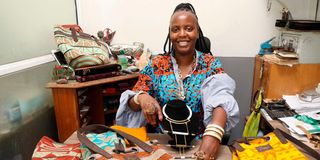
Veronica Gakio sees jewellery as more than adornment. Worn close to the body, it can signal identity and cultural heritage while drawing attention to the materials and craftsmanship used to make it.
In Kiambu, artisans process Ankole cattle horn, a slaughterhouse by-product, into jewellery and homeware pieces. Along Kilome Road and in Rongai, other craftspeople work with recycled brass and set semi-precious stones used to make the jewellery and accessories.
The work is part of Ankole Luxury, a business Veronica founded in 2019 using African-inspired designs and locally available materials. Veronica says her decision to start the business was also influenced by her daughter’s autism diagnosis. She wanted greater flexibility to work while being available to support her daughter during therapy.
“We started with an emphasis on design and materials, but as we understood market demand better, we expanded by working with more rural artisans and increasing our retail presence locally and abroad,” she says.
The horn, sourced from local abattoirs and, at times, from Uganda, is first sun-cured and then boiled in oil to soften it, making it pliable enough to be folded, cut and shaped. It is then degreased, cleaned and precision-cut before being crafted into finished pieces.
Artisans hand-carve, sand and buff the horn components, while recycled brass sourced from informal metalworkers is incorporated during production. Semi-precious stones are obtained from suppliers, with gemstones from the Taita region also used occasionally. The production process is labour-intensive, involving more than 50 artisans across the value chain, from raw-material processors to master bench jewellers.
Veronica says some of the artisans previously worked with international jewellery brands whose products have been sold through retailers such as Ashley Pittman, Neiman Marcus and Bergdorf Goodman.
“Our artisans have worked with global brands, and that experience has helped us maintain the standards required as we develop our own collections and serve customers in different markets,” she says.
Crochet bags and baskets by Ankole Luxury displayed at the company’s production area along Kirinyaga Road in Nairobi on October 9, 2026.
Photo credit: Bonface Bogita | Nation Media Group
The experience provides the company with access to skilled artisans, while expansion requires it to maintain consistent quality across a larger volume of production.
Each piece passes through several stages of manual production, so increasing output depends on artisan capacity, production coordination and the company's ability to maintain consistent supply.
Ankole Luxury currently offers more than 50 products, including jewellery, home décor items and leather accessories. Prices range from Sh3,500 to Sh45,000, depending on the design, materials and amount of handwork involved.
“Premium materials like clean Ankole horn and high-grade brass come with real cost pressures. We price our pieces to ensure we never have to compromise on material integrity or quality control, while keeping the products accessible to both local and our export clients,” she says.
The cost of the products also reflects labour, brass, stones, leather, packaging, finishing and distribution. Producing in small batches limits some of the economies of scale available to larger manufacturers. The company also partners with women in Tharaka and Juja who hand-crochet intricate bag frames using materials and equipment available in their communities.
The completed frames are transferred to the Nairobi workshop, where the bags undergo leather finishing, hardware fitting and final quality checks before being sold from Sh5,000 to Sh15,000, depending on the size, leather detailing and brass hardware involved.
Veronica says the handbag line has also changed how the company organises production, with different stages now carried out by artisans in different locations.
“The introduction of the Jadi Crochet bags line has expanded our product offering and allowed us to distribute different stages of production across our artisan network and Nairobi facility,” she says, and adds that this allows the company to match production requirements with the skills and resources available in each location, while retaining oversight of the final stages.
Veronica says expanding the product range reduces the company's reliance on a single product category. At the same time, each additional product line introduces its own production requirements, material costs and quality-control considerations. The company sells through its online platforms in Kenya, boutique hotel gift shops and stockists in Nairobi. Its Kenyan customers include expatriates, urban professionals and corporate gift buyers.
It also exports to the United States, Australia, Singapore, South Africa and the UAE through specialty stockists, international craft marketplaces and direct shipping.
Exporting adds costs related to shipping, customs compliance, protective packaging and longer delivery times. For a small-batch producer, these costs can affect margins and the final price paid by international customers.
“International demand for authentic, ethically made African luxury is strong, but navigating cross-border logistics requires careful margin management,” she says, adding that freight rates and customs clearance must be factored into pricing.
Maintaining export sales also requires the company to meet production standards and delivery schedules, while securing sufficient raw materials. Although the raw material is generally available, obtaining undamaged pieces of the required thickness can become difficult during dry seasons.
Because horn is a natural material, variations in colour, thickness and texture can affect how it is used in production. “Natural horn is not a standardised factory commodity, every piece has its own density, curvature and grain,” she says.
“Sorting through raw batches to find export-quality pieces requires patience, and when high-grade supply tightens, our artisans have to tailor their carving techniques to maximise yield without compromising structural integrity.”
Ankole Luxury earrings displayed at the company’s production area along Kirinyaga Road in Nairobi on October 9, 2026.
Photo credit: Bonface Bogita | Nation Media Group
The company also faces financing requirements as it expands its manufacturing operations. Upfront inventory costs for raw materials, together with advance payments to rural artisan groups, place demands on working capital.
Veronica says that access to asset financing for modern cutting machinery and export credit lines would support expansion, while in their absence, increasing production capacity requires self-funding. These financing requirements affect the company's ability to increase production and take on larger orders without putting additional pressure on cash flow.
As production grows, she says the company will need continued investment in artisan training, workshop equipment, quality control and management.
“Growth cannot come at the expense of our artisans' craftsmanship or their economic well-being. As we scale, our goal is to build an institutional structure that preserves the authentic handcrafting process while providing our rural and urban team members with steady, predictable livelihoods,” she explains.
A handmade necklace displayed at Ankole Luxury's production area in Nairobi on October 9, 2026.
Photo credit: Bonface Bogita | Nation Media Group
The company is looking to establish an artisan training hub, expand its home décor range and increase its network of boutique stockists in North America.
The business is also developing a dedicated digital platform for international wholesale and reseller clients, allowing buyers to view collections, access product information and place orders. The company is also seeking wholesale stockists in Europe and South Africa and plans to open a showroom in Nairobi. It is targeting urban markets in Kenya, Western Europe and the Gulf region.
“Our roadmap focuses on establishing Ankole Luxury as a global benchmark for African artisanal heritage. We want to prove that decentralised handcrafting can operate at international scale without compromising on quality, authenticity or our commitment to rural communities.”
Veronica says the company's commercial opportunity lies in using locally available materials and artisan skills to produce goods for markets where consumers are willing to pay for design, quality and provenance.