Sylvia Omina spent her childhood between Nairobi and Busia, the western Kenyan town where she was born, and it was here during her formative years that her affinity for craft first became apparent.
Surrounded by readily available natural materials, she fashioned dolls from clay, intricately plaiting their hair and crocheting miniature dresses from yarn. Immersed in a culture where craft and creativity were integral to everyday life, she learned the art of making from her mother and grandparents, who were skilled artisans.
Her mother was an avid crocheter, while her grandparents supplemented the family income through weaving traditional baskets. This upbringing, coupled with an awareness of the socioeconomic challenges facing marginalised communities, particularly women in rural areas, planted the seeds of a creative journey that would later grow into a business venture.
Handcrafted rings made from woven fibres and brass, on display at Omina Otsieno’s workshop in Kibera, Nairobi, on July 24, 2026.
Photo credit: Bonface Bogita | Nation Media Group
In 2017, she founded Omina Otsieno, a fashion brand that initially specialised in apparel and yarn-based jewellery. As her interest in sustainable design deepened, the company reinvented itself around banana-fibre jewellery, formally embracing the niche in 2021.
“The transition marked a new chapter for the brand. We wanted to create jewellery that celebrated indigenous materials while responding to growing demand for contemporary sustainable fashion,” she says.
Today, the enterprise crafts jewellery from banana fibre extracted from banana stems, a renewable and biodegradable material, transforming what was once an underutilised agricultural by-product into modern fashion accessories.
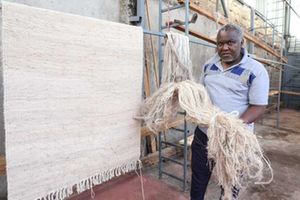
Omina explains that production begins with the harvesting of banana stems, followed by a series of preparation processes that render the fibre suitable for use. Once processed and dried, it is shaped and woven into jewellery using artisanal techniques, combining traditional handcrafting methods with design applications that bridge heritage practice and present-day aesthetics. The venture has created income-generating opportunities for more than 20 women and farmers in Busia, who participate across the banana-fibre jewellery value chain.
Through training in banana-fibre jewellery making, the initiative indirectly benefits more than 140 family members, based on an average household size of seven.
A pair of handmade earrings by Omina Otsieno, pictured at her workshop in Kibera, Nairobi, on July 24, 2026.
Photo credit: Bonface Bogita | Nation Media Group
The enterprise has also catalysed the development of a local banana-fibre value chain by connecting rural producers with specialised craftspeople. Its decentralised production network allocates work between rural and urban collaborators according to their respective expertise.
To complete the jewellery, the company partners with artisans who produce the brass fittings and embellishments used in the finished pieces, extending the venture's economic impact to an estimated 35 additional family members.
"We work with five artisans in Nairobi, with whom we co-create brass accessories used in finishing the jewellery," she says, adding that the collaboration brings together complementary strands of craftsmanship, combining banana fibre sourced in western Kenya with metalwork produced in the capital.
A bracelet with woven-fibre details is pictured at Omina Otsieno's workshop in Kibera, Nairobi, on July 24, 2026.
Photo credit: Bonface Bogita | Nation Media Group
Omina says her work is shaped by economic disparities in rural areas, informing her engagement with local craft, fashion and design skills as a means of developing products that generate income for communities.
Traditional craftsmanship reliant on natural materials has long existed across various parts of Kenya, though many of these skills are becoming less prevalent as younger generations move away from inherited artisanal trades. Her designs pay homage to this heritage through intricate weaving techniques and traditional motifs reinterpreted in jewellery form.
One of the less visible challenges has been translating vernacular craft knowledge into design language without erasing its cultural specificity, adapting weaving sensibilities into forms that resonate with modern jewellery markets while retaining their symbolic logic.
Ingabo ring, a handmade piece of jewellery crafted from woven fibres, on display at Omina Otsieno’s workshop in Kibera, Nairobi, on July 24, 2026.
Photo credit: Bonface Bogita | Nation Media Group
The textures of the pieces draw on the cultural practices, everyday life and folklore of the Marachi, a Luhya sub-community, grounding the work in local heritage while extending traditional forms into new visual expressions. The brand also navigates questions of cultural authorship, particularly how indigenous techniques are credited and preserved when reinterpreted for commercial design.
For Omina, this involves ensuring that artisans are not only producers, but also custodians of knowledge within the creative process. Sales are driven through direct customer orders, craft exhibitions and online platforms, allowing the brand to balance bespoke production with small-scale retail distribution. With more than 60 products in its portfolio, priced between Sh3,000 and Sh150,000 depending on design and materials, the brand targets the mid-market fashion jewellery segment, combining artisanal craftsmanship with accessible price points.
The venture has faced a range of operational challenges, from sourcing materials to building brand visibility and navigating the complexities of an early-stage enterprise. Each obstacle, Omina notes, has provided an opportunity for learning and refinement.
“We addressed early operational challenges through incremental adjustments to sourcing and production processes, strengthening access to banana fibre by building closer relationships with local suppliers and expanding our network of artisans to ensure consistency in output,” she explains.
A necklace, featuring woven-fibre details, pictured at Omina Otsieno’s workshop in Kibera, Nairobi, on July 24, 2026.
Photo credit: Bonface Bogita | Nation Media Group
Difficulties in establishing brand visibility were addressed through gradual market positioning, supported by strategic collaborations, participation in craft and design platforms, and direct engagement with potential buyers, enabling the venture to establish a presence within the emerging ethical fashion space. Despite growing interest in the sector, Omina notes that African-made jewellery continues to face market perceptions that associate value primarily with imported or industrially manufactured goods, requiring additional effort in presentation and narrative.
Over time, these refinements helped stabilise operations while strengthening both production systems and market presence. Omina frames her journey around purpose shaped by impact, creativity, autonomy and legacy, finding particular fulfilment in the tangible outcomes of her work on individuals and communities, particularly in cultural preservation and more responsible approaches to design.
“The process also provides a platform for creative expression, enabling me to develop new products, explore ideas and respond to challenges through design-led solutions, while offering the independence to make decisions consistent with my long-term vision,” she says.
Her long-term objective is to build a brand with enduring commercial and social relevance, one that outlasts its founder and continues to create value across generations. Omina outlines plans to extend the brand’s footprint across both domestic and international markets through strengthened distribution networks, strategic partnerships and enhanced digital positioning.
Lububi ring pictured at Omina Otsieno’s workshop in Kibera, Nairobi, on July 24, 2026.
Photo credit: Bonface Bogita | Nation Media Group
The enterprise is pursuing further product diversification through continued innovation in sustainable materials and product design. Improvements in operational efficiency and a sustained focus on environmental responsibility across the supply chain remain a priority in its long-term strategy, alongside continued engagement with artisanal networks within a craft-led commercial approach in the global ethical fashion sector.
“If we can show that materials drawn from our own environment can meet global standards of design and quality, then we are not just building a brand, but setting out what African craft can represent in the modern economy,” she says.