The sun beats down on vast banana plantations, where towering stems rise, sturdy yet unremarkable, often left to rot after a bountiful harvest, unnoticed by the farmers who tend the land.
For many, these discarded plants are little more than waste, a by-product of the fruit that sustains the region’s farms. However, at Ziada Solutions, co-founded by Samuel Thuo and Alex Gotley, banana stems that would otherwise be discarded are processed into fibre and transformed into a range of value-added products, such as homeware, sustainable hair extensions, and paper. The process reduces waste, provides products that support farmers, creates employment for local women and youth, and promotes circular farming practices.
Ziada Solutions is a climate-smart, fully circular agri-processing business that repurposes banana stem waste while supporting rural communities and contributing to a cleaner, greener future.
“We noticed farmers discarding banana stems after harvest, even though they are rich in fibre and nutrients. I realised there was an opportunity to transform this waste into something useful for people and for the environment,” says Samuel.
Founded in Taita-Taveta County in 2023, the company began by producing banana fibre. Since then, it has evolved, establishing an additional workshop in Nairobi to convert the fibre into a wide range of value-added products. The banana plant bears fruit only once in its lifetime. After harvesting, large quantities of pseudo-stems are often dumped, creating significant environmental hazards.
Extracting fibres from banana stems is not widely practised, even though they are fully biodegradable, recyclable, and safe for the environment. Globally, organic products made from banana fibres are growing in popularity, with strong potential in sectors such as apparel and homeware, where waste stems can be transformed into high-value items.
“These fibres are highly versatile. They can replace synthetic textiles, create employment opportunities for rural communities, and produce value-added products that boost the profitability of banana farming,” Samuel points out, noting that using banana stems reduces demand for wood and other cellulose products, helping to limit deforestation.
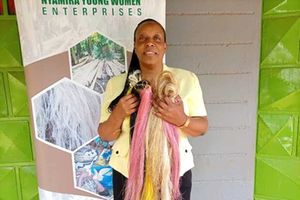
Hair extensions made from banana stem fibres at the Ziada Solutions production facility near Kikuyu in Kiambu County on January 29, 2026.
Photo credit: Bonface Bogita | Nation Media Group
The company works directly with the Taita-Taveta Banana Cooperative Society, which has 600 members. It is a valued partnership, since the company procures banana stems and bananas at prices above the market rate.
“Paying a fair price benefits the farmers and strengthens the relationship. When they see that their produce is appreciated and contributes to useful products, it motivates them and improves overall quality,” he explains.
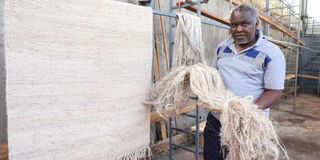
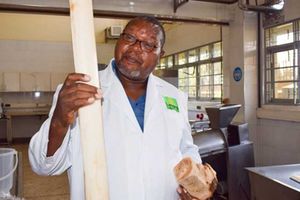
The production process is carefully managed. Once harvested, banana stems are separated into usable fibres and residual material. The fibres are washed, dried, and treated to remove impurities before skilled artisans weave them into carpets, shape them for paper-making or process them into hair extensions.
Nothing from the banana plant goes to waste. Every part is transformed into useful products—fibres, carpets, hair extensions, paper, and compost that replenishes the soil.
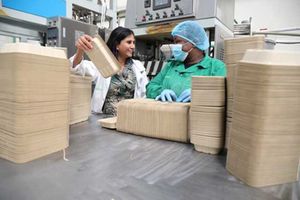
The fibres are highly versatile, suitable for a wide variety of applications. Banana paper provides a sustainable alternative for stationery and packaging, while the compost restores nutrients and retains moisture.
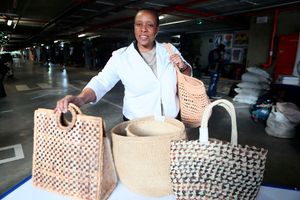
It operates on a fully circular model, producing banana fibre, compost, hair extensions, paper, and household items such as carpets, baskets, trays, mats, and storage units, with prices ranging from Sh200 to tens of thousands of shillings depending on size and product type.
“Turning what would otherwise be discarded into useful items creates value at every stage, supporting farmers’ livelihoods and meeting the growing demand for sustainable goods. Extracting fibre threads from the stems puts extra income directly into the hands of farmers,” he explains.
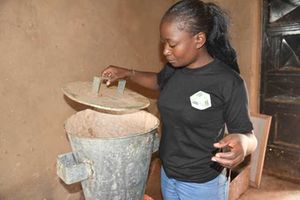
The company has also turned traditional skills into economic opportunities. Women in local communities are trained to weave the banana fibres, producing baskets, mats, carpets, lamp shades and other homeware products. Banana fibre can be softened to the level of cotton, giving artisans greater flexibility. This preserves local craftsmanship while introducing new techniques such as rope making and hand-looming, empowering women and creating sustainable livelihoods.
The company also provides training and access to markets, enabling women to earn a sustainable income. Higher earnings contribute to better education for children, healthier families, and improved well-being across the wider community.
For women affected by climate-change-induced droughts and farmers who have lost cattle or crops due to harsh weather, the weaving workshops offer a reliable source of support.
“We aim to create not just products, but opportunities. When women have skills and access to markets, they can participate fully in the local economy and generate lasting impact for their households and communities.”
Samuel notes that every kilogram of banana stem converted into fibre, paper, or compost is one less kilogram contributing to waste. “It is satisfying to see the impact on both the environment and local communities,” he adds.
Hair extensions made from banana stem fibres at the Ziada Solutions production facility near Kikuyu, Kiambu County, on January 29, 2026.
Photo credit: Bonface Bogita | Nation Media Group
The business also provides both direct and indirect employment in rural areas, currently employing over 40 people. Farmers benefit from higher prices for their produce, transporters gain steady work, and staff at the processing facility enjoy reliable employment.
Samuel believes that this model could be replicated elsewhere. “If more farmers and entrepreneurs embraced circular agriculture, it would improve incomes, reduce waste, and encourage sustainable development across the country.”
The company also runs workshops for farmers on sustainable agriculture and waste management, training them to handle banana stems after harvest and to integrate organic waste into soil improvement practices.
The sessions strengthen relationships with the cooperative. “Education and collaboration go hand in hand. Helping farmers understand the value of what might appear to be waste, they improve production and promote sustainable practices that benefit everyone.”
Financial planning has been important to the company’s growth. Although starting capital was limited, careful budgeting and reinvestment of profits allowed the business to expand steadily.
“We kept overheads low, focused on high-value products, and ensured that every sale contributed to further investment. Gradual growth has been our strategy, and it has worked well,” he notes.
Ziada Solutions has received recognition from environmental and business organisations for its innovative approach. The company continues to refine its processes while exploring new opportunities, experimenting with new uses for banana by-products to ensure that nothing goes to waste and every product has value. It is an ongoing effort, but one that delivers tangible benefits.
There are plans to expand distribution beyond local markets and pursue collaborations with educational institutions and businesses interested in sustainable materials. Samuel says the company is exploring new markets for banana fibre and paper products. “There is growing interest in eco-friendly materials, and we want to ensre that Kenyan products are part of that movement,” he explains.
The long-term vision is to integrate circular agriculture into mainstream business practices, demonstrating that economic growth and environmental responsibility can coexist.